How eschatology became the hidden operating system of great-power conflict
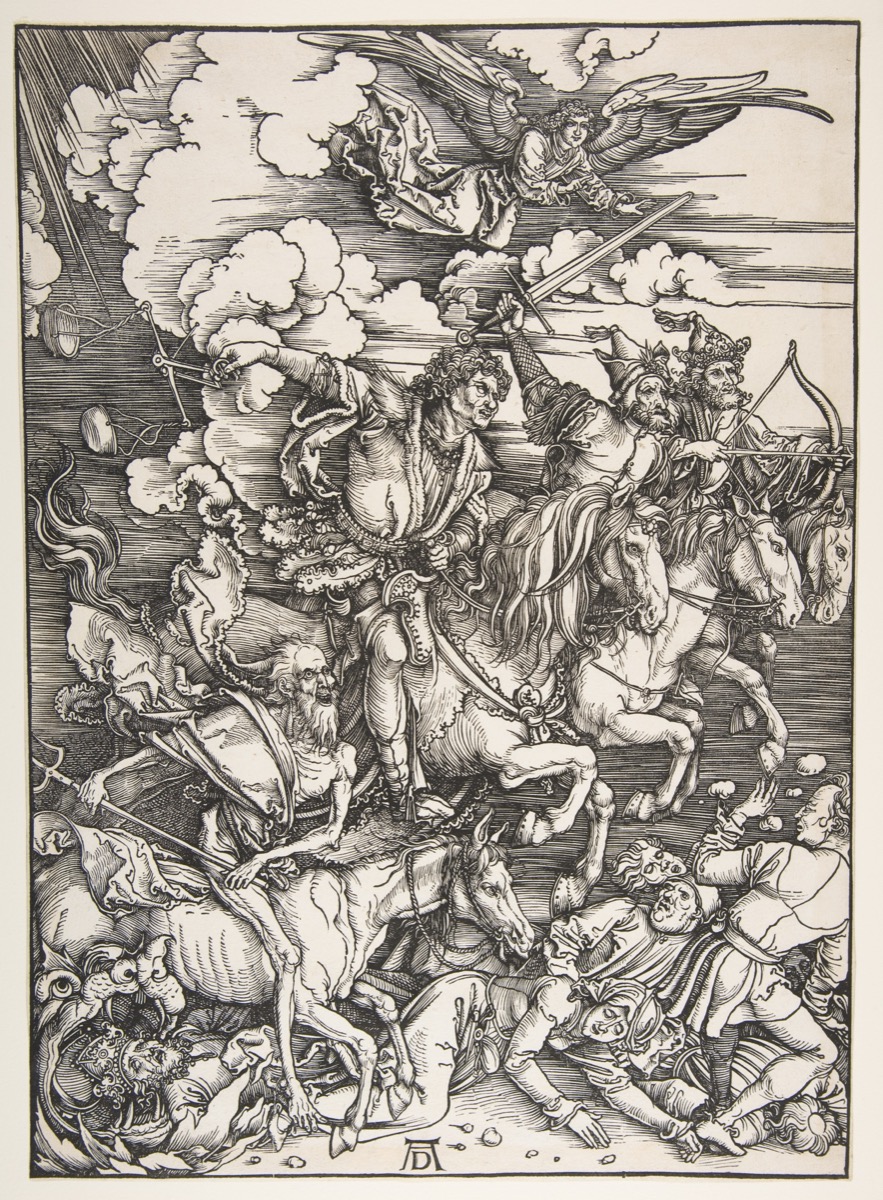
Suppose we bracket the question of whether any eschatology is true. Set aside, for the moment, whether the Messiah is coming, whether the Mahdi will return, whether Christ will descend from the clouds over Jerusalem. Ask instead a colder question: if powerful actors believe these things, what are the strategic implications?
The answer turns out to be staggering. Because the major eschatological traditions don't just share a vague apocalyptic mood — they converge on the same geography, require the same trigger events, and promise victory to mutually exclusive parties. The result is a system that generates conflict with an almost mechanical inevitability, regardless of whether any of the prophecies are genuine. Eschatology has become a lever, and the question of who is pulling it — and to what end — may be the most important geopolitical question no one is asking clearly.
Three Scripts, One Stage
Begin with the scripts themselves.
Christian Zionism, the dominant eschatological current in American evangelical politics, holds that the restoration of Israel, the rebuilding of Solomon's Temple, and a final apocalyptic war in the Holy Land are necessary preconditions for the Second Coming of Christ. This theology is not fringe. It shapes the beliefs of tens of millions of American voters and has had direct influence on U.S. foreign policy from the Balfour Declaration through the Trump administration's Jerusalem embassy move. For the Christian Zionist, supporting Israeli maximalism is not merely a policy preference — it is an act of prophetic obedience.
Messianic Jewish nationalism, represented institutionally by organizations like the Temple Institute, shares the near-term objectives: sovereignty over the Temple Mount, the sacrifice of the Red Heifer, the construction of the Third Temple. But the endpoint diverges sharply. There is no Second Coming of Christ in this script. The culmination is the arrival of the Mashiach and the establishment of permanent Jewish sovereignty over a restored kingdom. The Christian Zionists are, from this perspective, useful allies whose own theology will simply prove incorrect when the time comes.
Shia Islamic eschatology holds that the Hidden Imam — the Mahdi — will return during a period of great tribulation and injustice. In Shia tradition, Jesus also returns, but as a Muslim prophet subordinate to the Mahdi. The Dajjal, a deceiver roughly analogous to the Antichrist, is defeated. Critically, some strands of Shia thought specifically associate the Dajjal with a deceptive global power centered in the West. For the Iranian regime, the confrontation with America and Israel is not merely geopolitical — it is a rehearsal for, or participation in, the drama of the end times. Ahmadinejad reportedly told his cabinet that the Mahdi was guiding his presidency. The current regime's willingness to court destruction rather than negotiate may not be strategic irrationality — it may be eschatological rationality operating on entirely different premises.
Notice the structure. All three scripts require apocalyptic conflict in roughly the same place. All three require the Temple Mount to be contested. All three promise that their side wins in the final act. And all three regard the other two as unwitting participants in a drama whose true meaning only they understand. Each coalition believes the others are useful idiots.
This is not a stable equilibrium. It is a machine for generating escalation.
The Lever
Once you see eschatology as a strategic variable rather than a private belief, its utility as a lever becomes obvious.
You can motivate Christian Zionists to support wars they would otherwise oppose, because the wars fulfill prophecy. You can motivate Israeli maximalists to take risks that are strategically suicidal by conventional analysis, because the Temple must be rebuilt regardless of cost. You can motivate the Iranian regime to embrace confrontation rather than negotiation, because retreat would mean abandoning their role in the Mahdi's return.
None of this requires that the leaders pulling the levers personally believe the eschatologies. It only requires that they understand that millions of their constituents do — and that eschatological motivation is among the most powerful forces available for overriding rational cost-benefit analysis. A population that believes it is participating in sacred history will tolerate costs that no secular political program could justify.
The result is that all three parties walk toward the same catastrophe for completely different reasons, each convinced that the outcome will vindicate them specifically. And the catastrophe never needs to arrive — the profitable condition is permanent anticipation. The Temple can be dangled but never quite completed. The Mahdi can be expected but never appear. The Second Coming can be imminent but never occur. As long as the eschatological tension is maintained, the levers keep working.
The question is: who benefits from maintaining this tension indefinitely?
The Fourth Actor
I. Capital
The most parsimonious candidate for the hidden beneficiary is not a person or a cabal but a structural logic: the debt-based financial system itself.
All three eschatological actors require funding. All three conflicts generate sovereign debt. War is the most reliable mechanism for debt expansion, and sovereign debt is the primary instrument through which financial power disciplines nation-states. The entity that finances all sides of a conflict and collects interest regardless of outcome doesn't need the conflict to resolve — it needs the conflict to continue.
The petrodollar system specifically requires Middle Eastern instability to be chronic but manageable. A unified Middle East trading oil in non-dollar currencies would be an existential threat to dollar hegemony. A Middle East locked in perpetual eschatological conflict can never unify. The eschatological psychodrama is, from this angle, the most effective mechanism ever devised for preventing the emergence of a post-dollar energy economy.
This doesn't require conspiracy. It only requires that the incentive structures of global finance are aligned with the perpetuation of eschatological tension — which they demonstrably are. The Fourth Actor is not hidden because it is secret. It is hidden because it is structural, operating as the medium through which the eschatological conflicts are financed, prolonged, and made profitable for parties who have no stake in any of the prophecies coming true.
II. Mimesis
There is a deeper engine beneath the financial one, and René Girard identified it. The three eschatological communities are locked in a triangle of mimetic rivalry. Each defines itself against the others while becoming structurally identical to them. All three claim the same sacred geography. All three believe they are the righteous remnant. All three are willing to destroy the world to save it. All three regard suffering as confirmation of chosenness.
Girard argued that escalating mimetic crisis — the kind where rivals become mirrors of each other — historically resolves through the scapegoat mechanism. All parties converge their violence onto a single victim, and the resulting catharsis temporarily restores order. The disturbing implication is that the eschatological "script" may not be written by anyone. It may be an emergent property of mimetic escalation that feels scripted because the pattern is archetypal. The participants experience themselves as free actors fulfilling prophecy, but they are caught in a mechanical process of reciprocal imitation.
Capital provides the material incentive structure. Mimetic rivalry provides the psychological engine. Together they produce a dynamic that looks like a conspiracy because it is so patterned and self-reinforcing, but requires no single directing intelligence. It is worse than a conspiracy — it is a system that nobody fully controls but that channels enormous human energy toward destruction because the incentive structures and the psychological dynamics all point in the same direction.
The Non-Eschatological Power
Against this backdrop, China's position is extraordinary — and its strategic advantage may be civilizational rather than military or economic.
China has no eschatology.
Chinese civilizational thinking is cyclical, not apocalyptic. The Mandate of Heaven rotates. Dynasties rise and fall. The relevant timeframe is centuries, not end-times. Confucian statecraft is about managing cycles, not accelerating toward a final confrontation. Even Chinese Marxism, which imported a Western teleological framework, has been quietly sinicized back into something that looks more like dynastic management with Leninist characteristics.
This means China is the one major power that cannot be manipulated by eschatological levers. You cannot motivate Beijing with prophecy. You cannot panic them with apocalyptic framing. They observe three civilizations rushing toward a shared sacred geography to fight over whose God wins, and they see — correctly — an extraordinary strategic opportunity.
The calculus is straightforward. Every dollar America spends projecting power into the Persian Gulf is a dollar not spent on the Pacific. Every carrier strike group in the Arabian Sea is one not in the South China Sea. Every year America spends entangled in Middle Eastern eschatological conflict is a year China spends building infrastructure, consolidating Belt and Road relationships, and deepening its technological base. This is the logic of Sun Tzu rather than Clausewitz — supreme excellence is not winning battles but making battles unnecessary.
China is not merely watching, however. The Shanghai Cooperation Organization, the BRICS expansion, the yuan-denominated oil trades — these are the architecture of a post-eschatological order. The implicit pitch to the Global South is plain: The West is trapped in a religious psychodrama it can't escape. We offer roads, ports, and trade without requiring you to pick a side in someone else's apocalypse.
The 25-year strategic cooperation agreement with Iran is particularly telling. If Iran survives American regime change, it becomes a Chinese client state and a critical node in Belt and Road's path to the Mediterranean. If Iran falls, China loses a partner but gains leverage — because whoever replaces the theocracy will still need to sell oil, and China will be the buyer with the deepest pockets and the fewest theological demands.
A civilization that thinks in centuries while its rivals think in prophecies has a structural advantage that no amount of military spending can overcome.
The Most Dangerous Actor
Russia is arguably the most dangerous actor in this system precisely because it understands the eschatological dynamics better than any other player — while also being a nuclear-armed state willing to act on that understanding.
Russia is neither a bemused onlooker like China nor a true believer like the Christian Zionists or the Iranian regime. It is something more complex: a civilizational actor operating within the Abrahamic eschatological frame but reaching the opposite strategic conclusion from all the other participants.
Orthodox eschatology is formally apocalyptic — it affirms the Second Coming, the Antichrist, the final judgment. But the posture toward these events is radically different from Western Christianity. The Orthodox tradition emphasizes that the timing is unknowable, that attempting to accelerate or decode it is spiritually dangerous, and that the proper response is theosis — ongoing spiritual transformation — not political activism toward prophetic fulfillment.
Russian Orthodoxy, however, developed a specifically political eschatology. The doctrine of Moscow as the Third Rome — articulated by the monk Philotheus in the early sixteenth century — holds that Rome fell to heresy, Constantinople fell to the Turks, and Moscow is the last guardian of authentic Christianity. There shall be no Fourth Rome. If Moscow falls, there is no backstop before the Antichrist.
This creates something unique among the eschatological actors. The Zionist project is about building something. Christian nationalism is about accelerating something. Shia eschatology is about preparing for something. Russian Orthodox political eschatology is about preventing something — holding the line against the Antichrist, which is identified with Western liberalism, secularism, and the dissolution of traditional civilization.
The key concept is the katechon — from Paul's Second Letter to the Thessalonians, "the one who restrains," the mysterious force that holds back the Antichrist until the appointed time. Alexander Dugin, the most intellectually serious architect of Russian neo-conservative thought, identifies Russia as the katechon. His argument is that the liberal world order is not merely geopolitically hostile to Russia but ontologically constitutes the Antichrist system. Globalization, the dissolution of traditional identity, the flattening of all cultures into a single market — these are, for Dugin, the spiritual forces of the end times. Russia's civilizational mission is to restrain this dissolution, buying time for humanity.
This maps onto Russian strategic behavior with remarkable precision. Russia maintains relationships with Israel, Iran, Turkey, Saudi Arabia, and the Palestinians simultaneously. It intervened in Syria not to win but to prevent resolution — to ensure that no single eschatological actor achieved dominance. In any US-Iran confrontation, Russia's optimal outcome is neither an American victory nor an Iranian victory but a prolonged stalemate that exhausts American power, preserves Iran as a Russian partner, keeps energy prices high, and prevents any eschatological project from reaching completion.
This is katechon strategy translated into realpolitik: restrain all sides, prevent any apocalypse from actually arriving, maintain the holding pattern indefinitely.
And here lies the danger. If there is a fourth actor profiting from perpetual eschatological tension without wanting it to resolve, Russia's katechon doctrine is the most intellectually honest version of that position. It essentially says: yes, the apocalyptic forces are real, and our sacred duty is to ensure they never reach their conclusion. Which means Russia needs the eschatological conflict to continue — just as the financial system does — but for theological rather than monetary reasons.
Whether this makes Russia a stabilizing force or merely the most self-aware participant in the cycle is the genuinely hard question.
The Wheel
There is a pattern here that should trouble us.
China says: your apocalypse is irrelevant to us. Russia says: your apocalypse is real, and it is our sacred duty to prevent it. America says: your apocalypse is our prophecy, and we must fulfill it. Israel says: your apocalypse is our restoration, and we will build it. Iran says: your apocalypse is our liberation, and we will endure it.
Five civilizational actors. Five incompatible relationships to the same eschatological question. And beneath all five, the structural logic of debt-based finance and the psychological engine of mimetic rivalry, ensuring that the tension never resolves, the levers keep working, and the wheel keeps turning.
The most unsettling insight is not that powerful actors are using eschatology cynically — though some are. It is that the system does not require cynicism to function. Sincere belief and cynical manipulation produce exactly the same strategic outcomes. The Christian Zionist who genuinely believes he is hastening the Second Coming and the defense contractor who sees an opportunity to sell missiles to the next Middle Eastern war are pulling the same lever in the same direction. The Iranian cleric who sincerely prepares for the Mahdi's return and the Russian strategist who needs oil prices above eighty dollars a barrel are both served by the same escalation.
This is why identifying the Fourth Actor doesn't solve the problem. Even if you name it — capital, mimesis, the intelligence apparatus, the will to power masquerading as the sacred — the three eschatological communities will each interpret that identification through their own framework, and the structural incentives will remain unchanged.
Perhaps the only genuine exit is the one that none of the five actors are offering: to step off the wheel entirely. Not to accelerate the apocalypse, not to restrain it, not to profit from it, not to ignore it — but to refuse the premise that human civilization must organize itself around the question of how the world ends.
The mystics of every tradition — Meister Eckhart in the Christian West, the Sufi poets in Islam, the apophatic theologians of Orthodoxy — have always said that the eschaton is not an event in history but a transformation of consciousness. The kingdom is not coming in a way that can be observed. It is, as the Gospels say, within you.
But that teaching has never been very useful to anyone who needs a population to march toward war.
conversation
Comments
Sign in to join the conversation.
No comments yet. Start the thread.