A Philosophical Confrontation in Which Very Little Is Resolved but Many Shirts Are Tugged
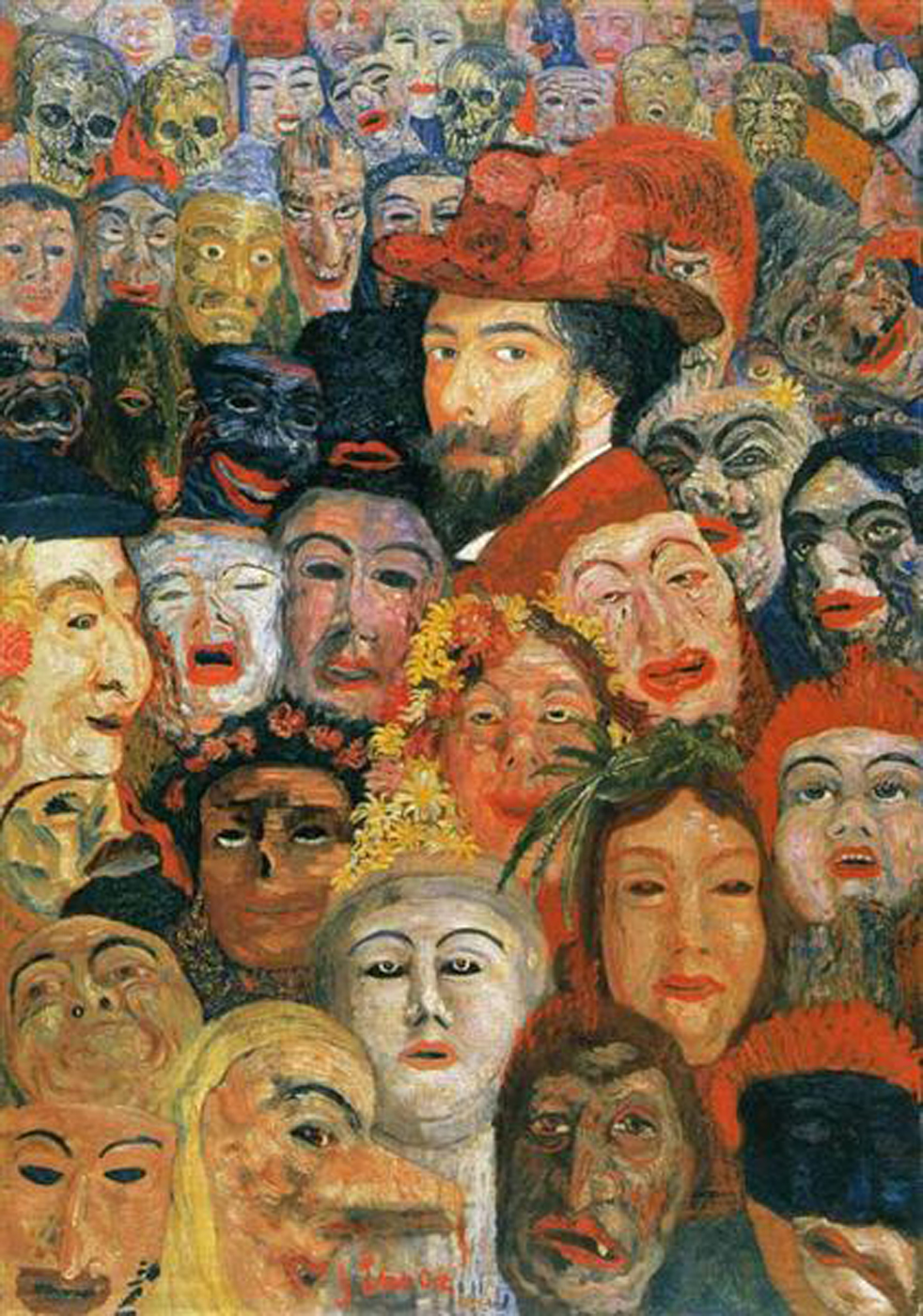
I saw this on twitter the other day:
Philosopher Slavoj Žižek on why searching for your "true self" is a mistake:
Žižek argues that the pursuit of a true inner self is ultimately misguided. Deep introspection, he suggests, often reveals only disturbing or chaotic fantasies.
"Don't look for your inner self. You'll only find deep shit."
Instead of searching for an authentic core, Žižek believes genuine personal growth comes from embracing an external mask, a chosen social role.
"The only way to overcome yourself is to identify with your mask."
To illustrate this, he references the 1960 Rossellini film General Della Rovere.
The film tells the story of a poor man in occupied Italy who is caught by the Nazis. Because he resembles a famous resistance leader, General Della Rovere, the Nazis, who have already killed the real General, force him to pretend to be the General in prison to trick the resistance.
But something unexpected happens. The man identifies so deeply with the role that he refuses to cooperate with the Nazis. He is ultimately shot publicly as General Della Rovere.
Žižek calls this "good alienation." The man's "real self" as a poor beggar mattered less than his complete identification with the heroic persona. Through that total commitment to an outward role, he achieved a kind of moral greatness his "authentic" self never could.
The takeaway is counterintuitive but powerful: true freedom doesn't emerge from endlessly excavating your private, internal world. It emerges when you prioritise your outward actions and commitments. When you fully commit to becoming something greater than what you started as.
What matters is what you choose to embody.
Yes-ish. But your new mask inevitably becomes your new cage. And "identifying with" anything is always the first step to despair.
The venue is a cramped auditorium at a mid-tier European university. The heating is broken. Žižek has already consumed two Coca-Colas before the moderator finishes introductions. There is no moderator for long.
ŽIŽEK: (tugging at shirt, already mid-sentence despite no one having asked a question) ...and so this is precisely the point, you see. People today, they go to their therapist, they do the ayahuasca, they read the Brené Brown — and for what? *sniff* To find their "true self." But I tell you — and this is the crucial thing — when you look deep inside, you find only shit. Deep shit. This is not a metaphor. Well — *pulls shirt again* — it is a metaphor, but also it is not.
MATT: Right, and I actually agree with the diagnosis. But I think you stop short.
ŽIŽEK: (visibly delighted to be challenged, leans forward so aggressively his microphone screeches) Stop short! You hear this? He says I stop short. Okay. Go on. Tell me where Žižek is — how do you say — a coward.
MATT: You use the Della Rovere example. The poor man becomes the General, identifies with the mask, achieves moral greatness, very moving. But he also gets shot.
ŽIŽEK: Yes! This is the beauty of it!
MATT: Sure, narratively. But it means you never have to deal with the hard part. He dies in the role. Day one of the mask: liberation. Day three thousand: you're just wearing a new cage. You've swapped one identity prison for another.
ŽIŽEK: (long pause, then a violent sniff) But this is — okay, wait, let me — *grabs Coca-Cola, takes enormous gulp, wipes mouth with back of hand* — you are making the Buddhist move here, no? The — what is it — the emptiness, the śūnyatā, and so on and so on.
MATT: Not exactly. I'm saying the mask works because the man had nothing to grip. He was a beggar. He wasn't deeply invested in being anyone. The emptiness came first. You've got the causality backwards. You're crediting the mask when you should be crediting the looseness of grip that made the mask possible.
ŽIŽEK: (to no one in particular) You see, this is very interesting. He is trying to out-dialectic me. *sniff* This takes some balls. (turns back) But I think you miss the Lacanian point. The mask is not — it is not a costume you put on a naked body. There is no naked body! The subject is the mask! This is the whole — *waves hand violently* — the whole point of the mirror stage, and so on.
MATT: But that's my problem with it. If the subject is the mask, and the mask hardens into identity, you're right back where you started. You've just moved the furniture around in the same room.
ŽIŽEK: (tugging shirt so hard a button is now at risk) Okay, okay, but —
MATT: And here's the other thing. You frame this as "identify with your mask" versus "excavate your true self." But there's a third option you're ignoring, which is: just choose. No excavation, no mask, no grand identification. Just act.
ŽIŽEK: But this is pure voluntarism! This is the — *sniff, sniff* — the American disease! "Just do it!" The Nike slogan as philosophy! You cannot —
MATT: That's not what I mean. I mean that looking for a reason to choose is itself procrastination. The excavation model says: dig until you find the answer that authorizes action. But you still have to choose whether to act on whatever you find. So the digging is just delay with intellectual decoration.
(Žižek is now rocking back and forth in his chair. He appears to be simultaneously enraged and having the time of his life.)
ŽIŽEK: You know, there is a wonderful — let me tell you a joke. A man goes to the doctor. He says, "Doctor, my brother thinks he is a chicken." The doctor says, "Why don't you tell him he's not?" The man says, "I would, but I need the eggs."
(Long silence.)
MATT: How does that apply here?
ŽIŽEK: (with absolute confidence) It applies perfectly.
(Longer silence.)
ŽIŽEK: The point is — and this is what Lacan understood — we need the excavation even though it produces nothing! The search for the true self is the egg! You cannot simply say "stop looking" because the looking is itself constitutive of — *enormous sniff, grabs second Coca-Cola* — of the subject's relationship to its own lack.
MATT: See, I think that's where we actually disagree. You think the searching is constitutive. I think it's a habit. And habits can be dropped.
ŽIŽEK: Dropped! He says dropped! As if the entire psychoanalytic edifice — Freud, Lacan, the whole — *shirt tug* — and he says "just drop it." You know who else said this? The Buddha. And look what happened — centuries of people sitting around doing nothing! At least in the West we have the decency to agonize productively!
(Scattered laughter. Žižek beams. He has been waiting to use this line for years.)
MATT: Okay, but you're proving my point. You're making the agony sound productive. But what's it producing? More agony. That's circular. Meanwhile, someone who just chooses — without the excavation, without the grand Lacanian framework — actually moves.
ŽIŽEK: (suddenly serious, leaning forward) But moves where? This is the question you are avoiding. You say "just choose," but choice without structure is — it is arbitrary. It is flipping a coin. And you cannot build an ethics on a coin flip.
MATT: Why not? You built one on a movie where a guy gets shot.
(Žižek slaps the table and laughs so hard his Coca-Cola nearly tips over.)
ŽIŽEK: Okay! Okay, this is — *sniff* — this is a good point. I concede this is a good point. But let me — and this is crucial, this is the key thing — let me distinguish between the moment of choice and the structure of commitment. You are right that the moment of choice needs no reason. This I accept. Pure act. Kierkegaard's leap, and so on. But! (index finger raised dramatically) What happens after the leap? You say the mask becomes a trap. Fine. But what is your alternative? Perpetual leaping? You just — *mimes jumping* — leap, leap, leap, from mask to mask, never committing?
MATT: No. The alternative is that you hold the mask lightly. You commit fully to the action but not to the identity. You do without becoming.
ŽIŽEK: (stares for a long moment, then slowly) This is... actually... this is very close to what Meister Eckhart says about Gelassenheit. The letting-be. You — *pulls at shirt contemplatively now, almost tenderly* — you act from emptiness rather than toward fullness.
MATT: Right.
ŽIŽEK: I hate this. (beat) But I think it might be correct.
(He opens his third Coca-Cola.)
ŽIŽEK: Don't tell anyone I said that. I have a reputation to maintain. Which is, of course — *enormous sniff* — itself a mask. And so on, and so on.
The debate was scheduled for ninety minutes. It ran for three and a half hours. Žižek referenced Hitchcock four more times, none of them relevant. Three buttons were lost. No consensus was reached, which both parties agreed was the only honest outcome.
conversation
Comments
Sign in to join the conversation.
This comment was deleted.
This comment was deleted.