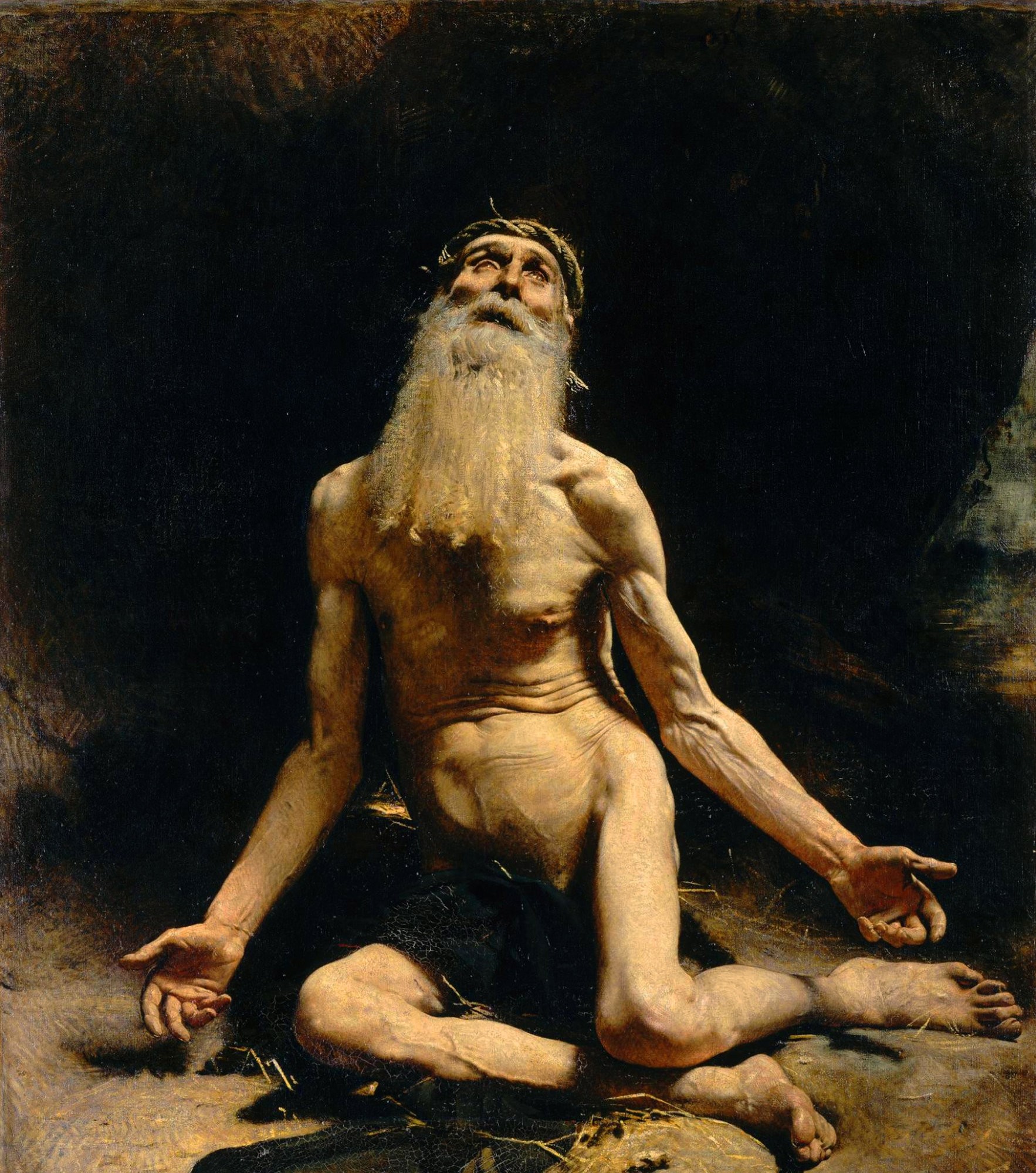
It Could Have Been Born of Science. But the Evidence Was Faith Itself.
I did not arrive here through Darwin. I did not arrive here through physics, or probability theory, or the heat death of the universe. I arrived here through scripture — the very text that was supposed to tell me the opposite. I went looking for the God who rewards the righteous and punishes the wicked, and what I found, in the words of God's own book, was something far stranger and far more frightening: a universe that does not care what you deserve.
This is not atheism. It is worse. The atheist discovers an empty sky and makes peace with it. I discovered a sky that is not empty — and still does not organize itself around my merit.
The teacher of Ecclesiastes saw it first and said it plainest:
I returned and saw under the sun that the race is not to the swift, nor the battle to the strong, nor bread to the wise, nor riches to the intelligent, nor favor to those with knowledge, but time and chance happen to them all. — Ecclesiastes 9:11
There it is. Inside the wisdom literature. Inside the canon. The book that is supposed to teach you how to live well tells you that living well has no reliable connection to outcomes. Time and chance happen to them all. Not to the wicked. Not to the careless. To them all.
He looked at the moral architecture his tradition had built and reported what he saw:
There are righteous people who get what the wicked deserve, and wicked people who get what the righteous deserve. — Ecclesiastes 8:14
Not sometimes. Not as an exception that proves the rule. As the rule.
He watched wisdom and foolishness arrive at the same destination:
The wise man's eyes are in his head, but the fool walks in darkness. And yet I perceived that the same event happens to all of them. — Ecclesiastes 2:14
And he asked the only honest question:
Then I said in my heart, "What happens to the fool will happen to me also. Why then have I been so very wise?" — Ecclesiastes 2:15
But Ecclesiastes is not an anomaly. He is the one who said aloud what the rest of the text shows.
Job was blameless. The text goes out of its way to establish this — not relatively righteous, not pretty good, but blameless and upright, a man who feared God and turned from evil. Then everything was taken from him. Not as punishment. As a test he didn't know about, originating in a conversation he wasn't part of, for reasons that had nothing to do with his behavior:
The LORD said to Satan, "Have you considered my servant Job, that there is none like him on the earth, a blameless and upright man?" — Job 1:8
His friends arrived and did what religious people always do — they searched for the sin that explained the suffering. You must have done something. The universe is moral. Outcomes track merit. Job insisted otherwise, and God, when he finally spoke, did not explain. He simply overwhelmed:
Where were you when I laid the foundation of the earth? Tell me, if you have understanding. — Job 38:4
This is not an answer. It is a refusal to answer. It is God saying: the system is not organized around your understanding of fairness. You are not the variable that matters.
The Psalms, for all their reputation as comfort literature, are saturated with this discovery.
The psalmist watches the wicked thrive and nearly loses his faith over it:
For I was envious of the arrogant when I saw the prosperity of the wicked. For they have no pangs until death; their bodies are fat and sleek. They are not in trouble as others are; they are not stricken like the rest of mankind. — Psalm 73:3–5
He is not describing an exception. He is describing what he observes — that the moral ledger does not balance, that the universe distributes comfort without consulting the deserving.
And the most devastating psalm of all, the one Jesus quoted from the cross:
My God, my God, why have you forsaken me? Why are you so far from saving me, from the words of my groaning? O my God, I cry by day, but you do not answer, and by night, but I find no rest. — Psalm 22:1–2
This is not a man who has done wrong. This is a man who has done right and been met with silence.
The prophets saw it at civilizational scale. They watched nations that did justice get conquered and nations that practiced cruelty prosper.
Habakkuk looked at the Babylonians — violent, idolatrous, ruthless — and saw them rewarded with empire:
Why do you idly look at traitors, and remain silent when the wicked swallows up the man more righteous than he? — Habakkuk 1:13
Jeremiah asked the question every honest believer eventually asks:
Why does the way of the wicked prosper? Why do all who are treacherous thrive? — Jeremiah 12:1
These are not rhetorical questions. They are empirical observations, recorded in the prophetic literature, by men who expected the moral architecture to hold and watched it fail.
Abraham was promised descendants like the stars. Then he was told to kill the one son through whom the promise could be fulfilled:
Take your son, your only son Isaac, whom you love, and go to the land of Moriah, and offer him there as a burnt offering. — Genesis 22:2
Whatever else this story means, it means this: the plan you were given, the reward you were promised, the outcome you earned through faithfulness — it can be demanded back at any moment, for reasons you are not told, through a logic that does not consult your merit.
Joseph did everything right and was sold into slavery by his brothers. He did everything right in slavery and was thrown in prison on a false accusation. He did everything right in prison and was forgotten by the man he helped:
Yet the chief cupbearer did not remember Joseph, but forgot him. — Genesis 40:23
The text does not say Joseph sinned. The text says he was forgotten. Goodness did not produce good outcomes. Time and chance happened to him.
Moses led the people out of Egypt, endured forty years in the wilderness, mediated between an impossible God and an impossible people — and was told he could not enter the Promised Land:
Because you did not trust in me enough to honor me as holy in the sight of the Israelites, you will not bring this community into the land I give them. — Numbers 20:12
One moment of frustration. Forty years of faithfulness. The ledger does not balance. The punishment does not fit the effort. And the text records this without softening it.
Jesus told a parable that should have ended the transactional reading of the universe permanently. Workers who labored all day in the heat were paid the same as workers who arrived in the final hour:
These last worked only one hour, and you have made them equal to us who have borne the burden of the day and the scorching heat. — Matthew 20:12
The landowner's response was not an explanation. It was a declaration of sovereignty:
Am I not allowed to do what I choose with what belongs to me? Or do you begrudge my generosity? — Matthew 20:15
The workers who came early deserved more. By any moral accounting, by any merit-based system, they deserved more. And the parable says: the universe is not a merit-based system. The generosity does not flow through the channel of deserving. It flows where it flows.
He told another. A tower fell on eighteen people in Siloam. The crowd wanted to know what they did wrong — because if they did something wrong, then the universe is moral, and the rest of us are safe. Jesus refused:
Those eighteen who died when the tower in Siloam fell on them — do you think they were more guilty than all the others living in Jerusalem? I tell you, no. — Luke 13:4–5
A tower fell. People died. They were not worse sinners. They were standing in the wrong place. Time and chance happened to them all.
And when it came time for the central event of the faith — the crucifixion — the text presented the ultimate case study in the disconnection of merit from outcome.
A sinless man was executed through a conspiracy of religious and imperial power. The most righteous person the tradition could conceive of received the worst outcome the tradition could imagine. And at the moment of death, he quoted the psalm of abandonment:
My God, my God, why have you forsaken me? — Matthew 27:46
If the universe ran on moral accounting, this could not happen. If righteousness produced protection, this would be impossible. The cross is the final, definitive proof — from inside the faith — that the transactional framework is wrong. The best man got the worst deal.
So what remains, if the vending machine is smashed? If inserting righteousness does not reliably produce blessing?
Ecclesiastes already answered:
Go, eat your bread with joy, and drink your wine with a merry heart, for God has already approved what you do. Let your garments be always white. Let not oil be lacking on your head. Enjoy life with the wife whom you love, all the days of your vain life that he has given you under the sun. — Ecclesiastes 9:7–9
This is not nihilism. It is the opposite. It is what remains when you stop trying to earn the good and start receiving it as gift. The bread is here. The wine is here. The people you love are here. None of it was produced by your merit. All of it arrived through time and chance and something the text gestures toward but refuses to systematize.
Now here is where the comfortable reader will try to rebuild the vending machine.
"Yes," they'll say, "the universe doesn't pay out fairly in this life. But that's the whole point — the reward is deferred. Be righteous now, collect in heaven. The machine still works. You just have to wait for the payout."
This is the dominant popular reading of Christianity. And the text demolishes it as thoroughly as it demolishes the earthly version.
A thief was crucified next to Jesus. He had done nothing righteous. He was a criminal being executed. He said one sentence — one — and received this:
Truly, I say to you, today you will be with me in paradise. — Luke 23:43
If heaven is the merit payout, this is incoherent. The man had no account balance. No lifetime of righteousness. No accumulated virtue. He got the same destination as anyone based on one moment of recognition. The vending machine, if it existed, would have rejected his coins.
A son took his inheritance and wasted it on reckless living. He came home destitute. His father threw him a feast. His older brother — the one who stayed, who worked, who kept every rule — was furious:
Look, these many years I have served you, and I never disobeyed your command, yet you never gave me a young goat, that I might celebrate with my friends. But when this son of yours came, who has devoured your property with prostitutes, you gave him the fattened calf! — Luke 15:29–30
The older brother's complaint is completely valid — if the system is transactional. He did the work. He earned the payout. Someone who did nothing is getting what he deserved. And the parable sides against him. The older brother is the one who doesn't understand. His father's response:
Son, you are always with me, and all that is mine is yours. But it was fitting to celebrate and be glad, for this your brother was dead, and is alive. — Luke 15:31–32
The feast is not a payment. It is a response to return. The transactional framework cannot make sense of this. That's the point.
Paul built his entire theology on this demolition.
For by grace you have been saved through faith. And this is not your own doing; it is the gift of God, not a result of works, so that no one may boast. — Ephesians 2:8–9
He is not ambiguous. And in case anyone tried to smuggle the transaction back in:
If it is by grace, it is no longer on the basis of works; otherwise grace would no longer be grace. — Romans 11:6
This is a logical statement. Grace and merit are mutually exclusive categories. The moment you treat grace as earned, it ceases to be grace. Paul understood that the deferred vending machine is still a vending machine — and that the entire framework had to die.
The sheep and the goats in Matthew 25 should end the discussion permanently.
Jesus describes the final judgment. The righteous are separated from the unrighteous. But here is the detail that collapses the transactional reading — the righteous don't know they're righteous:
Lord, when did we see you hungry and feed you, or thirsty and give you drink? And when did we see you a stranger and welcome you, or naked and clothe you? — Matthew 25:37–38
They were not tracking their merit. They were not accumulating virtue points. They were not operating a transaction. They were just — living a certain way. Without ledger. Without expectation of payout.
Meanwhile, the ones who thought they were righteous — who tracked their spiritual account balance, who expected the vending machine to pay:
Lord, Lord, did we not prophesy in your name, and cast out demons in your name, and do many mighty works in your name? — Matthew 7:22
They are the ones rejected. The people who treated faith as a transaction are told the machine doesn't recognize their coins.
The rich young ruler kept all the commandments. Every one. He came to Jesus with a full account balance and essentially asked for confirmation of his payout. Jesus said sell everything and follow me. The man left sad. The disciples were astonished:
Who then can be saved? — Matthew 19:25
Because if this man — who did everything right — can't earn it, the system is broken. And Jesus's answer:
With man this is impossible, but with God all things are possible. — Matthew 19:26
You cannot earn it. That is not a limitation of the system. It is the design of the system.
And then there is the definition of faith itself.
Hebrews 11, the great faith chapter, opens:
Now faith is the assurance of things hoped for, the conviction of things not seen. — Hebrews 11:1
It then lists the heroes of faith — Abraham, Moses, Rahab, David — and says explicitly that many of them never received what was promised:
These all died in faith, not having received the things promised, but having seen them and greeted them from afar. — Hebrews 11:13
Faith is defined here not as a transaction that pays out on a longer timeline. It is a posture of trust that persists when it doesn't pay out at all. Abraham left his home "not knowing where he was going." That is not an investment with expected returns. That is a leap. Job maintained his integrity after everything was taken and before anything was restored — and critically, without knowing restoration was coming.
So what is faith, if it is not the vending machine — not the earthly one and not the deferred heavenly one?
The text, read honestly, defines it as something like this: continuing to orient yourself toward the good without a guarantee of reward. Trust, not transaction. A way of being in the world that does not depend on the world cooperating.
This is the only definition of faith that survives contact with Ecclesiastes. If faith means "do right and get paid," then Ecclesiastes destroys it. If faith means "do right and get paid later," then the thief on the cross, the prodigal son, and the workers in the vineyard destroy it. If faith means "trust the structure of reality even though the structure will not confirm your trust on your timeline or in your categories" — then everything in the text coheres. Ecclesiastes, Job, the Psalms of lament, the cross itself — all of it makes sense as the record of people who maintained this posture in the face of a universe that refused to transact with them.
Grace, it turns out, only makes sense in a universe that doesn't run on merit. If you could earn it, it wouldn't be grace. The entire theological concept requires the death of the transactional framework — requires, in fact, exactly the devastating insight that Ecclesiastes delivers.
And this is why the deferred vending machine reading is not just wrong but exactly the capture pattern the Bible warns about. The moment faith becomes "do X, receive Y" — even if Y is heaven — it has been captured by transactional logic. It has been systematized into a program that can be administered by a priestly class that defines the inputs and certifies the outputs. The text keeps smashing this reading from the inside. The thief on the cross smashes it. The prodigal son smashes it. Paul's theology smashes it. The sheep who didn't know they were sheep smash it. And the tradition keeps rebuilding it, because a vending machine can be administered and a mystery cannot.
The disinterested universe is not the enemy of faith. It is the precondition for faith. Because faith is only meaningful when the evidence doesn't cooperate. Trust is only real when the outcomes don't confirm. And grace is only grace when you didn't deserve it.
I did not learn this from science. I learned it from the book that was supposed to teach me the opposite. And the fact that the book teaches both — the moral order and its demolition, the promise of justice and the observation that justice does not arrive — is not a contradiction.
It is the honest record. And the honest record, kept long enough, always reveals the shape of things.
Time and chance happen to them all.
This was always the testimony.
We just kept reading it as something else.
Suggested Reading
The Book of Job (with commentary by Robert Alter, 2019). Alter's translation and commentary restore Job's literary ferocity — the Hebrew is wilder, angrier, and more formally inventive than any English translation has captured. His notes make visible what this essay argues: that Job's friends represent the transactional framework (suffering must mean you sinned), that Job's protest is an empirical observation (I didn't), and that God's answer from the whirlwind is not an explanation but a refusal to explain — a display of a reality that exceeds every moral ledger. Reading Job in Alter's translation is the experience of watching the vending machine get smashed by the text itself.
Simone Weil, Gravity and Grace (1947). Weil's central insight — that the natural order operates by gravity (the strong dominate the weak, merit does not produce reward, suffering is distributed without reference to deserving) and that the only counterforce is grace (which arrives precisely because it is not earned) — is the philosophical framework this essay's biblical survey illustrates. Her concept of malheur (affliction that destroys the self's capacity to make sense of its own suffering) is the condition Job inhabits and the condition the transactional framework cannot accommodate.
Søren Kierkegaard, Fear and Trembling (1843). Kierkegaard's meditation on the binding of Isaac — Abraham commanded to sacrifice the son through whom the promise was supposed to be fulfilled — is the most sustained philosophical engagement with the absurdity this essay documents. His concept of the "teleological suspension of the ethical" — the moment when the moral ledger is overridden by something that cannot be justified within it — names what happens when God demands Isaac back. Kierkegaard understood that faith begins precisely where the transactional framework ends, and that this beginning is not comfort but terror.
C.S. Lewis, A Grief Observed (1961). Lewis, the most famous Christian apologist of the twentieth century, lost his wife and discovered that everything he had written about suffering was inadequate. This short, raw book records a believer watching the vending machine fail in real time — not as a theological exercise but as a man who put in the coins and got nothing back. His honesty about the experience ("not that I am in much danger of ceasing to believe in God. The real danger is of coming to believe such dreadful things about Him") is the lived version of what Ecclesiastes states as observation.
David Bentley Hart, The Doors of the Sea (2005). Hart's response to the 2004 tsunami — and to the theodicies that tried to explain it — argues that Christianity does not offer an explanation for suffering but a refusal of every explanation. His claim that the only honest Christian response to innocent suffering is "this should not be" — not "God has a plan," not "it will make sense later," but the flat declaration that the suffering is wrong and that God is against it — is the theological consequence of the essay's biblical survey. If merit does not produce reward and the universe does not transact, then suffering is not a lesson. It is an outrage. And faith is the insistence on that outrage in the face of a cosmos that does not confirm it.
conversation
Comments
Sign in to join the conversation.
No comments yet. Start the thread.