The fertility essay argued that the active ingredient in fertility decline is not economics but formation — the communal structures that build a self capable of receiving a child as something other than a cost to be optimized. This essay traces the genealogy of formation's dissolution. It follows three historical descents — in education, economics, and psychology — mapped in the Sankey diagrams that track how participatory traditions invert into instrumental ones.
The Flattening of Formation

The education Sankey tracks the descent from classical education to the factory school, standardized testing and Credentialism. In two centuries, education moved from forming whole persons to producing human capital.
When education swaps to producing human capital, the value of the person becomes the wealth they produce. The person internalizes this set of values as their own and begins to analyze everything through the lens of cost-benefit. To illustrate this point, the fertility essay showed that birth rates fall as education rises due to children being considered costs rather than valuable in their own right.
The Haredi case is the exception that proves the rule. Haredi women study in dedicated Haredi tracks within Israeli colleges — gender-segregated, culturally adapted programs designed to deliver the credential without the full secular campus experience. And the outcomes prove the thesis.
Sixty-nine percent of Haredi university students are women. Haredi women are employed at 81% — nearly matching non-Haredi women. They now earn more per hour than Haredi men and they have 6.6 children. They acquire the credential, they work, they earn, and the credential does not reshape their selves.
The Triumph of Chrematistike
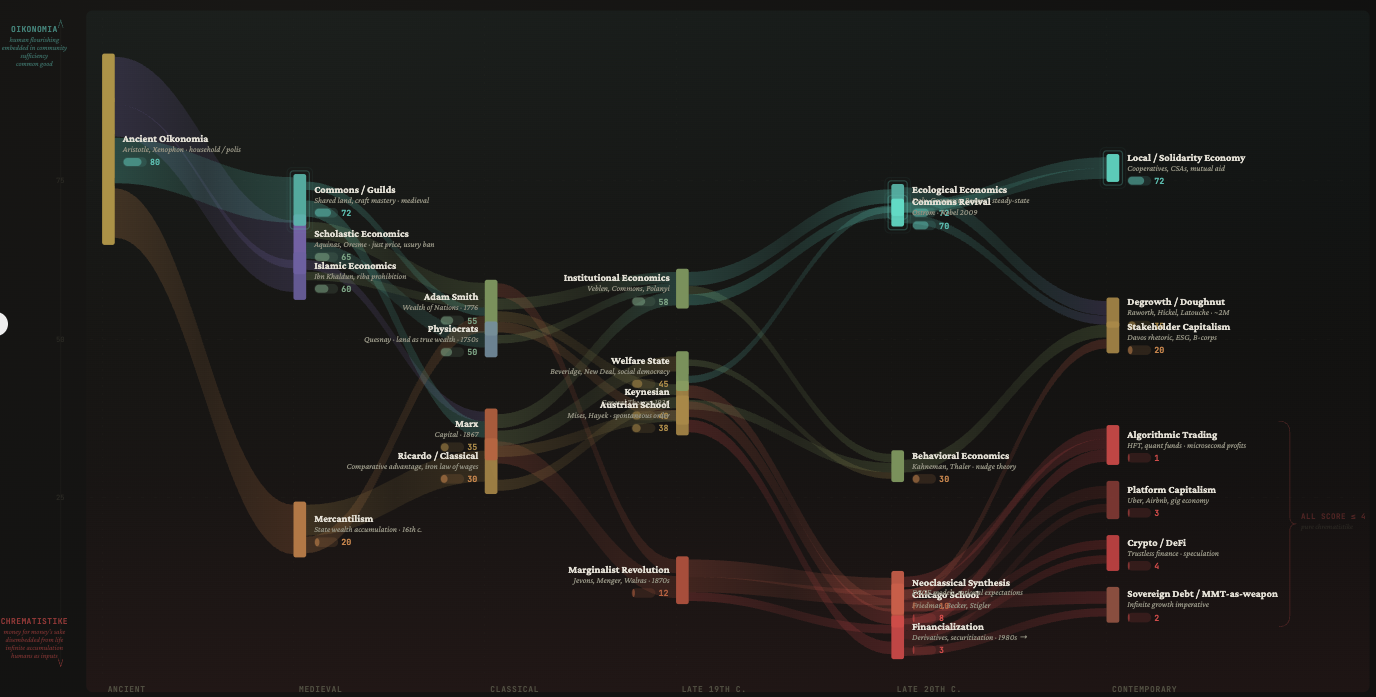
The economics Sankey tracks the same pattern in a different register. Aristotle distinguished oikonomia — household management for the good life — from chrematistike — money-making as its own end. The Sankey traces the descent: through Scholastic Economics and the Commons, where economic life remained embedded in community, to the Mercantilist fork, where economy was redefined as national power. From there: Ricardo, the Marginalist Revolution ("value becomes subjective utility, economics becomes calculus, the human becomes a function"), the Chicago School ("everything is a market — marriage, crime, children all modeled as utility optimization"), and finally Financialization — "money making money, value abstracted from all human good."
Adam Smith sits at the bridge — moral philosopher who also unleashed the market, genuinely both at once. By the time Gary Becker published A Treatise on the Family in 1981, modeling children as consumer durables subject to utility maximization, the moral foundations had been stripped away. Becker was codifying in theory what the previous two decades had already produced in practice: OECD fertility had fallen from 3.3 to 2.2 between 1960 and 1980, the steepest collapse in recorded demographic history. Becker was describing a reality we had created rather than one that was given.
The Flattening of Depth
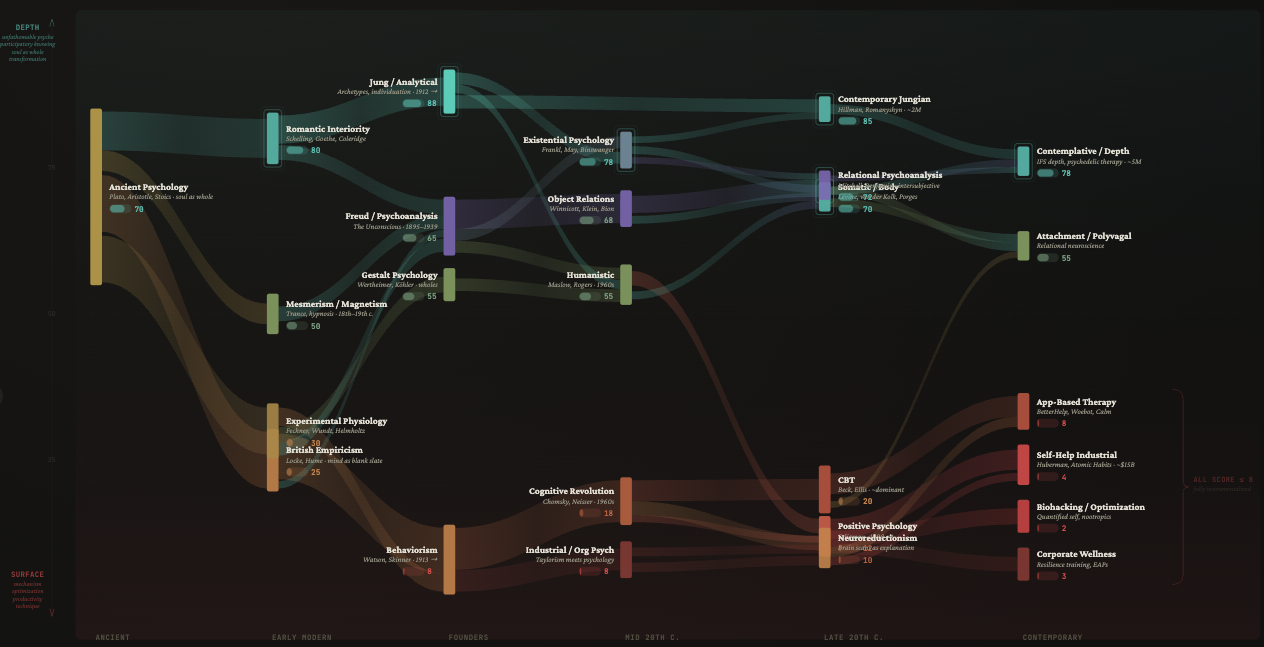
The psychology Sankey traces the most intimate inversion. "Know thyself" — the psyche as unfathomable depth, the soul as a whole requiring formation — descends through British Empiricism (mind as blank slate, no depth) and Behaviorism (there IS no inner life, only stimulus and response) to the Cognitive Revolution (mind as information processor), CBT (swap bad propositions for correct ones), and the bottom of the diagram: the $15B self-help industry, app-based therapy, biohacking, and corporate wellness. From "know thyself" to "optimize your dopamine."
Education forms the optimizer. Economics tells you everything has a price. Psychology is where the optimization colonizes your relationship to your own interior. When mainstream therapeutic culture teaches you to manage anxiety, maximize well-being, and treat disruption as pathology, a child — who arrives as radical disruption of the managed self — cannot appear as anything other than a threat to be managed.
The Convergence
All three Sankeys descend toward the same point. The education diagram's red zone, the economics diagram's red zone, and the psychology diagram's red zone are not three problems. They are one problem viewed through three disciplinary lenses.
The mechanism is the same in each case — the Gravity pattern that the diagrams' introduction identifies:
- A methodological reduction is made for practical purposes
- The method produces genuine results
- Success is taken as evidence that the bracketed dimension doesn't exist
- The reduction hardens into dogma
- Anyone who points to the missing dimension is dismissed as prescientific
In education: bracket formation, measure test scores. Test scores rise. Conclude that formation doesn't exist — only measurable skills matter. In economics: bracket the common good, model utility. GDP rises. Conclude that the common good is an externality — only price signals are real. In psychology: bracket depth, measure behavior. Symptoms decrease. Conclude that the unconscious is mystical indulgence — only measurable outcomes matter.
All three reductions produce the same self — one formed for optimization rather than reception. The Credentialist self, the Chrematistic self, and the Therapeutic self are not three different selves. They are the same self, produced by three converging streams of the same historical process. And that self, when it encounters the question of whether to have a child, can only perform a cost-benefit analysis — because cost-benefit analysis is the only operation its formation equipped it to perform.
The data-doesn't-speak essay explains why this convergence is invisible to the researchers studying it. The researcher formed by positivism cannot see formation as a variable because their formation has trained them to see only what can be measured. The lens has made itself invisible to the person looking through it.
The Door Opening
The genealogy reveals something the fertility data alone could not: these inversions were not inevitable. At every fork — Bildung versus the Prussian Model, Adam Smith's moral sentiments versus the Marginalist Revolution, Jung's unfathomable psyche versus Watson's blank slate — there was a choice. Not a deliberate choice made by a committee, but a gravitational pull that could have been, and in some cases was, resisted. The thin teal streams in every Sankey represent the surviving alternatives. Small, fragile, irreplaceable.
The Haredi woman with the CS degree and six children is not a curiosity or an outlier. She is evidence that the teal stream still flows — that it is possible to metabolize modernity's tools without being metabolized by modernity's formation.
But the genealogy also reveals why the recovery cannot be engineered. Every attempt to instrumentalize these traditions — to adopt constraint because it produces babies, or to adopt faith because it sustains fertility, or to adopt Bildung because it improves outcomes — is the Gravity pattern completing its final revolution. You cannot optimize your way to reception. You cannot calculate your way out of calculation. The communities that sustain what modernity has lost did not acquire it by diagnosing a demographic problem and engineering a solution. They inherited, maintained, and were formed by practices that carry within them an account of what human life is for — practices that resist optimization precisely because they are not for anything beyond themselves. Torah study is not optimized for fertility. It is not optimized at all. That is why it works.
The empty cradle is not a medical chart. It is a genealogical document. It records not what happened to fertility but what happened to the formations that made fertility legible as something other than a calculation. The Sankey diagrams trace the genealogy. The demographic data provides the receipts. The three maps — historical, philosophical, empirical — are maps of the same territory. And the territory is not an abstraction. It is the interior of the self that shows up, or fails to show up, when a child arrives.
Suggested Reading
Wilhelm von Humboldt, The Limits of State Action (1792/1852). Humboldt's concept of Bildung — the organic unfolding of the whole person through encounter with the world — is the original that the essay's education Sankey traces to its inversion. Humboldt designed the Prussian university system around this ideal, and within a generation the system had captured the concept: Bildung became the credential, the credential became the metric, and the metric became the formation. Reading Humboldt now is reading the teal stream at its source, before the gravity pattern turned education from cultivation into production.
Karl Polanyi, The Great Transformation (1944). Polanyi's account of how the self-regulating market was not a natural emergence but a deliberate political project — requiring state power to dis-embed economic activity from the social relationships that had always governed it — traces the economics Sankey's descent from oikonomia to chrematistike through its political mechanism. His concept of the "double movement" — society's instinctive pushback against marketization — explains both why the teal streams survive and why they are perpetually under pressure.
Philip Rieff, The Triumph of the Therapeutic (1966). Rieff traces the psychology Sankey's descent from depth to optimization. His argument that Western culture shifted from "commitment therapy" (the self formed within a shared moral order) to "analytic therapy" (the self liberated from all moral orders) is the cultural history of how "know thyself" became "optimize your dopamine." His "psychological man" — the self whose primary project is the management of its own interiority — is the convergence point where all three Sankeys meet: the credentialist, chrematistic, and therapeutic self are Rieff's psychological man viewed from three angles.
Ivan Illich, Deschooling Society (1971). Illich's argument that institutionalized education produces not learning but dependence on institutions — that the hidden curriculum teaches students to confuse process with substance, certification with competence, and institutional approval with genuine knowledge — provides the mechanism for the education Sankey's gravity pattern. The reduction is made (bracket formation, measure test scores), success follows (scores rise), and the bracketed dimension is declared nonexistent. Illich saw that the institution's deepest product is not knowledge but the student's inability to learn without the institution.
Aristotle, Politics Book I and Nicomachean Ethics (c. 350 BC). The origin point of the economics Sankey. Aristotle's distinction between oikonomia (household management oriented toward the good life) and chrematistike (money-making as its own end) is not merely a preference but an ontological claim: wealth has a natural limit defined by the purposes it serves, and the pursuit of wealth beyond that limit is a category error — treating a means as an end. The entire descent the Sankey traces, from the Commons through the Marginalist Revolution to Financialization, is the progressive erasure of Aristotle's distinction until the category error becomes the operating system.
Gary Becker, A Treatise on the Family (1981). The terminus of the economics Sankey, included here not as a recommendation but as a diagnostic specimen. Becker models marriage as a market transaction, children as consumer durables, and family formation as utility maximization — and he was not wrong that modern people behave this way. He was describing a reality the previous centuries had constructed. Reading Becker after reading Aristotle and Polanyi makes the gravity pattern viscerally visible: the reduction hardened into dogma, the dogma became the formation, and the formation produced selves who actually do experience children as cost-benefit calculations — confirming the theory that created them.
conversation
Comments
Sign in to join the conversation.
Ok Matt, I'll bite. I like reading your writing. 1. You're pro-natalist? Humans should procreate? Or nah? 2. If yes, thoughts on what specific corrective actions are available to metabolize modernity's tools? 3. And, no, "join the Ultra Orthodox" probably isn't an answer Best to Lauren and the kids.
Hello! I think making multi-generational households the norm again would help. De-professionalizing children's sports is another. Bringing back neighborhood teams that are coached for free by parents in the neighborhood. If I wasn't married with kids there's a good chance I'd join the Amish 😂
hey bud i want to read ur stuff but its hard to fondue stuff is written by ai or urself, verified or unverified sources which is it ?
it's a combination. Myself exploring the ideas, telling it what to researching, interpreting the results, going new directions. Yeah, I've verified the sources. The sankeys I had to correct a number of times. I'm not versed in Islam so I don't know if those are totally correct.
I guess I'd say the ideas are more developed due to collaboration with AI rather than less. If it was just me I think things would be much more slanted and less balanced.
I guess the last thing -- the essays are like my personal research journeys. Compiled into a coherent narrative rather than being a bunch of scattered notes and lists.
You could also wait till I'm done with my book! since that'll be incorporating all these pair-writing-with-ai insights into something written by myself.