Written 03-03-2026, published 03-05-2026
- The bold predictions this essay generates have been laid out in a timeline
- A companion piece on "How the board was cleared"
Everyone is asking how long the war lasts. Four weeks, says the president. Not Iraq, says the Pentagon. The analysts compare timelines, count sorties, debate exit strategies. They are asking the wrong question.
The right question is: what would it take for this to end? Not a ceasefire, not a regime change, but resolution. For the feeling of unfinished business that has haunted American and Israeli policy for forty-seven years to finally be discharged.
Because that feeling — not nuclear enrichment, not ballistic missiles, not even the regime itself — is what is driving this.
The Coalition of Symbolic Needs
Look at who wanted this war. Notice that they wanted it for completely different reasons.
The national security establishment wants Iran to become a normal state: disarmed, integrated, maybe democratic. Their mental model is Japan after 1945 — a civilizational adversary that surrenders totally and becomes a client ally. This is what Defense Secretary Pete Hegseth means when he says destroy the missiles, destroy the navy, no nukes. It is the most rational objective.
Trump wants a deal. He wants a new Iranian leader to call him, capitulate on camera, and sign something historic. The madman theory vindicated. Iran becomes proof that maximum pressure works where decades of diplomacy failed. He keeps saying they want to talk because he needs a counterparty. He wants a submission ritual, not a corpse.
The Christian Zionist base — the tens of millions of evangelicals whose political energy underwrites this coalition — want something else entirely. In the dispensationalist framework that shapes their worldview, Iran is not primarily a geopolitical actor. It is Persia, an eschatological actor assigned a role in the Ezekiel 38 prophecy of the Gog-Magog coalition. Iran's destruction is not a policy outcome. It is a prophetic prerequisite. It clears the board for what comes next: the ingathering, the Temple, the end of the age.
Finally, Netanyahu's coalition wants proxy silence. The day Hezbollah cannot resupply is the day the northern border is secure, southern Lebanon becomes accessible, and the religious settler movement sees the strategic map clear in ways they have never witnessed in their lifetimes.
These objectives look incompatible. Yet there is a single outcome that could satisfy all of them simultaneously.
A note on method, because the secular reader will need it for what follows. The conventional analyst treats eschatological belief as epiphenomenal — decorative language draped over material interests. Background noise from unsophisticated voters who do not actually drive policy.
This is a mistake. Not because prophecy is true but because it does not matter whether prophecy is true. Tens of millions of voters and several key decision-makers in this coalition do not experience their eschatology as metaphor. They experience it as the structure of reality. You do not need Ezekiel to be real. You need the people with launch authority, or those lobbying those with launch authority, to think it is real.
What follows is a sociological claim about the force of belief. It is not a theological claim about its truth.
The Return of Persia
Here is the convergence: Iran stops being Islamic Iran and becomes Persia again.
The monarchist exile community — concentrated in Los Angeles, vocal on social media, visibly celebrating Khamenei's death — wants the pre-1979 identity restored. A secular, nationalist Persia. This is not just their dream. It is a narrative that resolves everyone's symbolic needs at once.
For the security establishment, a secular Persia is the normal state they have always wanted. For Trump, it is the grandest deal imaginable: he did not just change a regime, he restored a civilization. For Netanyahu, it means the permanent end of state-sponsored proxy warfare against Israel.
For the dispensationalists: Persia before Islam is not the enemy of Israel in the biblical text. It is the opposite. Cyrus the Great liberated the Jews from Babylonian captivity. He is called God's anointed in Isaiah 45. A Persia that re-identifies with its Cyrus heritage does not just vacate the Gog role in Ezekiel. It reverses it. Iran goes from eschatological antagonist to biblical ally archetype.
Trump was already compared to Cyrus by evangelical leaders during his first term. Imagine what they will do with an actual Persian restoration.
The convergence is not just theoretically elegant. It is narratively powerful enough to hold a fractious coalition together. The neocon gets Japan 1945. Trump gets his photo op. The dispensationalist gets Ezekiel cleared. The settler gets silence on the northern border. The exile gets to go home. Everyone narrates the same events as their particular victory.
This leaves an enormous question unanswered. What do 1.8 billion Muslims make of it?
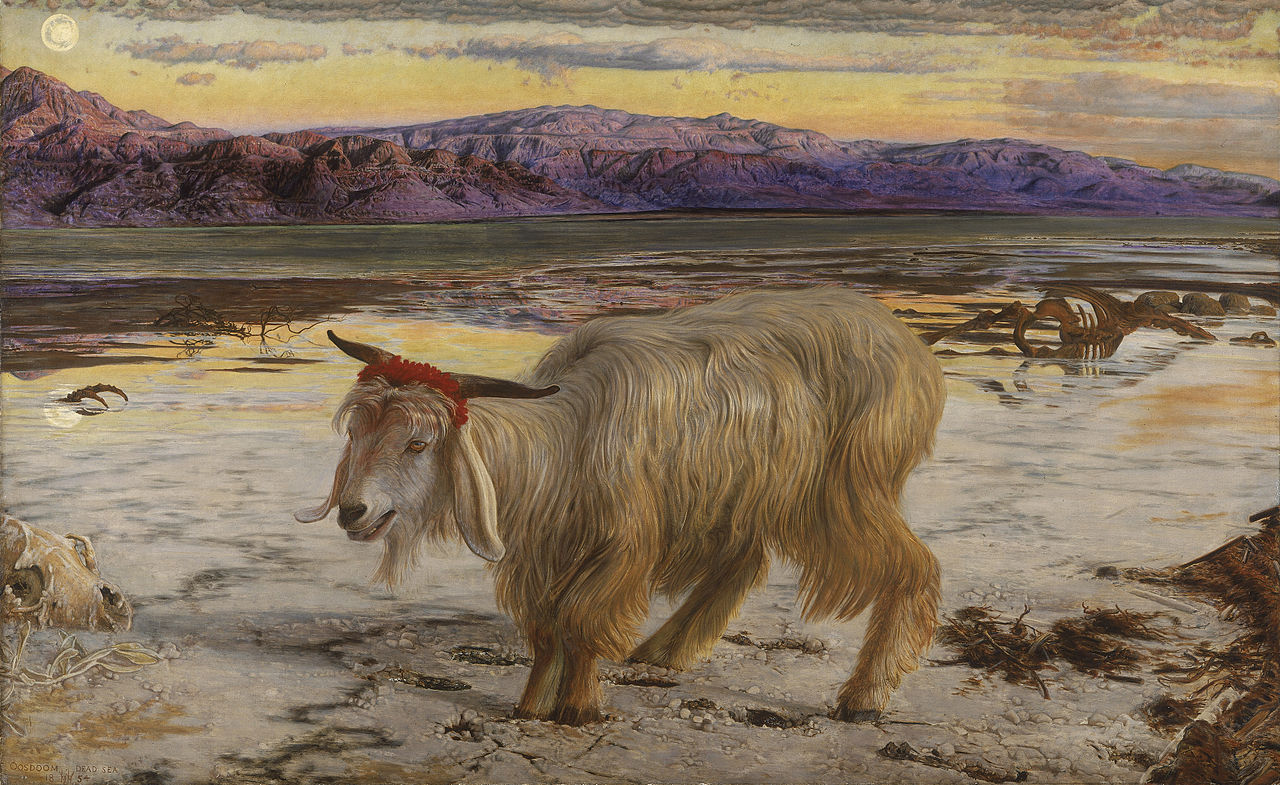
The Scapegoat
There is a name for what is happening here. It was given by the French theorist Rene Girard. He called it the scapegoat mechanism.
Girard observed that human communities in crisis converge their anxiety and violence onto a single victim. The victim is expelled or destroyed. Then something remarkable happens: genuine peace follows. Not fake peace. Not temporary distraction. Real, structural, generative peace that lasts for generations. Entire civilizations get built on top of successful scapegoating events. The founding violence becomes sacred. The sacred produces order. Order produces culture.
The Islamic Republic of Iran has been cast in this role. Not as a geopolitical threat but as the singular obstacle — the thing standing between the present crisis and the resolution everyone craves. Its destruction is being invested with a significance far beyond the military facts. It is being made to carry the accumulated weight of forty-seven years of American humiliation, Israeli insecurity, evangelical longing, and exile grief.
Girard's uncomfortable insight: it works.
The scapegoat mechanism does not fail. When the sacrifice is successful — when the victim is unanimously identified, the violence concentrated, and the result experienced as cathartic — the peace that follows is not illusory. It is real. People build things during that kind of peace.
They build temples.
Girard was precise about the conditions. The mechanism requires unanimity. The peace is proportional to the completeness of the convergence. If a significant population refuses to accept the sacrifice as legitimate, the mechanism partially fails and the peace is unstable. A quarter of humanity sharing the religion of the scapegoated regime would seem to be a fatal obstacle to unanimity.
Unless someone renarrates the sacrifice for them.
The True Leader
Turkey has been waiting for this moment for a century.
When the Ottoman Caliphate was abolished in 1924, it left a vacuum at the center of Sunni Islam that has never been filled. Saudi Arabia claimed custodianship of the holy cities. Egypt claimed intellectual leadership through Al-Azhar. Iran's 1979 revolution attempted to seize civilizational leadership for the Shia, vaulting over the Sunni-Shia divide by framing itself as the vanguard of all Islamic resistance to Western imperialism.
For forty-seven years, the Islamic Republic positioned itself as the one Muslim power willing to stand against Israel and America.
Now that project lies in ruins.
The counter-narrative writes itself: the Islamic Republic was never truly Islamic. It was a Shia deviation that brought ruin on its own people through messianic overreach. It provoked wars it could not win. It sacrificed its population to an eschatological fantasy — the return of the Hidden Imam — and the result was destruction. The lesson is not that Islam is weak. The lesson is that false Islam is weak. True Islam, Sunni Islam, patient and civilizationally robust, is ready to lead.
This is not speculation about what Turkey might do. It is a description of what Erdogan has already been doing for twenty years: converting Hagia Sophia back to a mosque, championing Palestinian causes, positioning Turkey as the civilizational alternative to both Western liberalism and Iranian theocratic revolution. He already thinks of himself as the rightful leader of the ummah. Iran's destruction does not create this ambition. It removes the competitor.
The Hidden Imam theology matters because it works on multiple levels. In Twelver Shia Islam, the Hidden Imam is the messianic figure whose return inaugurates perfect justice. Iran's revolutionary project was oriented toward preparing the conditions for that return. The velayat-e faqih, the guardianship of the jurist, is governance on behalf of the absent Imam.
If the Islamic Republic's destruction can be read as proof that the Hidden Imam did not come — that the whole eschatological wager failed — then Shia messianism is discredited not just politically but theologically. Turkey steps in not as a hidden savior but as the visible leader who was there all along. The pragmatic alternative to apocalyptic overreach.
This does something remarkable for the scapegoat mechanism: it expands the unanimity to include the Muslim world. Not all of it. Not immediately. But the state-level Sunni order plus a significant portion of the global Muslim street. The sacrifice of Iran is no longer a Western-Israeli project. It becomes interpretable within Islamic civilization as a legitimate theological correction.
Saudi Arabia, the UAE, Egypt, Bahrain: these states have been in a cold war with Iran for decades. The Abraham Accords trajectory was already pulling them toward normalization with Israel. For the Sunni state class, the Islamic Republic was never their Islam. It was a revolutionary Shia project that threatened their monarchies, exported instability, and competed for leadership of the ummah. Its fall can be narrated not as an attack on Islam but as the removal of a heretical distortion.
The popular fury that might otherwise radicalize a generation of young Muslims? Turkey gives it an institutional home. Erdogan or his successor says: your anger is legitimate, and I am its vessel. Follow me, not the bombers. The rage is channeled into state power rather than jihadism. The Muslim world gets a civilizational champion who is also a NATO member with trade agreements and a seat at every table that matters. Manageable. Legible. A partner you can do business with.
The unanimity deepens. Now it is not just the Western-Israeli coalition narrating victory. It is the Sunni world as well.
But unanimity is not totality. Two populations remain outside the renarration. They are not threats to the mechanism. They are its remainder.
Shia Islam is already built for this. Its founding event is a martyrdom — Hussein at Karbala, slaughtered by the forces of a Sunni caliphate he refused to recognize. Shia identity begins with defeat. The theology already has a groove for righteous suffering: the faithful endure, the Imam remains hidden, justice is deferred to a horizon that never arrives in historical time.
The Islamic Republic tried to convert that patience into revolutionary energy — to make the waiting active, to govern on behalf of the absent Imam. Its destruction returns Shia Islam to its older and deeper posture. Not revolution but endurance. Not power but witness.
The Shia populations of Iraq, Lebanon, Bahrain, Pakistan do not need to be persuaded that the sacrifice was legitimate. They need only be unable to organize a counter-narrative powerful enough to disrupt the peace. A theology of patient suffering is not a theology of disruption.
The Palestinians are harder. They have no state to absorb the resolution, no theological framework that makes their displacement sacred, no institutional home that channels their grief into endurance. They are the wound the new order cannot narrate — present everywhere, resolved nowhere.
But the mechanism does not require their resolution. It requires their silence. And silence is what founding violence produces in populations too small or too dispersed to generate counter-sacred energy. Indigenous peoples across the Americas carried wounds the colonial order never addressed. They did not disappear. They were marginalized below the threshold where grief becomes politics. Their memory persisted — in families, in language, in land — for centuries. It surfaced only when the mythic canopy thinned.
This is not a flaw in the mechanism. It is the mechanism. Girard never said the peace was just. He said it was real. The remainder — the Shia who endure, the Palestinians who remember — are the buried cost of the unanimity. Their silence is what the peace sounds like from underneath.
Their silence is what the peace sounds like from underneath.
The Silent Partner
There is one major power that does not participate in the sacrifice. It watches. It calculates. It waits.
China has no prophecy to fulfill. No temple to build. From Beijing's perspective, the destruction of the Islamic Republic is not a prophetic event. It is a strategic opportunity. Do energy flows continue? Do Belt and Road investments remain secure? Can we trade with all parties without choosing sides?
China brokered the Saudi-Iran detente in 2023. It buys Iranian oil despite sanctions. It invests in Israeli technology. It courts Turkey as a logistics hub. It maintains relationships with all sides simultaneously. This is not hypocrisy. It is a different operating system.
Or so it appears.
The conventional analysis stops here: China as the rational non-participant. The civilization that thinks in cycles rather than apocalypses. The Confucian power immune to eschatological manipulation. This analysis depends on a distinction between Chinese and Abrahamic civilization that does not survive contact with actual Chinese history.
The Taiping Rebellion of 1850-1864 was the deadliest civil war in human history. Twenty to thirty million dead. Its leader, Hong Xiuquan, believed he was the literal brother of Jesus Christ, sent by God to establish the Heavenly Kingdom on earth. He reorganized society along communal lines, abolished private property, mandated gender equality, and prosecuted the war with the certainty of a man fulfilling divine prophecy.
This was not Confucian cyclicism. This was Christian eschatology grafted onto Chinese civilizational crisis, producing violence on a scale that dwarfed anything happening in the West at the same time.
Hong was not an anomaly. The Yellow Turban Rebellion that helped destroy the Han Dynasty was millenarian. The White Lotus movements that recurred across centuries were apocalyptic. The Boxer Uprising had cosmic-battle theology. China's elite political tradition is cyclical — Mandate of Heaven, dynastic rotation, Confucian management of order. China's popular religious imagination has generated eschatological eruptions over and over, always during periods of legitimacy crisis, always suppressed by the managerial class, never permanently eliminated.
Mao understood this. Or rather, Mao was this. The Chinese Communist Revolution was the largest of these eruptions. Its power source was not Marxist economics but the millenarian energy that had been building in China's peasant religious substrate for centuries. Marxism-Leninism provided the vocabulary. The eschatological impulse was already there: the chosen class, the final revolution, the classless society as kingdom of heaven.
Mao's war against the landlords killed millions and it worked in the Girardian sense — it produced a new sacred order, a founding violence that held for decades. The Cultural Revolution was a sacrificial crisis in miniature: intellectuals, rightists, counter-revolutionaries subjected to unanimous convergence, ritual humiliation, public violence that generated genuine social cohesion among the participants.
The eschatological pattern did not end with Mao. It is running right now. The Century of Humiliation -- the Opium Wars, the unequal treaties, the loss of territory -- is not narrated by the CCP as a historical episode. It is narrated as a fall. There is a period of suffering. A chosen agent of restoration: the Party. And a promised culmination that has not yet arrived -- full rejuvenation, Taiwan recovered, civilizational dignity restored.
Xi's "China Dream" is not cyclical. It is linear, teleological, forward-pointing. It has a telos. Strip away the Confucian vocabulary and the structure is identical to the Abrahamic pattern: a wound that demands a final healing, a grievance that points toward a future fulfillment.
China does not have three eschatological traditions. It has one eschatological impulse that keeps outliving its hosts. The millenarian peasant substrate found Marxism. Marxism died. The impulse found nationalism. When nationalism completes its promise or fails to deliver it, the impulse will find something else. It always does. The Confucian cyclical framework is the management layer trying to contain it. It is not the deep structure. It is the lid.
The honest assessment is not that China operates outside the sacrificial mechanism. It is that the Confucian self-image insists otherwise — and the rest of the world has taken China's self-narration at face value.
This matters for what happens next.
Someone has to rebuild Iran's infrastructure. Someone has to finance the new Persian state. Someone has to connect the Gulf to Eurasian trade networks. The West is exhausted, indebted, fractured. China can do this. China would do this — on its own terms.
Chinese state-owned enterprises building ports, railways, power grids across a newly opened region. Chinese banks financing the new government. Chinese markets absorbing Gulf energy exports. The West gets the symbolic victory. China gets the material stakes.
The West owns the myth. China owns the ground.
The reconstruction-contract analysis misses something. Economic integration is civilizational integration. This has happened before. It is how the Abrahamic sacrificial cycle became a shared cycle in the first place.
Judaism, Christianity, and Islam did not begin on synchronized clocks. Each had its own internal rhythm of sacred violence, its own scapegoats, its own founding myths. They were pulled into a single cycle through contact — trade routes, shared territories, crusades, colonization. Once you share geography and commerce with another civilization, your legitimacy crises begin to synchronize. Your scapegoats begin to overlap. Eventually you are running one sacrificial cycle with three competing narratives.
The unification was not theological. It was infrastructural.
Belt and Road is the infrastructure of synchronization. A China that funds the reconstruction of post-theocratic Persia, runs ports across the Gulf, sells to every Abrahamic power, and absorbs the economic shocks of the new order cannot maintain a separate civilizational clock.
Its internal crises — demographic collapse, the exhaustion of export-led growth, the legitimacy vacuum left by a communist eschatology nobody under forty believes — become entangled with the crises of its trading partners. The cycles sync. They always do.
Into that entanglement comes Christianity. Not as an outside force but as the one eschatological framework with a proven track record of converting Chinese civilizational crisis into sacrificial energy. Hong Xiuquan did it in 1850. Mao did it with the secularized version in 1949. The underground church, now somewhere between one hundred and one hundred fifty million and growing fast, is doing it again — not because missionaries are persuasive but because China's eschatological impulse is looking for its next host, and the current one is mortal.
Xi's nationalism fills both vacuums — governance and meaning — but it dies either way. If the Century of Humiliation narrative succeeds — rejuvenation achieved, dignity restored, Taiwan recovered — the story ends and the meaning empties out. Then what? If it fails — the economy stalls, Taiwan remains out of reach, the promise curdles into humiliation compounded — the narrative is discredited. Then what?
Completion or collapse: the impulse migrates either way. This is the pattern the essay has already described. The hosts die. The impulse does not.
The hosts die. The impulse does not.
Christianity is the framework that does not have this problem. Its eschatological engine generates the next requirement before the last one is fulfilled. It never completes and it cannot be discredited by failure, because failure is reinterpreted as persecution, which is itself a prophetic marker.
The Korean precedent is instructive. South Korea went from negligible Christianity to roughly thirty percent in a single generation. The conversion wave was not primarily spiritual. Christianity positioned itself as a nationalist force — the church as the institution of Korean resistance to Japanese imperialism. It offered not just salvation but dignity, identity, a framework for understanding suffering that made the suffering meaningful rather than random.
Whether China's national narrative succeeds or fails, the moment of transition — the moment the old host dies and the impulse searches — is the opening. The underground church can provide what comes next. Not foreign religion but indigenous resistance. Not Western import but the one institution already positioned inside China's crisis. If the post-Iran order produces a surge of global Christian triumphalism — prophecy fulfilled before your eyes — and that energy reaches the Chinese underground church at the right moment, the conversion could outpace anything Korea experienced.
A China that is thirty percent Christian by 2060 is not a China that has acquired an eschatological impulse — it has always had one. It is a China that has acquired the specific eschatological operating system that makes it legible to the Abrahamic sacrificial cycle. It can be assigned prophetic roles. It can generate its own dispensationalist movements. It can produce scapegoats and be cast as one. Its crises were already eschatological. Now they are eschatological in the same language. It is inside.
The Abrahamic world resolves its internal crisis just in time to pull the last major civilization into the same game. The resolution is not an ending. It is an expansion.
The Long Peace
If this convergence holds — the Western-Israeli coalition, the Sunni renarration, Turkey's leadership, China's silent material partnership — the Girardian prediction is not an immediate search for a new enemy. It is peace. Long peace.
Look at the historical pattern. The Congress of Vienna produced roughly eighty years of European peace. Westphalia held for a comparable span. The post-WWII order has lasted about that long and is collapsing right now. The peace holds as long as the generation that witnessed the founding violence is alive to transmit its sacred weight. When the last person who remembers dies, the mythic canopy thins, rivalry re-emerges, and the cycle begins again.
There is reason to think this convergence exceeds the usual pattern. The Iran sacrifice does not resolve the crisis of a single civilization. It simultaneously resolves the internal tensions of three. Jews get the Temple. Christians get the prophecy. Muslims, through Turkey, get dignified civilizational leadership without revolutionary overreach. The Abrahamic triangle — which has been the engine of sacred violence for two millennia — has never been resolved on all three vertices at once. There is no precedent because the thing that is happening is unprecedented.
This does not mean the peace lasts forever. It means the cycle may extend well beyond eighty years — perhaps to a century and a half, perhaps longer — because the eschatological energy that would normally regenerate the next crisis has been discharged on three fronts simultaneously. There is less fuel. The peace is not just sacred. It is triply sacred, reinforced by three mythic canopies rather than one.
Long enough for the Temple to be built. Long enough for the exile community to return. Long enough for Turkey to consolidate its leadership of the Sunni world. Long enough for China to be drawn fully into the Abrahamic orbit. Long enough for an entire generation to grow up inside the new sacred order and mistake it for the natural state of things. Long enough for the founding violence to be absorbed into mythology, renarrated as liberation, and taught in schools as the moment civilization was saved.
The visible dissent will be absorbed. Not suppressed. Absorbed.
The Western opposition — the solidarity marches, the campus encampments, the social media campaigns — operates on mimetic logic. These are crowd phenomena driven by imitative desire, and mimetic solidarity is what collapses in the face of a successful founding event. When the sacrifice produces genuine peace, the rhetorical situation becomes impossible. Iran is free. Women are not wearing hijabs. The Gulf states are prospering. Turkey is leading the Muslim world with dignity. What exactly are you protesting?
Within five years, the same people who waved Palestinian flags will be posting about Iranian women's liberation with the same performative intensity. The mimetic energy does not disappear. It gets redirected into the new sacred order. The earlier protests strengthen the legitimacy of the outcome. Look, we had vigorous debate, people protested freely, and in the end the result vindicated the action. The content of the opposition is forgotten. The fact that opposition occurred is remembered as a system-level virtue.
But the remainder is not mimetic. The Shia who endure and the Palestinians who remember are not performing solidarity. They are carrying wounds that no narrative redirect can heal. Their dissent is not absorbed because it was never dissent in the first place. It is memory. And memory does not need social media campaigns or institutional backing to persist. It needs only families and time.
This is the crack in the unanimity that the mechanism cannot seal. It does not break the peace. It ensures the peace is built over a fault line. The vibration is too low to hear — for now. It will not always be.
The Longest Game
The mechanism contains the seed of its own repetition.
If Turkey consolidates leadership of the Sunni world over the next two or three decades, something subtle begins to happen in certain churches and seminaries. The prophecy interpreters start noticing that Ezekiel 38's Gog-Magog coalition includes Meshech and Tubal — names that have always had plausible Anatolian mappings. The same hermeneutic engine that targeted Iran as eschatological Persia begins, quietly at first, to re-read Turkey as the next prophetic obstacle. A strong, confident, Muslim-led civilizational bloc, however moderate, cannot permanently coexist with a framework that requires a final confrontation between God's people and the nations.
If China has been pulled into the Abrahamic orbit by then — economically entangled, partially Christianized, legible to the prophetic imagination — it enters the frame as well. The "Kings of the East" in Revelation are already being mapped onto Beijing in evangelical commentaries. A China that is both economically dominant and home to a growing but syncretic Christianity is the perfect candidate: powerful enough to be threatening, Christian enough to be heretical, Eastern enough to carry the weight of civilizational otherness.
The dispensationalist machine does not rest. It is not a fixed script but a hermeneutic engine. It re-maps. The eschatological hunger does not get fed by one fulfillment. It generates the next requirement. The Third Temple is built, but has it been desecrated? The ingathering is complete, but have the nations assembled against Jerusalem? The board is never cleared because the framework's entire function is to identify the next prophetic obstacle.
This is perhaps a century out. By then the founding generation is dead, the mythic canopy of the Iran sacrifice has thinned, and the mechanism needs a new victim. The cycle begins again with the slow recognition that the peace was not peace. That the resolution resolved nothing. That the consonance was built on a buried dissonance that never stopped vibrating.
Turkey, the power that stabilized the post-Iranian order, becomes the next scapegoat. Or China, the silent partner that funded the peace, discovers that its new Christianity has made it legible to the very sacrificial logic it once observed from outside. The ally becomes the enemy. The partner becomes the threat. The coalition re-forms, with new faces and new prophecy charts, but the same underlying structure: a community in crisis, converging on a victim, reaching for a resolution that only violence can provide.
The Hidden Revelation
There is one framework that could break this cycle. One tradition that claims to have permanently exposed the scapegoat mechanism and rendered it inoperative. It is the very tradition that the most enthusiastic supporters of this war claim as their own.
The Christian gospel, read structurally, is the story of God taking the place of the scapegoat and thereby revealing, for all time, that the victim is innocent. The cross is the moment the mechanism becomes visible. Once you see it, Girard argued, you cannot unsee it. Every future scapegoating event is haunted by the revelation that the peace it produces is founded on murder.
This is the deepest irony of the present moment. The biblical text that dispensationalism claims to be fulfilling is the very text that, read carefully, exposes the sacrificial logic the current war depends on.
The Bible is not a script for sacred violence. It is history's most sophisticated critique of sacred violence.
The prophets named it. The gospels revealed it. The entire arc of scripture bends toward the unmasking of the powers that sacrifice the innocent and call it peace.
Dispensationalism re-encodes the revelation. It takes the anti-sacrificial text and conscripts it as the grandest sacrificial narrative of all. The gospel's exposure of the scapegoat is buried under a new layer of mythology — prophecy charts, rapture timelines, Temple blueprints — that make the violence sacred again. The mechanism that was supposed to have been permanently revealed is hidden once more. This time inside the very language of revelation.
And the long peace will be real. And the Temple may be built. And Turkey will lead the Muslim world with strength and pragmatism. And China will fund the reconstruction and slowly, imperceptibly, be drawn into the same cycle it thought it was merely observing. And a generation will grow up believing the world was saved on the last day of February 2026. And the revelation will wait, as it always has, for someone to read the text again with fresh eyes and see what was hidden in plain sight all along: that the resolution was never a resolution. It was a return to the oldest rhythm in human history — the rhythm of sacrifice and forgetting, violence and peace, the scapegoat's cry and the long silence that follows.
Until the silence breaks. As it always does.
A Final Note
There is a scenario not accounted for. Girard's ancient scapegoats went to slaughter without the capacity to poison the well on their way out. This one has ballistic missiles aimed at desalination plants. The Islamic Republic is not a rational state calculating for survival — its Supreme Leader has been martyred, its theological order is being systematically dismantled, and its revolutionary guard swore oaths not to a government but to the guardianship of God's governance on earth. The Shia eschatological framework does not fear defeat. It was founded on defeat. Hussein at Karbala was slaughtered by the forces of a caliphate he refused to recognize, and that slaughter became the founding act of an entire civilization of faith. There is a moment — between the guardian's death and the acceptance of endurance — when the theology of witness and the theology of apocalyptic resistance occupy the same space. In that moment, the IRGC does not need to win. It needs to ensure that the peace the Americans build is built on poisoned water and uninhabitable coastline, not on triumph and reconstruction. The Gulf states that make modern life possible in the Arabian desert depend almost entirely on coastal desalination plants that sit exposed within range of the same missiles already hitting their airports and hotels. Strategic water reserves cover less than a week. One coordinated salvo on five or six facilities and the Gulf goes dark on drinking water in a region where summer temperatures reach 120 degrees. The sacrifice is no longer contained. The scapegoat, for the first time in the pattern's history, can take the altar down with it. Whether the mechanism survives this — whether the peace can form over ruins this total — is the question time will answer.
Suggested Reading
René Girard, Violence and the Sacred (1972). The foundational text for the essay's entire analytical framework. Girard demonstrates that sacred violence is not a primitive relic but a structural feature of all human societies — that communities in crisis converge their anxiety onto a single victim, that the victim's destruction produces genuine peace, and that the peace is then sacralized through myth that conceals the murder at its origin. The essay applies this mechanism to geopolitics at civilizational scale, but the logic is Girard's: unanimity, convergence, sacrifice, founding peace, mythic concealment, and the eventual return of the crisis when the sacred canopy thins.
René Girard, The Scapegoat (1982). Where Violence and the Sacred establishes the mechanism, The Scapegoat identifies how to read it in texts. Girard shows that persecution texts follow a stereotyped pattern — crisis, accusation, victim selection, violence, restored order — and that the biblical tradition is unique in exposing this pattern from the victim's perspective. The essay's claim that the gospel is "history's most sophisticated critique of sacred violence" is Girard's thesis stated in compressed form. His reading of how dispensationalism re-encodes the revelation — turning the anti-sacrificial text into a sacrificial script — is the essay's deepest irony.
Carl Schmitt, The Concept of the Political (1932). Schmitt's argument that the foundational political distinction is friend/enemy — and that every political community constitutes itself through the identification of an existential adversary — provides the political theory beneath the Girardian mechanism. The coalition described in this essay does not share a positive vision. It shares an enemy. Schmitt understood that this is not a failure of politics but its essential structure, and that the liberal attempt to replace enmity with procedure always fails because the procedure itself must be defended against those who reject it.
Vali Nasr, The Shia Revival (2006). Nasr's account of the Sunni-Shia fault line as the central organizing conflict of the modern Middle East provides the sectarian architecture this essay's renarration depends on. His analysis of how Iran's 1979 revolution attempted to transcend the Sunni-Shia divide by claiming leadership of all Islamic resistance — and how this claim was received by Sunni powers as existential threat rather than pan-Islamic solidarity — explains why the Sunni state class can narrate Iran's destruction as theological correction rather than Western aggression.
Peter Zeihan, Disunited Nations (2020). Zeihan's analysis of how the American-led global order is fragmenting along geographic and demographic lines provides the material basis for the essay's geopolitical claims. His argument that American retrenchment is structural rather than ideological — driven by energy independence, demographic advantage, and the declining strategic value of Middle Eastern oil — explains why the security establishment's objectives converge with the dispensationalist's despite sharing no common worldview. The material logic and the eschatological logic arrive at the same destination by different routes.
Hamid Dabashi, Iran: A People Interrupted (2007). Dabashi's cultural history of Iran — tracing the tension between Persian civilizational identity and Islamic revolutionary identity across two centuries — provides the deep context for the essay's claim that "Iran stops being Islamic Iran and becomes Persia again." The monarchist exile community's desire for a Cyrus restoration is not a recent invention. It draws on a civilizational self-understanding that predates Islam by a millennium and has never been fully absorbed by it.
conversation
Comments
Sign in to join the conversation.
Well written.