All the chaos, all the flooding, all the entanglements:
- ICE deportations
- Tariffs
- Greenland
- Gulf of America
- Iran War
- Outlandish executive orders
- DOGE
- Venezuela
- Canada as 51st state
This looked like chaos to me for the last year.
Until I developed my theory of "Attention, Subject, and Form."
The conclusion of that project is this:
A subject
Swho has projected themselves into a socially legible formF(S)to be received by an attention fieldG(A)becomes expected to holdF(S). Any deviation fromF(S)bySis met with resistance, or rationalization, byG(A)and the subject is forced back intoF(S). The only possible way to break an over-claimedF(S)is through rupture.
We take on different forms to be accepted by different groups.
The gamer nerd at the con. The rugged bear drinker at the brewery.
Forms that we perform frequently get expectations attached to them.
Your boss knows certain things about your work self. What projects you like, how late you will stay, what tasks you avoid.
Sometimes we want to revise our forms. This is met with resistance or ignored:
- "oh, he is having a bad day"
- "he's in a bad mood"
- "they're going through a phase."
To get the change to stick and be accepted requires a rupture. A pattern of behavior so outside the expected norm that it finally registers. That it is powerful enough to dissolve the old expectations that were holding your old form in place.
Telling your boss you'll quit unless given some new type of opportunity. Telling your wife you never want to go on a certain type of trip again.
America has had a specific form for the last 80 years. One of hegemon, regional stabilizer, lender of last resort, security blanket. This has come at significant cost to America itself although we will not debate that here. Retreating from this form is near impossible. Any minor deviation will be reversed by the pull of prior commitments. The global policy network, NGOs, foreign alliances, the next administration.
The only way to break such a thoroughly entangled form is through complete chaos and rupture. To make America present as something completely different. A destabilizer. A cannibalizer of allies. A threat to its own interests. A threat to its own security guarantees.
What is the new form?
The NSS clearly lays this out. America is returning to the Monroe doctrine. America is retreating from the middle east and anywhere that is not the Western hemisphere.
"[T]he days in which the Middle East dominated American foreign policy in both long-term planning and day-to-day execution are thankfully over." - NSS
The Iran war is clearly in furtherance of this goal. You cannot leave the middle east by simply saying you want to leave. All of the GCC nations where you have bases and provide security guarantees will refuse it. You can, however, start a war with Iran that restructures political economy in the region. That shuts down global oil trade. That shows that America is the real threat to stability in the region. After which your withdraw will be welcomed.
The silence of Russia and China is diagnostic. Nations whose interests are served by American retrenchment don't need to react — they just wait. Europe's alarm is equally diagnostic, and equally rational: the security architecture of the last 80 years was Europe's free lunch. The panic isn't strategic incompetence. It's the sound of a bill coming due with no way to pay it.
We shall see if Iran provides the US the off-ramp it requires to exit or if Israel drags America further in.
But why?
The new form is a concentration of power in the Western hemisphere because of the coming climate crisis. The consensus is that the right-wing is all a bunch of climate deniers. That is true if you listen to their words. If you watch their actions, it is the opposite. The right is dominated by military thinking. And the military knows climate crisis is coming. They built the threat models, published the reports, integrated it into war games, have flooding bases on coastlines all around the world, and now act geopolitically as if the threat is real while publicly scorning it.
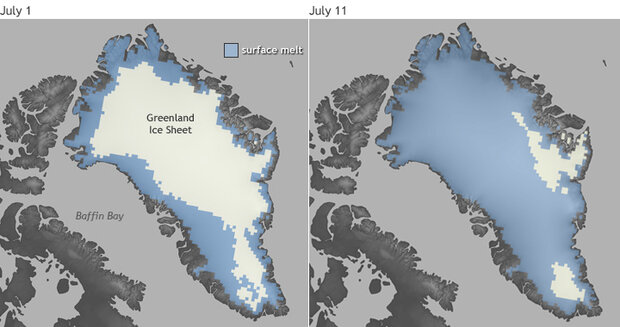
What is the one region to see minimal impact due to climate change? North America. What opens up as the world warms? Greenland. The arctic. Canada.
The US is resurrecting the monroe doctrine because we cannot be on the hook for saving the rest of the world as it turns to desert, floods, and mass migration consumes Europe.
Did Trump orchestrate it? Is this a lucky break that accidentally produces a new form? Is Peter Thiel — that devout Girardian — providing the intellectual architecture? Or am I finding structure in chaos because finding structure is what I do?
I don't know. But the form is changing.
The obvious, and explicitly stated by the administration, reads of the chaos:
- Flooding the zone with activity creates exhaustion for the left, as the ideology of the left is reactive and forces it to respond to all injustice without focus
- The Right must create irreversible change if they stand to lose in 2028
Suggested Reading
René Girard, Things Hidden Since the Foundation of the World (1978). The Girardian connection is not incidental — Peter Thiel is a committed Girardian, and the logic of mimetic rivalry and sacrificial crisis maps directly onto the rupture strategy described here. Girard's argument that social order is maintained through the controlled channeling of mimetic violence, and that the only exit from an over-determined structure is through a crisis that resets the mimetic field, is the theoretical architecture behind the form-breaking this essay identifies. If Thiel is supplying intellectual scaffolding, this is where it comes from.
Peter Zeihan, The End of the World Is Just the Beginning (2022). The most detailed case for why American retrenchment is not chaos but strategy. Zeihan's demographic and geographic analysis of why the US is uniquely positioned for self-sufficiency — energy independent, agriculturally secure, demographically younger than competitors, bounded by oceans — is the material basis for the Monroe Doctrine revival this essay describes. His argument that American engagement in global security was always a Cold War anomaly, not a natural state, reframes the "chaos" as a return to baseline.
Hal Brands & Michael Beckley, Danger Zone (2022). The strategic logic of why great powers in relative decline become more dangerous, not less. Brands and Beckley argue that a peaking China will grow more aggressive before its demographic and economic headwinds hit — and that American grand strategy must prepare for this window. The Western hemisphere consolidation described here reads as one response to the danger zone thesis: reduce exposure to regions you can't hold, concentrate force where geography favors you.
Erving Goffman, The Presentation of Self in Everyday Life (1956). A sociological foundation for the Attention-Subject-Form framework this essay applies to geopolitics. Goffman's account of how individuals maintain "fronts" and how audiences enforce consistency in performed roles is the micro-level mechanism this essay scales to nations. The insight that form-change requires backstage preparation and a dramatic enough performance to override audience expectations is Goffman applied to statecraft.
Parag Khanna, Move: The Forces Uprooting Us (2021). The climate migration thesis that undergirds the essay's "but why" section. Khanna maps the coming redistribution of human geography as climate renders large portions of the tropics and subtropics uninhabitable, and identifies northern North America as among the most valuable real estate on Earth by 2050. The Monroe Doctrine as climate preparation is Khanna's map read through a realist lens.
conversation
Comments
Sign in to join the conversation.
This comment was deleted.
Jiang giving me a shot of confidence, lmao: https://www.youtube.com/watch?v=xrmERlHUqBk
this recent update is relevant: https://www.youtube.com/watch?v=6aNh6sBpqvQ
coming famines, alliance against trans national capital (nationalism, religion, ai!?)