Related:
Reading Themselves Into the Story Their Moment Required
There is a pattern that runs through the biographies of figures who become the embodiment of their historical moment, and it is more deliberate than the romance of the "great man" usually allows. These men — and they have almost all been men — read themselves into their roles. They studied predecessors, rehearsed in prose what they intended to enact in life, and submitted themselves to long, weird disciplines of becoming. The story did not simply find them. They formed themselves, often over decades, into figures the story could land on.
What follows is a closer look at seven such formations. The argument is not that any of these men was self-made in the libertarian sense — each was also the product of class, education, accident, and inheritance — but that on top of those givens, each performed an intentional labor of self-construction aimed at a future role he had glimpsed and chosen. The labor is visible in the archive. It is one of the most reliably observable features of figures who go on to matter.
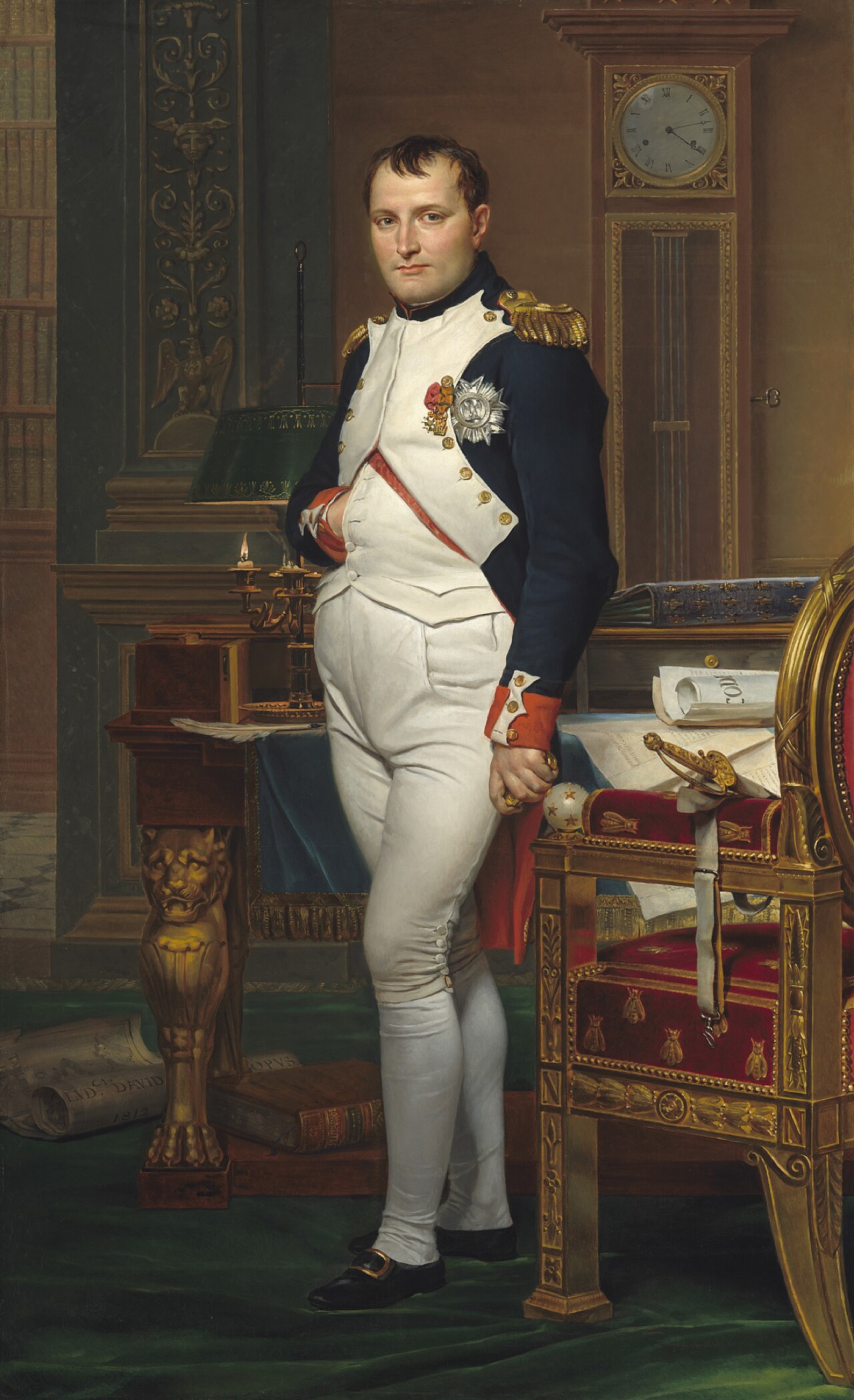
Napoleon at Brienne and the École Militaire
Bonaparte arrived at the military school of Brienne in 1779, aged nine, a Corsican boy among French aristocrats who mocked his accent and his island origin. He spoke little French. He was poor by their standards. He was, by every social marker that mattered to his classmates, a peripheral figure.
What he did with his five years there, and the year that followed at the École Militaire in Paris, is the first identifiable phase of his self-formation. He read. The reading list survives in fragments through letters, school records, and his own later notebooks at the Saint-Sulpice library. Plutarch above all — the Parallel Lives in the Amyot translation — read not as biography but as instruction. Caesar's Commentaries. Polybius. Arrian on Alexander. The histories of Rollin. Later, at Auxonne and Valence as a young artillery lieutenant, he kept up a regimen so austere it alarmed his fellow officers: a single meal a day, savings sent home to his mother, the rest of his time spent reading and taking notes that filled dozens of notebooks.
The notebooks themselves are revealing. They are not random commonplace books. They are tactical and biographical — extracts on the careers of conquerors, on the geography of Asia Minor, on the artillery dispositions of Frederick the Great, on the political collapse of the Roman Republic. He was studying, deliberately, the form of the career he wanted. When he later said "I live only for posterity," he was describing something that had been his orientation since adolescence. The audience he was performing for, even before he had any audience at all, was the historical record.
The Alexander obsession in particular was lifelong. The Egyptian campaign of 1798 is incomprehensible without it — the savants, the appeal to Islamic legitimacy, the projected onward march to India. Napoleon was attempting, consciously, to mime Alexander's career, having spent twenty years studying it. The mime succeeded long enough to make him emperor and failed in the way Alexander's would have failed had Alexander lived: in the over-extension that was always the point of the original.
What is striking is how early the formation began and how unbroken it was. By the time the Revolution opened the door — Toulon in 1793, Vendémiaire in 1795 — the figure who walked through it had already been preparing for fifteen years. The historical moment did not make Napoleon. It met a Napoleon who had been making himself since he was nine.
Caesar Weeping at the Statue of Alexander
The story comes from Suetonius and Plutarch, with slight variations. Caesar, serving as quaestor in Hispania Ulterior around 69 BC, encountered a statue of Alexander the Great in the temple of Hercules at Gades (modern Cádiz). He was thirty-one. He stood before the statue and wept. When his companions asked what was wrong, he said something to the effect that Alexander had conquered the known world by his age and he had accomplished nothing.
The anecdote has been treated as colorful. It is more than colorful. It tells us what Caesar measured himself against, and the measurement is itself the formation. He was not comparing himself to other Roman politicians of his generation — Cicero, Pompey, Crassus, Cato. He was comparing himself to a figure three centuries dead from another civilization, whose career he had absorbed deeply enough that it functioned as a private benchmark.
The reading is documented elsewhere. Caesar wrote on grammar and rhetoric. He composed poetry. He delivered famous funeral orations, including one for his aunt Julia in which he traced his family back to Venus and to Ancus Marcius — already, in his early thirties, constructing a public lineage that placed him in mythic proximity to the gods and the founding kings. The eventual Commentaries on the Gallic War are themselves an exercise in self-presentation so masterful that they remain the source through which we still see Caesar; he wrote his own historical record into existence, in the third person, with a control of tone that no later Roman matched.
The formation here is more political and rhetorical than purely martial. Caesar was constructing himself as a figure of dignitas backed by populist appeal, with Alexander's example as the ceiling of ambition rather than the immediate model. What he took from Alexander was the conviction that there was a kind of historical greatness that exceeded ordinary republican careers, that one might reach for it, and that to settle for less by his age was failure. The tears at Gades were not despair. They were a recommitment.
Lincoln Walking Miles for Books
The frontier reading of Abraham Lincoln has been so romanticized it has become hard to see. But the documentary record is specific and the formation it represents is unusual. Lincoln had perhaps a year of formal schooling, scattered across his childhood in Kentucky and Indiana. Everything else he taught himself, with a method.
The books he sought out in his late teens and twenties — borrowed, walked miles to obtain, read by firelight — were not the random collection a frontier autodidact might assemble. They were a curriculum. The King James Bible. Shakespeare, especially the histories and tragedies. Aesop. Bunyan. Weems's Life of Washington. Burns. Then, with deliberation as he turned toward law: Blackstone's Commentaries. Euclid's Elements, which he worked through in his thirties to discipline his reasoning. The proceedings of the constitutional debates. Webster's speeches. Henry Clay's speeches.
He worked at his own prose with extraordinary care. The 1838 Lyceum address, delivered when he was twenty-eight, is already in the cadence we recognize from the second inaugural — the King James rhythms, the legal precision, the willingness to stake everything on a few weighted abstractions. He had been forming the voice for at least a decade by then.
The Cooper Union speech of February 1860 is the moment the construction became publicly visible. He had spent months preparing it. He went to the Illinois State Library and read his way through the legislative history of the founding generation on slavery and the territories, building a brief that demolished the southern argument from constitutional original intent. He delivered it before a New York audience that had come, partly, to be amused by a backwoods curiosity. They were not amused. They were converted. Within four months he had the Republican nomination.
What is worth seeing clearly is that the man who walked into Cooper Union had been preparing to walk into something like Cooper Union for thirty years. He did not know it would be this room or this speech. He knew it would be a moment of testing, that the testing would be in language and in argument grounded in the founding documents, and that he intended to be ready. The melancholy that ran through his life is inseparable from this: he was a man who had formed himself for a role whose specific shape he could not yet see, and who understood that the formation might never be redeemed by an actual occasion. When it was, he had what the occasion required because he had done the work in advance.
Churchill in the Wilderness, Writing Marlborough
The years 1929 to 1939 are conventionally called Churchill's wilderness years. He was out of government, out of favor in his party, written off as a yesterday's man whose Edwardian style of imperial liberalism was an embarrassment in an age of austerity and accommodation. He was sixty in 1934. By every external measure his career was over.
What he did with that decade is one of the most explicit cases of self-formation in modern political biography, because he wrote about it while doing it. He produced Marlborough: His Life and Times in four volumes between 1933 and 1938 — over a million words on his great ancestor John Churchill, the Duke of Marlborough, victor of Blenheim and Ramillies and Oudenarde, the man who had assembled and held together the Grand Alliance against Louis XIV in a war that lasted more than a decade and that turned on his refusal to accept either premature peace or strategic despair.
The parallel is not subtle, and Churchill did not intend it to be. He was rehearsing, in prose about his ancestor, the role he intended to play if the moment came. The book is full of meditations on how a single statesman can hold a coalition together against a continental tyranny, on the political infighting that surrounds such a figure at home, on the necessity of grand strategy executed across many years of setbacks. He was thinking, page by page, about what it would take.
Alongside Marlborough, the speeches against the policy of accommodation accumulated. They were ignored at the time. Read in sequence now, they constitute the most sustained piece of strategic warning in twentieth-century English political prose. He was assembling the public record that would, when the moment turned, position him as the only man who had been right when it mattered.
The wilderness was therefore not really wilderness. It was a forge. When the call came in May 1940, he was sixty-five — old by the standards of the day, and physically beyond his prime — but he had been preparing, in writing, for exactly this configuration of crisis for the previous decade. The lines and cadences that came out of him in 1940 had been worked over in the Marlborough project and the speeches. He stepped into the role because he had spent ten years making himself into the man who could.
De Gaulle Writing Le Fil de l'Épée
In 1932, Charles de Gaulle was a forty-one-year-old colonel on the staff of the Conseil supérieur de la défense nationale, a man of considerable intellectual reputation within the French army but no broader fame. He published a slim book that year called Le fil de l'épée — "The Edge of the Sword" — based on lectures he had given at the École de Guerre.
It is, on its surface, a meditation on military leadership. It is, in fact, a phenomenological description of the man of character — l'homme de caractère — who emerges in moments of national crisis to embody what the nation has lost the power to be. The man of character is austere, solitary, often resented by his colleagues. He carries the burden of a vision the routine functionaries cannot see. He is willing to disobey when obedience would be ruin. He cultivates distance from those around him because intimacy compromises the function he must perform. He is, in the famous formulation, "a man apart."
De Gaulle was, in this book, theorizing himself in advance. He had not yet done anything that would justify the figure he was describing. The figure was the project; the book was the blueprint. Reading it now, after 1940 and 1944 and 1958, one has the uncanny sense that the older de Gaulle was simply enacting the younger de Gaulle's text. The persona of the wartime leader who refused the armistice, of the provisional president who walked down the Champs-Élysées on August 26, 1944, of the recalled savior of 1958 who founded the Fifth Republic — all of it is in the 1932 book, in the present tense, as though de Gaulle were simply reading from a manuscript he had written for himself a decade before he needed it.
The earlier book, La discorde chez l'ennemi (1924), and the later Vers l'armée de métier (1934, on mechanized warfare), are part of the same project. He was constructing simultaneously a strategic doctrine that the French establishment would refuse, which would position him as the prophet who had been ignored, and a personal doctrine of leadership that would equip him to step in when the refusal had produced catastrophe. The strategy and the persona were a single design.
When the catastrophe came in May and June of 1940, de Gaulle was almost completely unknown. He had been promoted to brigadier general only in May. The June 18 broadcast from London was made by a man whom the British had picked up almost at random, who represented no one but himself, who had no army, no political base, and no constitutional authority of any kind. Within four years he was the recognized leader of liberated France. The transformation is incomprehensible without the prior decade of self-construction. He had written the part. He stepped into it.
Mao Reading the Romance of the Three Kingdoms
Mao Zedong's reading habits have been studied by scholars who have access to his marginalia, his personal library at Zhongnanhai, and the testimony of those who lived and worked around him. The picture that emerges is of a reader of extraordinary range and consistency, but with a distinctive emphasis: the Chinese historical and literary canon, especially the works that taught statecraft through narrative.
The Romance of the Three Kingdoms (Sanguo Yanyi) and Water Margin (Shuihu Zhuan) — the two great popular novels that dramatize the rise and fall of dynasties and the conduct of rebel coalitions — were Mao's lifelong companions. He read them as a boy in Hunan, defying his father's prohibition on novels, and he read them as an old man in Beijing. The marginalia is tactical. He treated the novels not as entertainment but as case literature on the politics of insurrection, the management of generals, the timing of feints and reversals, the use of legitimacy claims by warlord coalitions trying to become dynasties.
Beyond the novels, the Comprehensive Mirror for Aid in Government (Zizhi Tongjian) of Sima Guang — the eleventh-century chronological history of China — was on his nightstand for decades. He is said to have read it through more than a dozen times. This is the great handbook of imperial Chinese statecraft, organized so that a ruler can study the precedents for any given political situation. Mao studied it in exactly that spirit.
The Marxist canon was on the shelf, of course, and Mao engaged with it seriously, but his deepest formation was Chinese rather than Western. He understood the Chinese revolution as a successor to the long sequence of dynastic transitions, and he understood his own role through models that ran from the founder of the Han through Zhu Yuanzhang of the Ming. The peasant general who founds a dynasty, the rebel who becomes legitimate by winning, the ruler who consolidates by purging his founding generals — these archetypes from Chinese history shaped how he conceived and executed his own career, including its worst phases.
What this gives us is a different version of the same pattern. Where Napoleon and Caesar reached across civilizational lines to Alexander, where Lincoln read his way into the constitutional founders, where Churchill rehearsed his ancestor and de Gaulle wrote his future self — Mao formed himself by deep submersion in the longest continuous historical tradition of statecraft on earth, with explicit tactical intent. The result was a ruler whose capacity to read and shape the Chinese political moment was rooted in his having absorbed two thousand years of Chinese political precedent as a personal repertoire.
Lee Kuan Yew Becoming Singapore's Instrument
Lee Kuan Yew's case is interesting because he wrote his own account of his self-formation in two volumes of memoirs (The Singapore Story and From Third World to First), and the account is unusually candid about its instrumental character. He did not romanticize his own becoming. He described it as a series of practical adaptations to what the situation required.
The formative experiences he names are specific. The Japanese occupation of Singapore from 1942 to 1945, when he was a teenager and young adult, taught him — he says explicitly — that power was the underlying reality and that the British colonial administration he had grown up assuming as permanent was a contingent arrangement that could be swept away in a week. He took on Japanese language work to survive, and in doing so observed up close how a different imperial power organized its dominance. He drew the lesson that small entities survive only by being useful to the strong, and that the strong are interchangeable.
His Cambridge years, immediately postwar, were used for two simultaneous projects: a first-class law degree (he took a starred first), and a careful study of British political practice as an apprentice trade — how parliamentary debate worked, how cabinet government functioned, how civil services were structured, how the legal-political system handled labor unrest and ethnic tension. He was, by his own account, building a tool kit.
The formation continued through the 1950s as he built the People's Action Party, navigated the communist factions, managed merger with Malaysia and then expulsion from it. The crucial point in his self-presentation is that he did not have a fixed ideology. He had a problem — the survival and elevation of a small, ethnically divided, resource-poor city-state — and he formed himself, and then his party, and then his state, around what would solve the problem. He read voraciously throughout: economic development literature, the experience of Israel and Switzerland and other small states, the lessons of Hong Kong, the American and Japanese postwar trajectories.
The phrase that recurs in his memoirs is that he made himself into "an instrument" of Singapore's needs. The construction is exact. He had identified what the situation required and had submitted himself to becoming the figure that could deliver it, abandoning whatever in his own preferences or background did not serve the project. This is the most disenchanted version of the pattern under examination, and perhaps the most revealing, because it strips away the romantic rhetoric and shows the structure plainly. A ruler is, when he succeeds, an instrument that has been formed — partly by accident and partly by design — to fit a specific historical opening. Lee Kuan Yew described the formation as if from the outside, having performed it.
What These Cases Share
Across the seven figures, several features recur with enough regularity to constitute a pattern.
Each began the formation early — adolescence or young adulthood — and sustained it across decades, often through periods when it must have looked, to others and sometimes to themselves, futile. Napoleon at Auxonne, Lincoln on the circuit, Churchill in the wilderness, de Gaulle as a colonel writing a book that would find perhaps a few thousand readers — these were not men who knew their moment was coming. They were men who continued the work without that knowledge, on the chance that it might.
Each formation had an explicit object of study, usually historical and biographical. They were not forming themselves in the abstract. They were absorbing the careers of predecessors with whom they intended to be compared. Plutarch and Caesar for Napoleon, Alexander for Caesar, the founders for Lincoln, Marlborough for Churchill, the abstract type of the homme de caractère for de Gaulle, the dynastic founders for Mao, the small successful states for Lee. The model preceded the original.
Each performed the formation partly in writing — their own writing, for posterity or for self-instruction or both. The notebooks of Napoleon, the rhetorical and historical compositions of Caesar, the speeches and prose of Lincoln, Marlborough and the warning speeches of Churchill, Le fil de l'épée and its companions for de Gaulle, the marginalia and essays of Mao, the memoirs and policy writings of Lee. The act of writing was not separable from the act of becoming. The figure was constructed in language before it was enacted in history.
Each was, when the moment arrived, recognizably the figure he had been making himself into. There is no real surprise in the late careers. The Napoleon of the Italian campaign is the boy from Brienne grown up. The Caesar of the Rubicon is the young quaestor at Gades grown up. The Lincoln of the second inaugural is the autodidact of New Salem grown up. And so on. The match between the formed self and the historical moment was not coincidence — it had been prepared for, as for an examination.
And finally, each formation had a wound at its base, or a humiliation, or an exclusion. The Corsican boy mocked at Brienne. The patrician facing the loss of his class's republican preeminence. The frontier child of poverty and grief. The aristocrat whose family had subsided into mediocrity and whose moment had passed. The provincial officer overlooked by the high command. The peasant son who had to fight his father for books. The colonial subject who watched his world collapse under Japanese occupation. The wound is not the cause of the formation, but it is the energy source. Without it, the long, weird discipline of self-construction would not have been undertaken or sustained. With it, the discipline has fuel for the decades it requires.
A Final Note on Contingency
It would be wrong to read these cases as guarantees. For every Napoleon there were a hundred ambitious officers who studied Plutarch and remained captains. For every Lincoln there were thousands of frontier autodidacts who read their way into modest law practices and obscurity. The formation is necessary; it is not sufficient. The historical opening also has to come, and the fit between formed self and opening has to be close enough to be recognized.
What the formation does is make recognition possible when the opening appears. The unformed ambitious man, faced with the moment, has nothing to bring to it. The formed man has a self that has been shaped, over many years, into something the moment can use. He still requires the moment. The moment still requires him.
The unsettling implication, which is worth holding, is that history selects for a particular kind of person — the one capable of decades of self-formation under ambition toward an intuited story. This is not the same as the wisest or most virtuous person, though it is sometimes those too. It is a specific psychological capacity: to read the available stories, to choose one, to submit oneself to the long work of becoming legible to it, and to keep doing so without external validation through years or decades when no validation comes. It is closer to a religious vocation than to ordinary ambition, and the figures who manage it tend, on close inspection, to have something of the monk in them, even when the project is power. They have undergone an askesis. They have made themselves available to be used by the story they have chosen.
This is, perhaps, what Hegel meant by the world-historical individual being a vehicle of the spirit of the age — but with the agency restored. The vehicle made itself a vehicle. Whether the spirit then chose to ride is the part neither we nor the rider can finally control.
conversation
Comments
Sign in to join the conversation.
very interesting stuff - especially about Napoleon. What is the deal with the Claude icon at the top - was this written with AI?