The Vulnerability Principle
Published 2025-12-12The political-legal jeopardy faced by a powerful political figure, such as Donald Trump, is often analyzed purely in terms of the individual’s survival. However, a deeper, game-theoretic analysis reveals that such vulnerability fundamentally alters the entire political ecosystem around the actor, shifting their strategic options to align with the self-interested agendas of powerful surrounding factions.
In this model of power, the leader’s legal threat transforms from a liability into a lever used by allies, forcing the leader toward a “Pareto frontier” of action: strategies that maximize the leader’s personal protection and simultaneously advance the long-term, sometimes ideological, goals of their coalition.
I. The Four Major Factions and Their True Agendas
Political coalitions are rarely monolithic. Analysts divide the forces surrounding a figure like Trump into distinct groups, each with a different set of priorities:
-
The “National Conservative / Post-liberal” Intellectual Faction (e.g., the Thiel/Vance Orbit):
-
Agenda: Institutional re-foundation, not merely political survival. This faction seeks to assert stronger executive control over federal agencies, reorient industrial policy, and curtail what they view as “elite-driven managerial liberalism”.
-
Incentive: They believe a weakened Trump is easier to steer ideologically. They position themselves as the “thinkers” who can operationalize the deep structural changes the leader enables. The vulnerability is an opening to push for a complete regime shift.
-
This ambition is rooted in a critique of the modern liberal project itself. As Peter Thiel wrote in “The Straussian Moment,” the Enlightenment-era world of commerce and capitalism sought to eliminate or obscure “violent debates about truth—whether they concern questions of religion and virtue or questions about the nature of humanity—[because they] interfere with the productive conduct of commerce”. The post-liberals seek to reverse this philosophical retreat.
-
-
The “Traditional GOP Power Brokers / Corporate Republicans”:
-
Agenda: Stability, predictability, business-friendly policies, and maintaining strong donor networks.
-
Incentive: They want Trump’s base enthusiasm, but they fear his chaos. They prefer conventional governance where the leader functions as a figurehead delegating to institutional insiders.
-
-
The “Security-State Skeptics / Anti-Administrative-State Faction”:
-
Agenda: Drastically lowering the power of the civil service and replacing “neutral bureaucracy” with ideologically aligned staff, often through executive tools like “Schedule F”.
-
Incentive: Re-election is paramount because executive control is the key to their institutional project. They support any strategy that delays trials until executive power can be wielded.
-
-
Opportunistic Actors:
-
Agenda: Self-preservation, amplification, and media relevance.
-
Incentive: They prefer chaos and legal drama, as these “outrage cycles” increase ratings, influence, and personal financial gain. They often push the leader toward more extreme rhetoric, even if it undermines the leader’s legal position.
-
II. How Factional Incentives Alter the Strategic Map
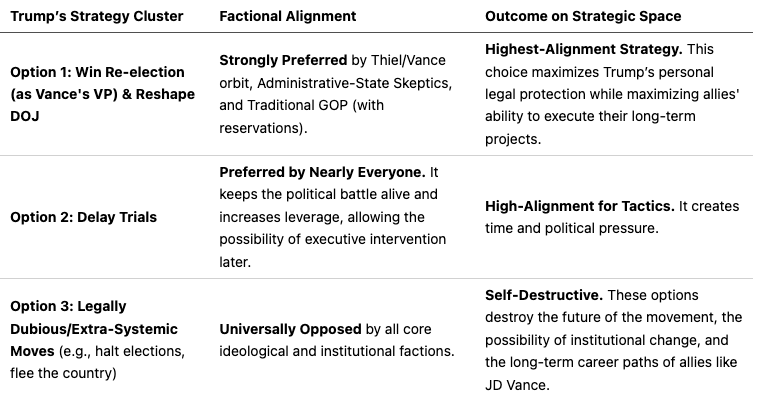
When faced with multi-front legal challenges, a political actor has options that fall into four categories: legal defense, political maneuvers (winning elections), constitutional/institutional moves, and extra-systemic options (fleeing, disrupting elections).
The surrounding factions effectively veto the most self-destructive options, leaving only the paths that serve a mutual benefit:
III. Synthesis: The Pareto Frontier of Power
The leader’s vulnerability creates a powerful, unseen force that narrows the strategic option-space. The pressure from ambitious, ideologically driven allies pushes the leader away from purely personal or chaotic survival attempts, and toward a cluster of actions that empower the entire coalition.
This “Pareto frontier” of Trump-world incentives is defined by the following actions:
-
Maximize Delay: Procedural maneuvers to push trials past the election.
-
Maximize Power: Win the election to gain the maximum personal legal protection and executive authority.
-
Maximize Institutional Change: Use the presidency to reshape the institutional architecture (e.g., administrative-state overhaul), often by delegating the ideological agenda to the Thiel/Vance orbit.
In essence, the threat of legal jeopardy gives the surrounding factions a decisive influence, compelling the leader to pursue structural change—a process that benefits them all and ultimately advances their individual agendas under the guise of the leader’s political survival. This dynamic illustrates a fundamental theory of power: a leader’s personal crisis often becomes the political vehicle for their followers’ ambition.