Know Thyself: Greek vs Christian
Published 2025-12-15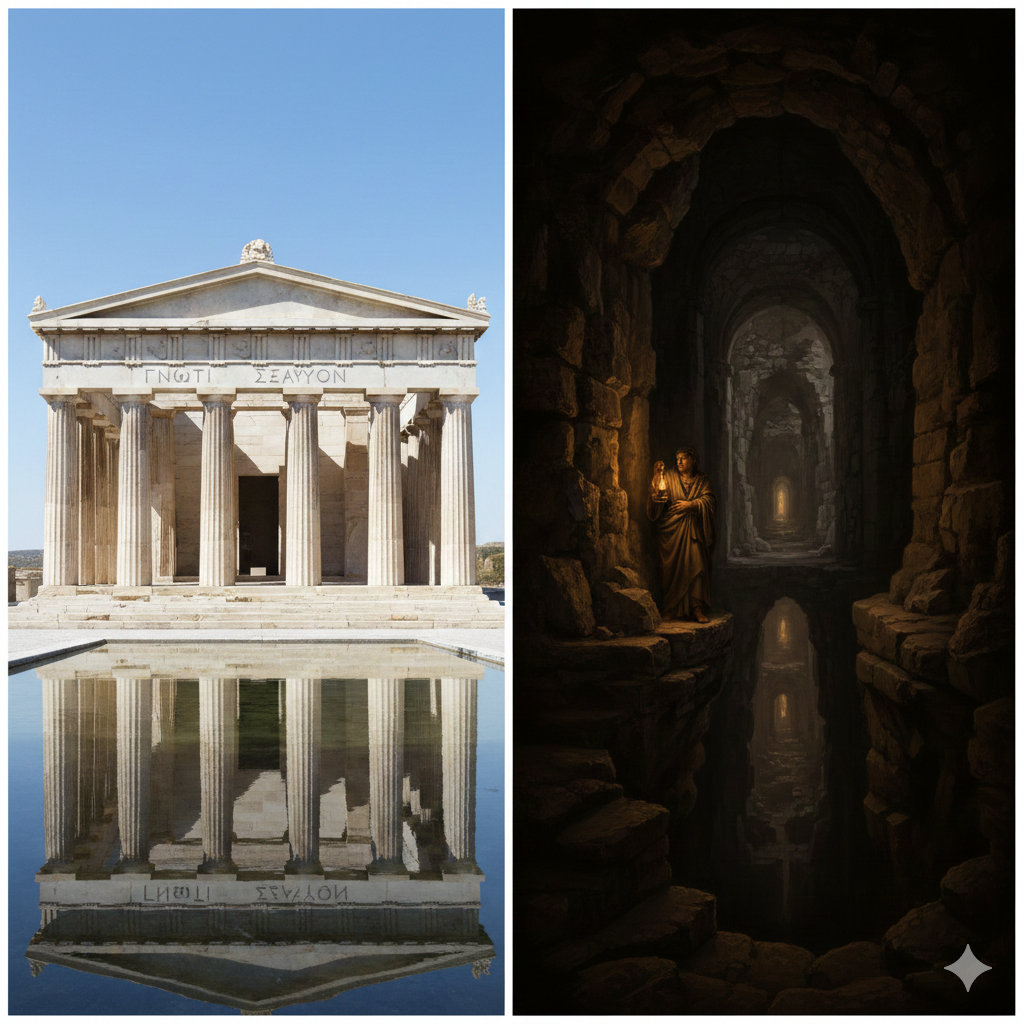
-
Pt 1: Greek vs Christian
-
Pt 4: No Self
“I have become a question to myself.” — Augustine, Confessions X.33
Knowing yourself for the Greeks does not mean the same thing as knowing yourself for Christians. One assumed that our desires are transparent and that we only need to examine our knowledge. The other that our desires are mysterious to us.
Note: this covers Pauline and Augustine Christianity. See The Kingdom Within for Christianity pre-Paul which is radically different.
Introduction
We moderns inherit a particular way of being selves. We assume that truth lives inside us—that authenticity means excavating our hidden desires, that mental health requires surfacing buried traumas, that self-knowledge means knowing what we really want. We sit on therapists’ couches and confess. We journal. We ask ourselves what we were truly feeling when we said that hurtful thing.
This interior orientation feels natural—like simply being human. But it is not. It was invented, and the invention can be dated with surprising precision. The Greeks, for all their philosophical sophistication, operated with a fundamentally different psychology. Christianity did not merely add new doctrines to the ancient world; it rebuilt the self from the inside out.
This essay traces the distinction through primary sources. The goal is not merely historical but therapeutic: by seeing that our current habits of introspection are contingent rather than necessary, we may gain freedom to think differently about what it means to know ourselves.
Part I: The Greek Orientation—Knowing Your Place
The Delphic Imperative
The famous inscription at Delphi—γνῶθι σεαυτόν, “know thyself”—did not invite introspection in our modern sense. Ancient sources consistently interpret it as a warning against overreach. Pausanias, writing in the second century CE, records the saying alongside two others: “nothing in excess” and “give a pledge and trouble is at hand.” The triad suggests a cluster of warnings about human limitation, not an invitation to psychological archaeology.
Plato’s Charmides explicitly discusses what “know thyself” might mean. Socrates proposes that it is the inscription’s way of saying “be temperate”—sōphrosunē. The dialogue circles around definitions: self-knowledge as knowing what one knows and does not know, or as a kind of meta-knowledge about knowledge itself. What it never becomes is knowledge of one’s desires, motives, or hidden psychological states. The question throughout is epistemic, not affective.
Socratic Examination: Testing Beliefs
The Socratic method represents the most developed Greek practice of self-examination—yet even here, the object is belief, not desire. In the Apology, Socrates describes his mission:
“I go about doing nothing else than urging you, young and old alike, not to care for your bodies or for wealth more than for the perfection of your souls, or even so much... The unexamined life is not worth living for a human being.”
— Apology 29d–38a (trans. Grube)
But what does examination mean here? The elenchus—Socrates’ characteristic method—proceeds by asking someone to state a definition, then showing through questioning that their stated beliefs are inconsistent. You say you know what justice is? Let us test whether you can give a coherent account. The examination targets the logos—your reasons, arguments, the rational structure of your commitments. It is an audit of cognitive consistency, not an excavation of hidden motives.
Even in the Alcibiades I (whether authentic or not, it reflects Platonic psychology), when Socrates does address self-knowledge directly, the model is optical rather than archaeological:
“When we look into the eye of another, we see our face reflected in that part which we call the pupil, as in a mirror... So if an eye is to see itself, it must look at an eye, and at that region of the eye in which the virtue of the eye is located, and this is vision.”
— Alcibiades I 133a (trans. Hutchinson)
The soul knows itself by looking at another soul—specifically, at “the region in which the excellence of the soul, wisdom, occurs.” Self-knowledge is gained through dialectical encounter with others, through the mirror of reason reflecting reason. There is no suggestion that the self contains hidden depths that speech must excavate.
Stoic Self-Review: Checking the Ledger
The Stoics developed the most systematic Greek practices of self-examination. Seneca describes a nightly review:
“When the light has been taken away and my wife has fallen silent, aware of my habit, I pass the whole day in review before myself and assess my deeds and words. I hide nothing from myself, pass over nothing. For why should I fear any of my errors, when I can say: ‘See that you do not do this again. I forgive you this time.’”
— On Anger III.36 (trans. Cooper and Procope)
This sounds remarkably like Christian examination of conscience—until you notice what is being examined. Seneca reviews his deeds and words. Did he argue too vehemently at dinner? Did he correct someone too harshly? The question is whether his actions aligned with reason. There is no attempt to probe beneath the deed to some hidden motive he cannot see.
Epictetus teaches a similar discipline, but focused on impressions—the way things appear to us:
“Make it your study at the very outset to say to every harsh impression, ‘You are an impression and not at all what you appear to be.’ Then examine it and test it by these rules which you have, and first and chiefly by this, whether the impression has to do with things which are under our control or things which are not under our control; and if it has to do with something not under our control, be ready with the answer, ‘It is nothing to me.’”
— Enchiridion 1 (trans. Oldfather)
The Stoic tests whether an impression is what it claims to be—whether the apparently terrible thing is actually terrible, whether it is within our control. The examination is rational classification, not psychological archaeology. Marcus Aurelius journals in precisely this mode, asking of each situation: what is its nature? What virtue does it call for? The self that emerges is a seat of rational judgment, not a container of hidden depths.
What the Greeks Did Not Ask
Notice what is absent from these practices. No Greek philosopher asks:
-
What did I really want when I did that?
-
What hidden desire was operating beneath my conscious intention?
-
What is the secret motive even I cannot see?
-
What childhood experience explains my current behavior?
The Greeks had a rich vocabulary for desire—eros, epithumia, thumos—but they treated desire as fundamentally transparent. You might be wrong about whether something was good, but you were not systematically deceived about what you wanted. The problem was ignorance, not self-opacity.
Aristotle is explicit about this in the Nicomachean Ethics:
“We deliberate not about ends but about means. A doctor does not deliberate whether to heal, nor an orator whether to persuade... They assume the end and consider how and by what means it is to be attained.”
— Nicomachean Ethics III.3, 1112b (trans. Ross)
Desire gives us our ends; reason deliberates about means. There is no suggestion that we might be deceived about what we want, that our professed ends might be masks for hidden ends, that the self might lie to itself about its own desires.
Part II: The Christian Turn—Excavating Desire
Augustine and the Opacity of the Self
Augustine’s Confessions (397–401 CE) represents a decisive break. The work is addressed to God, but more precisely, it is an extended speech-act of confessing—not in the later sacramental sense, but in the sense of confessio as acknowledgment, profession, praise. What makes it revolutionary is its assumption that the self is a problem to itself, that we do not simply know our own motives.
The famous episode of the stolen pears illustrates this perfectly:
“There was a pear tree near our vineyard laden with fruit that was not tempting either to look at or to taste. Late one night—having prolonged our games in the streets until then, as our bad habit was—a group of young scoundrels, myself among them, went to shake and rob this tree. We carried off a huge load of pears, not to feast upon ourselves, but to throw to the pigs, after barely tasting some of them ourselves. Doing this pleased us all the more because it was forbidden.”
— Confessions II.4.9 (trans. Chadwick)
What follows in the text is not remorse for petty theft but bewilderment at his own motivation. Augustine returns to this trivial incident again and again, asking why. He did not want the pears—they were not appetizing. He was not hungry. He threw them to pigs. So what did he want?
“What was it that I loved in that theft? Was it the pleasure of acting against the law, in order that I, a prisoner under rules, might have a counterfeit liberty...? What was the object of my love in the theft? In what way did I viciously and perversely imitate my Lord?”
— Confessions II.6.14
The text performs the problem it describes. Augustine cannot simply report his motive because his motive is opaque to him. The self has become a quaestio—a question, a problem to be investigated:
“I have become a question to myself, and that is my infirmity.”
— Confessions X.33.50
This is unprecedented. No Greek philosopher treats self-knowledge as fundamentally difficult in this way. For Socrates, self-knowledge means recognizing the limits of your knowledge—but you can do that simply by trying to give an account of what you think you know. For Augustine, self-knowledge means penetrating layers of self-deception to reach desires you did not know you had.
The Abyss of Memory
Book X of the Confessions contains Augustine’s famous exploration of memory—and it is here that the new psychology is most fully articulated:
“Great is this power of memory, exceedingly great, O my God—a large and boundless inner hall. Who has plumbed its depths? Yet this is a power of my mind and belongs to my nature, nor do I myself grasp all that I am. Therefore the mind is too narrow to contain itself. But where can that part of it be which it does not contain? Is it outside itself and not within? How then does it not grasp itself? A great wonder rises within me; amazement seizes me.”
— Confessions X.8.15
The mind cannot contain itself. There are regions of the self that the self cannot reach, depths that exceed its grasp. This is not the Socratic recognition that we do not know what justice is—it is the recognition that we do not know ourselves, that we are larger and stranger than we can fathom.
And these hidden regions are not merely forgotten trivia. They contain desires, motivations, tendencies that shape our actions without our knowledge:
“I am unable to grasp all that I am. The mind is not large enough to contain itself: but where can that part of it be which it does not contain? Is it outside itself and not within? In this situation the mind is too limited to possess itself.”
— Confessions X.8.15
The Desert Fathers: Taxonomies of Temptation
While Augustine was developing his theology in North Africa, monks in the Egyptian desert were creating practical technologies for navigating the newly discovered interior. The desert fathers did not merely flee the world—they entered a laboratory for studying the movements of the soul.
Evagrius Ponticus (345–399 CE) developed an elaborate taxonomy of thoughts (logismoi) that afflict the monk. His list of eight principal thoughts—later condensed into the seven deadly sins—was not merely a classification of bad actions but of interior movements:
“There are eight principal thoughts, from which all other thoughts stem. The first thought is of gluttony; the second, of fornication; the third, of love of money; the fourth, of discontent; the fifth, of anger; the sixth, of despondency; the seventh, of vainglory; the eighth, of pride.”
— Praktikos 6 (trans. Sinkewicz)
The monk must learn to identify which thought is attacking him, where it comes from (God, self, or demon), and how to combat it:
“Whether these thoughts trouble the soul or not does not depend on us; but whether they linger or not, whether they set the passions in motion or not—this does depend on us.”
— Praktikos 6
Notice the architecture this implies: thoughts arrive from outside (from demons, from God, from the self), and the monk must sort them, identify their origin, decide whether to entertain them. The interior life becomes a space of constant surveillance—not of actions, but of the movements of desire before they become actions.
John Cassian (360–435 CE) brought these Egyptian practices to the Latin West. His Conferences record conversations with desert elders and became a manual for Western monasticism. On the examination of thoughts, he reports the teaching of Abba Moses:
“The first step in this direction is to recognize at once the thoughts suggested to us, and by a careful scrutiny to trace them to their source, so that we may be able to discover their author, whether it is God who inspires us with what is good, or the devil who suggests what is evil, or our own heart.”
— Conferences I.22 (trans. Gibson)
This is discernment of spirits—discretio spirituum—and it becomes a core Christian practice. Every thought must be examined: Where did this come from? What does it want? Is it from God or Satan? Is it my own desire or a temptation from outside? The monk becomes a watchman at the gates of his own soul.
Confession Becomes Mandatory
The practices of interior surveillance developed in the desert eventually became institutionalized for all Christians. The Fourth Lateran Council (1215) required annual confession for every baptized Christian:
“All the faithful of both sexes shall after they have reached the age of discretion faithfully confess all their sins at least once a year to their own priest and perform to the best of their ability the penance imposed, receiving reverently at least at Easter the sacrament of the Eucharist.”
— Canon 21, Fourth Lateran Council
This created an unprecedented social technology. Every Christian, once a year at minimum, had to produce a verbal account of their sins—not just their actions, but their thoughts, desires, and intentions. The priest was not merely an absolver but an examiner:
“Let the priest be discreet and cautious that he may pour wine and oil into the wounds of the injured one after the manner of a skillful physician, carefully inquiring into the circumstances of both the sinner and the sin, that from these he may prudently discern what kind of advice he ought to give and what remedy to apply, using diverse experiments to heal the sick one.”
— Canon 21, Fourth Lateran Council
Confessor’s manuals proliferated, teaching priests how to examine penitents. The Summa Confessorum tradition provided detailed questions for every category of sin. Intention mattered as much as action: Did you consent in your heart? Did pleasure linger? For how long? What were you thinking?
Thomas Aquinas systematized the theology behind this:
“Properly speaking, sin consists in an act that proceeds from the will, whether that act be the will itself, as when a person wills something evil, or whether that act be an act commanded by the will.”
— Summa Theologiae I-II, Q.74, A.1 (trans. Fathers of the English Dominican Province)
Sin is in the will—in intention, desire, consent. External action matters, but the real locus of moral significance is interior. This creates an entirely different moral psychology than anything in the classical world. The Greeks asked: Did you act rightly? Christianity asked: What did you will? What did you desire? What did you consent to in your heart?
Part III: The Shape of the Difference
Two Models Compared
We can now summarize the contrast:
The Greek Model:
-
Self-knowledge means knowing your place (Delphi) or knowing what you know (Socrates)
-
Examination targets beliefs, reasons, the logos
-
Desire is fundamentally transparent; the problem is ignorance of the good
-
You learn about yourself through dialectical encounter with others
-
The goal is rational consistency and alignment with nature/virtue
The Christian Model:
-
Self-knowledge means penetrating your own opacity (Augustine)
-
Examination targets desires, intentions, hidden motives
-
Desire is fundamentally suspect; the problem is self-deception
-
You learn about yourself through speech addressed to God or his representative
-
The goal is confession, purification, submission of the will
The Greek asked: What do you believe, and can you defend it? The Christian asked: What do you want, and do you even know?
Why Speech?
Both traditions valued speech—but for different reasons. For Socrates, dialogue was the medium of examination because truth emerges through the testing of arguments. You state a position; I question it; we discover together where your reasoning fails. The elenchus is fundamentally social and rational.
For the Christian tradition, speech serves a different function. The desert fathers required monks to confess their thoughts to elders not primarily because the elder would offer good advice (though he might) but because the act of speaking itself transformed the thought:
“If we hide anything from our spiritual father, no healing can come to us.”
— John Cassian, Conferences II.10
Why should verbalization matter? The Christian answer involves the nature of sin and demonic power. Evil thrives in darkness; bringing it into the light weakens it. The serpent that whispered to Eve operated through hidden suggestion. Naming the thought, speaking it aloud, exposing it to another—this breaks its power:
“The devil’s wiles are ineffective against us if we do not hide our thoughts.”
— Evagrius, On the Eight Thoughts
Speech becomes a technology for dragging hidden things into visibility. This is not dialogue in the Socratic sense—not the mutual testing of positions—but confession in the Christian sense: the verbal exposure of the interior.
A New Kind of Truth
Michel Foucault, in his late lectures, argued that Christianity invented a distinctive relationship between truth and the self—what he called “veridiction” or truth-telling about oneself:
“In Christianity, not only must one be watchful over one’s thoughts, but one must also tell them to someone else, to a spiritual father or guide. And one must tell all one’s thoughts. This is what the Greeks never demanded... The obligation to tell the truth about oneself is bound up with the pastoral practices of confession, spiritual direction, the examination of conscience.”
— The Hermeneutics of the Subject (paraphrase)
The Christian is obligated to produce verbal truths about the self—to confess, to examine, to articulate interior states. This creates a new kind of expertise: the director of conscience, the confessor, and eventually the therapist, the analyst, the counselor. All presuppose that the self contains hidden truths that must be brought to speech, and that there are techniques for drawing them out.
Part IV: Liberation Through History
The Point of This Exercise
Why does this history matter? Not merely as antiquarian interest. We are trying to see ourselves from outside.
The habits of introspection we inherit—the assumption that authenticity means digging into hidden desires, that self-deception is a central human problem, that “processing” emotions requires verbal articulation—these are not simply human universals. They are the residue of a specific spiritual technology, invented for specific purposes (salvation, the combat with demons, the purification of the will), which has been secularized into our therapeutic culture.
This does not mean these practices are worthless. The question is whether they are necessary, whether they are the only way to relate to oneself, whether the problems they were designed to solve are our problems.
Alternative Possibilities
The Greeks offer one alternative: a self oriented outward rather than inward, knowing itself through its reasons rather than its desires, finding coherence through rational examination rather than archaeological excavation. You do not need to dig to know yourself; you need to give an account.
Other traditions offer others. Zen Buddhism suggests that the search for the “true self” may itself be the problem—that the introspective orientation reifies a self that is not there. Confucianism suggests that self-cultivation happens through ritual practice and social relationship, not interior examination.
Even within Christianity, alternative currents exist. The Orthodox tradition of theosis—divinization—suggests that the goal is not self-knowledge but transformation, not excavating the true self but participating in divine life. The self is not a fixed reality to be discovered but a process of becoming.
The Residue We Carry
We are not Christians (most of us), and we do not believe in demons. But we have inherited the Christian topology of the self: the assumption that we are opaque to ourselves, that truth lies buried within, that speech is the shovel, that there are experts who can help us dig.
When we say “I need to process this,” we are speaking Christian. When we assume that self-knowledge requires years of therapy, we are speaking Christian. When we treat self-deception as a central human problem rather than a marginal failure mode, we are speaking Christian.
This is not an argument against therapy or introspection. It is an invitation to hold these practices more lightly—to recognize that they are tools, not necessities, and that other tools exist. The Greeks lived rich human lives without them. We might, at certain moments, do the same.
Conclusion: Questions, Not Answers
Augustine said: “I have become a question to myself.” This essay has tried to make that statement itself questionable—to show that the self-as-question is not a natural fact but a historical achievement.
Perhaps the self really is opaque. Perhaps self-deception is endemic to human psychology. Perhaps verbal excavation is the best technology we have. The Christian tradition might have discovered something true about the human condition.
But perhaps not. Perhaps the problems of self-deception and hidden desire are, to some extent, artifacts of the practices designed to reveal them. Perhaps the self is not as deep as we think—or its depths not as significant. Perhaps we have been digging in the wrong place.
The Greeks, at least, suggest another possibility: a self that knows itself by looking outward, not inward; through reasons, not desires; in dialogue, not confession. Whether this is adequate to human experience is a question each of us must answer.
But we cannot answer it if we do not know that there is a question—if we assume that our way of being selves is simply what being human means. History, at its best, restores our freedom by showing us that things have been otherwise, and therefore might be again.
Selected Sources
Greek Texts:
-
Plato, Apology, Charmides, Alcibiades I (trans. various, in Complete Works, ed. Cooper)
-
Aristotle, Nicomachean Ethics (trans. Ross)
-
Seneca, On Anger (trans. Cooper and Procope)
-
Epictetus, Enchiridion (trans. Oldfather)
-
Marcus Aurelius, Meditations
-
Pausanias, Description of Greece
Christian Texts:
-
Augustine, Confessions (trans. Chadwick)
-
Evagrius Ponticus, Praktikos and On the Eight Thoughts (trans. Sinkewicz)
-
John Cassian, Conferences (trans. Gibson)
-
Thomas Aquinas, Summa Theologiae (trans. Fathers of the English Dominican Province)
-
Fourth Lateran Council, Canon 21
Secondary Literature:
-
Foucault, Michel. The Hermeneutics of the Subject
-
Foucault, Michel. Security, Territory, Population (esp. lectures on pastoral power)
-
Taylor, Charles. Sources of the Self
-
Hadot, Pierre. Philosophy as a Way of Life
-
Brown, Peter. Augustine of Hippo