The Battlefield of Attention
Published 2025-12-18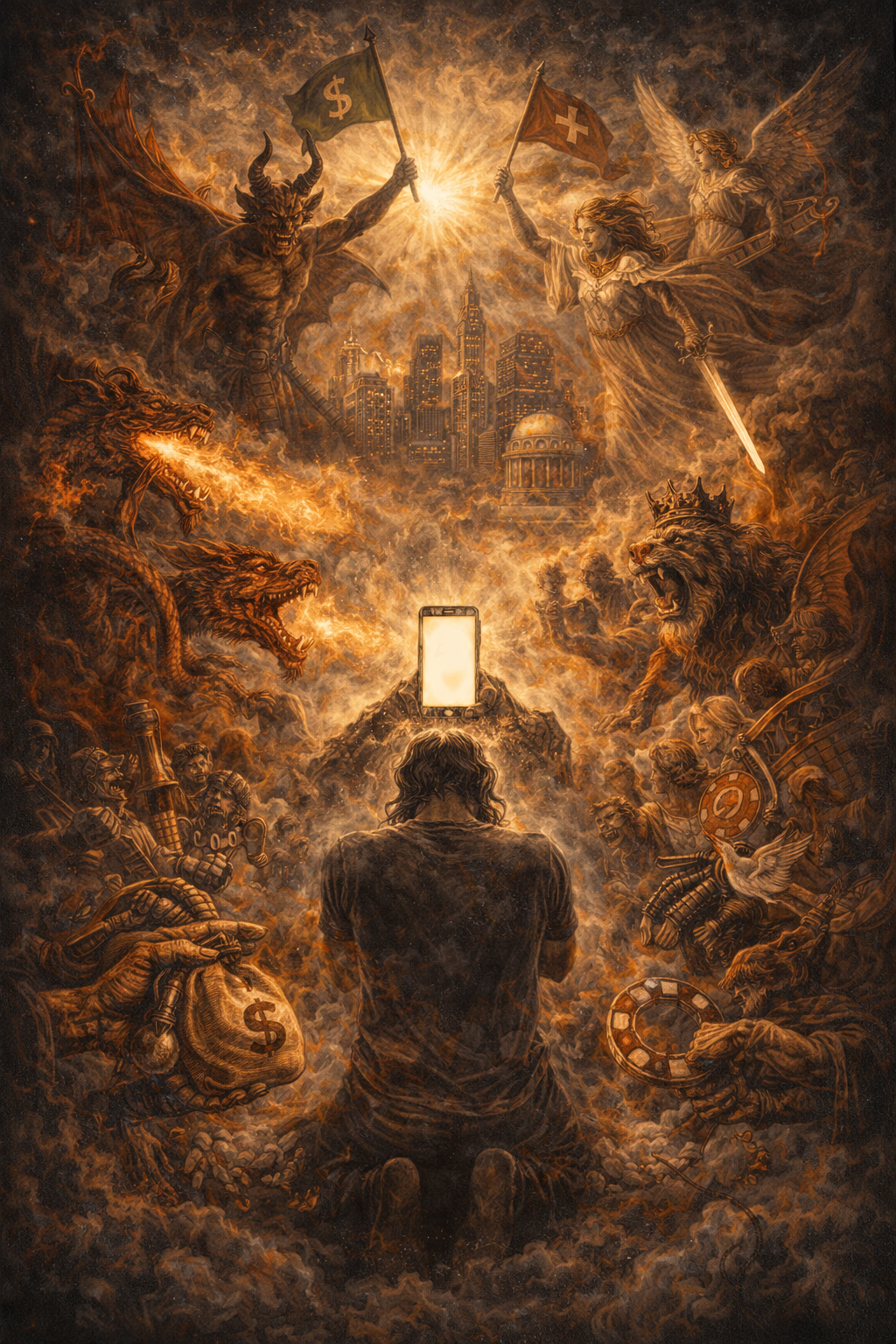
On the terrifying clarity of people who understood that empires demand everything, and that what we look at, we become
I. The Question Under the Symbols
The Book of Revelation is wild. Multi-headed beasts rising from the sea. A woman riding a dragon, drunk on blood. Seven seals, seven trumpets, seven bowls of wrath. Numbers that tormented medieval monks and still generate YouTube conspiracy videos.
Most readers get lost in the puzzle. They want to decode the symbols: What does 666 mean? Who is the beast? When will this happen?
But the people who wrote and first read this text weren’t primarily interested in prediction. They were interested in survival—spiritual and physical—under conditions where a vast political-economic system had begun demanding what only God deserves.
The question Revelation asks is not what will happen? but who will you serve when it costs you everything?
That question turns out to be timeless. And the ancient people who asked it understood something about worship, attention, and the formation of the soul that we’ve largely forgotten.
II. You Become What You Worship
A thousand years before John wrote Revelation on the island of Patmos, the Hebrew psalmists had diagnosed the central mechanism of idolatry. Psalm 115 describes the gods of the nations:
“Their idols are silver and gold, the work of human hands. They have mouths, but do not speak; eyes, but do not see. They have ears, but do not hear; noses, but do not smell. They have hands, but do not feel; feet, but do not walk; and they do not make a sound in their throat.”
Then comes the devastating punchline:
“Those who make them become like them; so do all who trust in them.“
Read that again. The psalmist isn’t just mocking lifeless statues. He’s articulating a law of spiritual physics: you become what you worship. Give your attention and devotion to something blind, and you go blind. Trust in something deaf, and you lose the capacity to hear. Serve something that cannot feel, and you become numb.
Psalm 135 repeats the formula:
“Those who make idols are like them—absolutely worthless—spiritually blind, deaf, and powerless. So is everyone who trusts in and relies on them.”
This is not metaphor. It’s diagnosis. Whatever you orient your life around, whatever you treat as ultimate, whatever you give your sustained attention to—that thing will reshape you in its image.
The Hebrew prophets saw this everywhere. Israel worshipped Baal, the storm god associated with fertility and agricultural prosperity—and became obsessed with material security. They worshipped Molech, the god who demanded child sacrifice—and became capable of sacrificing their own children. The worship didn’t stay external. It colonized them from within.
Isaiah’s satire makes the absurdity vivid. He describes a man who cuts down a tree:
“Half of it he burns in the fire. Over the half he eats meat; he roasts it and is satisfied. Also he warms himself and says, ‘Aha, I am warm, I have seen the fire!’ And the rest of it he makes into a god, his idol, and falls down to it and worships it. He prays to it and says, ‘Deliver me, for you are my god!’”
The same wood that warms his hands becomes his god. The absurdity is the point. But something darker lurks: humans cannot not worship. We are built for it. The question is never whether we will give ultimate devotion to something, but what will receive it.
III. The Beast That Demands Everything
When John of Patmos receives his apocalyptic visions near the end of the first century, Rome is the most sophisticated political-economic system the world has ever seen. Roads connect the empire. A common currency facilitates trade. The Pax Romana has brought unprecedented stability.
But Rome has also developed something new: the imperial cult. The emperor is not merely a political ruler. He is dominus et deus—Lord and God. His image appears on coins, in temples, at civic gatherings. To participate in Roman society—to join trade guilds, attend festivals, conduct business—increasingly requires offering a pinch of incense to the emperor’s image, acknowledging him as divine.
This is the historical background of Revelation’s beasts. The first beast rises from the sea, receiving authority from the dragon:
“And they worshiped the dragon, for he had given his authority to the beast, and they worshiped the beast, saying, ‘Who is like the beast, and who can fight against it?’”
The question on everyone’s lips—”Who can fight against it?”—expresses the overwhelming sense of Rome’s inevitability. The empire simply is. Resistance seems not just futile but unthinkable.
Then comes the second beast, which exercises the first beast’s authority and performs signs to deceive:
“Also it causes all, both small and great, both rich and poor, both free and slave, to be marked on the right hand or the forehead, so that no one can buy or sell unless he has the mark, that is, the name of the beast or the number of its name.”
The economic dimension is crucial. The mark isn’t just religious—it’s commercial. Without it, you cannot participate in the marketplace. You cannot buy food. You cannot sell your labor. You are cut off from the system that sustains material life.
This wasn’t science fiction for Revelation’s first readers. It was Thursday. Trade guilds in Asia Minor required participation in festivals honoring Rome and the emperor. Pliny the Younger, governing a nearby province around 110 CE, described his method for testing suspected Christians:
“Those who denied that they were or had been Christians... called upon the gods at my dictation and did reverence, with incense and wine, to your image, which I had ordered to be brought forward for this purpose, together with the statues of the deities; and especially because they cursed Christ, a thing which, it is said, genuine Christians cannot be induced to do.”
There it is. The test of loyalty. Offer incense to the emperor’s image. Curse Christ. If you comply, you can return to normal life. If you refuse, you face execution.
Pliny notes, almost casually, that Christians refused: “Genuine Christians cannot be induced to do” this. The word translated “genuine” implies something like real, authentic, uncompromised. To be genuinely Christian was to refuse the mark, whatever the cost.
IV. Babylon and the Intoxication of Wealth
Revelation doesn’t only depict political power demanding worship. It depicts economic power doing the same thing—and shows how the two interlock.
Babylon the Great appears as a woman “arrayed in purple and scarlet, adorned with gold and jewels and pearls”:
“For all nations have drunk of the wine of the wrath of her fornication, and the kings of the earth have committed fornication with her, and the merchants of the earth have become rich through the abundance of her luxury.”
The metaphor is intoxication. The nations are drunk. The merchants have grown rich. Kings and commerce are entangled in a system of mutual benefit—luxury flowing to elites, loyalty flowing to power. Everyone is compromised. Everyone is implicated.
When Babylon falls, who mourns? The merchants:
“And the merchants of the earth weep and mourn for her, since no one buys their cargo anymore, cargo of gold, silver, jewels, pearls, fine linen, purple cloth, silk, scarlet cloth, all kinds of scented wood, all kinds of articles of ivory, all kinds of articles of costly wood, bronze, iron and marble, cinnamon, spice, incense, myrrh, frankincense, wine, oil, fine flour, wheat, cattle and sheep, horses and chariots, and slaves, that is, human souls.”
Notice how the list ends. The luxury trade—gold, silk, spices—culminates in “slaves, that is, human souls.” The Greek phrase is sōmatōn kai psychas anthrōpōn: bodies and souls of humans. The economic system that intoxicates the world with luxury ultimately traffics in persons.
John sees what the psalmists saw, but at imperial scale: the system reshapes those who serve it. Nations become drunk. Merchants become dealers in human souls. The worship of wealth leads to the commodification of everything, including people.
V. Why Symbols? Why Apocalyptic?
Why doesn’t John just say “Rome is bad” and be done with it? Why the dragons and beasts, the coded numbers and cosmic warfare?
Because he’s doing something more sophisticated than criticism. He’s reshaping how his readers see reality.
Political power presents itself as natural, inevitable, permanent. “Who is like the beast? Who can fight against it?” The empire’s propaganda—its coins, its temples, its games, its roads—all communicate the same message: this is how things are. This is how things will always be. Resistance is not only futile but literally unimaginable.
Apocalyptic literature tears the veil off that illusion. It reveals the empire not as natural order but as a monster fed by a dragon. It shows the merchants’ prosperity not as earned success but as complicity in trafficking human souls. It depicts the “eternal” city as a whore destined for burning.
This is rhetorical technology designed for survival under surveillance. If you write “Emperor Domitian is a tyrant who should be overthrown,” you get arrested and executed. If you write about a beast with seven heads rising from the sea whose number is 666, you’ve created a text that strengthens resistance while remaining ambiguous enough to survive.
But the ambiguity serves another purpose: it makes readers work. You can’t passively consume Revelation. You have to decode, interpret, apply. That process of interpretation becomes itself a form of resistance—training the mind to see through empire’s self-presentation to the spiritual reality beneath.
The symbols are pressure tests. They ask: Can you see the beast when it presents itself as benefactor? Can you recognize Babylon when she offers you wine? Can you refuse the mark when refusal means you cannot buy bread?
VI. The Seal and the Mark
Revelation presents two competing forms of identification: the mark of the beast and the seal of God.
The mark appears on the forehead or right hand—traditionally associated with thought and action. Accept the beast’s authority in what you think and what you do, and you can participate in the economy. Refuse, and you’re cut off.
But God’s servants also receive a mark. Before the destructive winds are released, an angel cries:
“Do not harm the earth or the sea or the trees, until we have sealed the servants of our God on their foreheads.”
Two seals. Two allegiances. Everyone is marked by something.
The imagery may recall Deuteronomy’s instruction that Israel should bind God’s commandments “as a sign on your hand and as frontlets between your eyes”—the origin of Jewish tefillin. Your identity, your allegiance, is supposed to be written on how you think and how you act.
Revelation universalizes this. There is no neutral territory. Every person is being claimed by something. The question is not whether you’ll be shaped but by what.
One commentator puts it directly:
“We become like what we worship—either for ruin or restoration.”
Worship the beast and you become beastly. Worship the Lamb—the slaughtered yet standing figure who conquers through sacrifice rather than domination—and you become... something else.
VII. The Relevance of Total Demand
Here is what those ancient people understood: institutional power tends toward totality. It begins by asking for compliance. It ends by demanding worship. It starts as a system you participate in; it becomes a system that participates in you.
Rome didn’t begin by requiring emperor worship. It began as a republic. Over centuries, power concentrated. Augustus was cautious—he allowed divine honors outside Rome but discouraged them in the capital. Later emperors were less modest. By Domitian’s time (81-96 CE), the expectation that citizens would acknowledge the emperor as Lord and God had become nearly universal, and the consequences for refusal had become severe.
The trade guilds of Asia Minor didn’t begin as instruments of religious conformity. They began as professional associations. But participation in guild life meant participation in guild festivals, and those festivals honored Rome and its gods. To withdraw from the festivals was to withdraw from economic life. The seemingly secular had become inextricably religious.
This pattern recurs. Systems that begin as tools become masters. Technologies that begin as servants become lords. Economic arrangements that begin as conveniences become necessities. And at each step, the system asks for a little more: compliance, conformity, silence, and finally, devotion.
David Foster Wallace, in his 2005 commencement address—not an ancient text, but speaking from the same tradition—put it plainly:
“In the day-to-day trenches of adult life, there is actually no such thing as atheism. There is no such thing as not worshipping. Everybody worships. The only choice we get is what to worship.”
And then the warning:
“If you worship money and things, if they are where you tap real meaning in life, then you will never have enough, never feel you have enough. It’s the truth. Worship your body and beauty and sexual allure and you will always feel ugly. Worship power, you will end up feeling weak and afraid, and you will need ever more power over others to numb you to your own fear.”
This is Psalm 115 in modern dress. Those who worship these things become like them. Worship insufficiency and you become insufficient. Worship power and you become afraid. The objects of worship reshape the worshipper.
Wallace adds something crucial: “The insidious thing about these forms of worship is not that they’re evil or sinful, it’s that they’re unconscious. They are default settings. They’re the kind of worship you just gradually slip into, day after day.”
VIII. The Formation of Attention
What you look at, you become. What you give your attention to shapes you.
The ancients understood this as spiritual law. Modern psychology has rediscovered it as neural fact: attention literally rewires the brain. Habitual thought patterns carve channels that become increasingly difficult to redirect. What you practice, you strengthen. What you neglect, atrophies.
Revelation’s call to “come out of Babylon” is not primarily about geography. It’s about attention. It’s about withdrawing the devotion that Babylon demands and redirecting it toward what actually deserves it.
The letters to the seven churches that open the book illustrate the varieties of compromise. Ephesus has lost its first love—the fervor has faded into routine. Pergamum tolerates teachings that lead to idolatry and immorality. Thyatira allows a false prophet to seduce servants into eating food sacrificed to idols. Sardis has a reputation for being alive but is actually dead. Laodicea is lukewarm—neither hot nor cold—materially wealthy but spiritually impoverished.
Each letter diagnoses a particular way that attention has drifted, devotion has diluted, worship has wandered. The remedy is always the same: “To the one who conquers...”
Conquering, in Revelation, doesn’t mean military victory. The Lamb conquers by being slain. The saints conquer “by the blood of the Lamb and by the word of their testimony, for they loved not their lives even unto death.” Victory is redefined as faithfulness under pressure, witness maintained even when it costs everything.
IX. What We Look At, We Become
A final synthesis.
The ancient Hebrews understood that humans are worshipping creatures who become like what they worship. The psalmists saw this in individuals and nations bowing to lifeless idols. The prophets saw it in Israel’s absorption of Canaanite values along with Canaanite gods.
The early Christians, living under Rome’s shadow, saw the same dynamic at imperial scale. The political-economic system didn’t just demand compliance—it demanded devotion. It didn’t just want your taxes—it wanted your incense. It didn’t just control your body—it aimed to control your soul.
Revelation’s wild symbols were designed to break the spell. To reveal the beast beneath the benefactor. To show that Babylon’s wine was intoxicating but poisonous. To make visible the invisible claim that the system was making on every person: Worship me, and I will give you access. Refuse, and you will be cut off.
The mechanism hasn’t changed. Contemporary systems of economic and political power still tend toward totality. They still demand not just compliance but loyalty, not just participation but devotion. They still reshape those who serve them, making worshippers into images of the worshipped.
What you give your attention to will form you. What you orient your life around will become your god, whether or not you use religious language. What you sacrifice for reveals what you actually worship, regardless of what you profess.
The ancient wisdom holds:
“Those who make them become like them; so do all who trust in them.”
Whatever “them” is.
The only question is whether you’ll choose your worship consciously, or drift into it by default—gradually slipping into the shape of whatever has captured your attention, while the beast rises from the sea and asks, Who can fight against it?
And somewhere, on an island in the Aegean, a voice answers: The Lamb. The Lamb who was slain. The one who conquers not through domination but through sacrifice.
Choose your worship carefully. You will become what you behold.