The Incomplete God: Why Science Cannot Ground Itself
Published 2025-12-21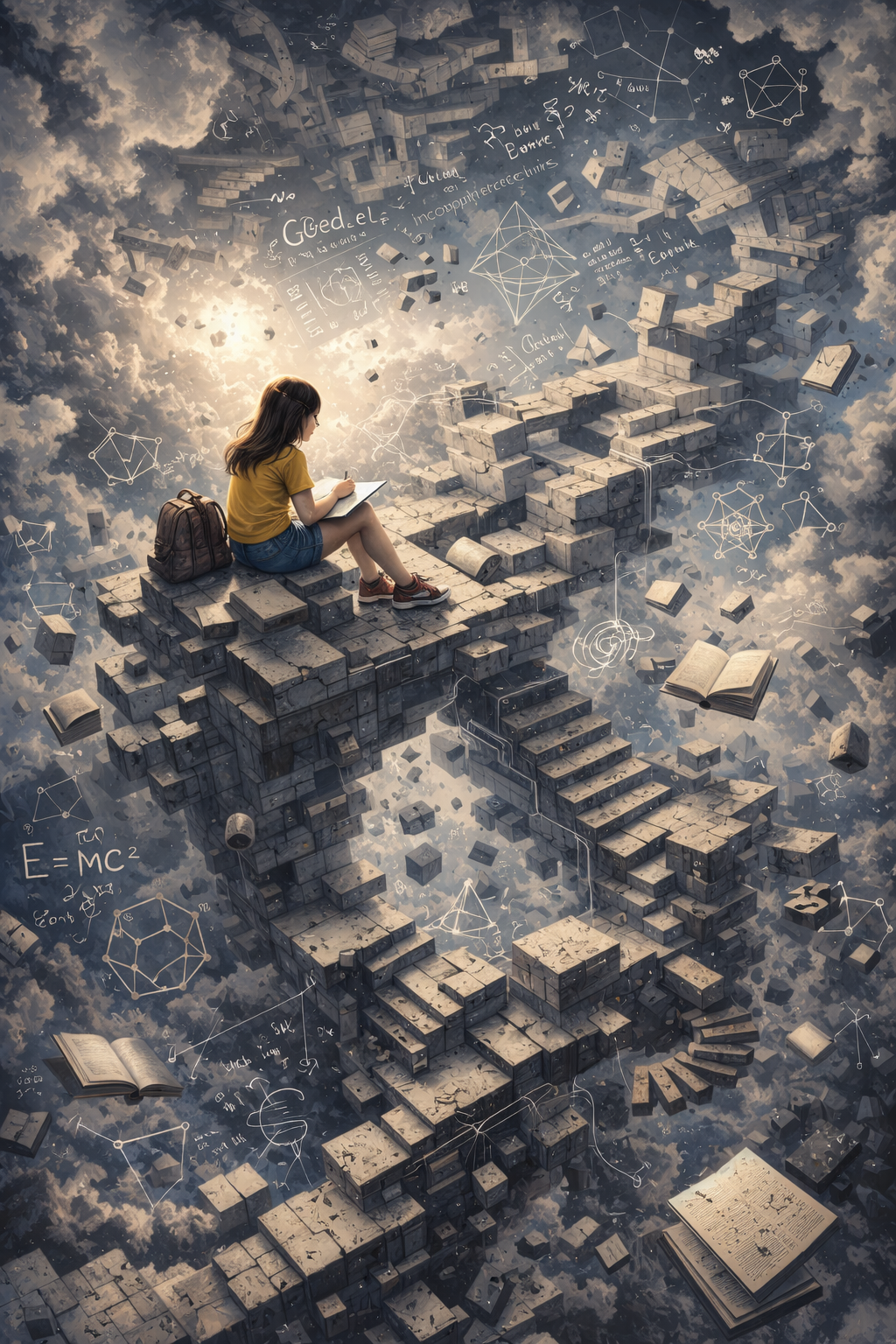
The Dream of Total Knowledge
The most ambitious vision of modernity is not merely that science is useful, or even that it is our best method for understanding nature. It is that science is, in principle, the only legitimate form of knowledge—that all genuine questions will eventually yield to its methods, and that domains currently outside its reach (ethics, meaning, consciousness, beauty) are simply territories not yet conquered.
This view, sometimes called scientism, holds that a completed physics would be a completed metaphysics. Give us the fundamental particles, forces, and laws, and everything else follows: chemistry reduces to physics, biology to chemistry, psychology to neuroscience, ethics to evolutionary psychology, meaning to function. The gaps we experience now—our inability to derive ought from is, to explain consciousness, to predict complex systems—are merely computational and empirical inconveniences. The God of classical theism has been replaced by a God-in-waiting: the final theory, the complete description, the view from nowhere that sees everything.
This essay argues that this vision is not merely incomplete in practice but impossible in principle. The limits I will describe are not gaps to be filled but boundaries built into the structure of formal systems, computation, and knowledge itself. Science cannot be its own ground. The dream of total knowledge contains a fatal reflexivity at its core.
And if this is true, then epistemic pluralism—the recognition that different domains require different modes of knowing—is not a retreat from reason but its mature expression.
I. The Formal Limit: Gödel’s Shadow
In 1931, Kurt Gödel proved two theorems that shattered the foundations of early twentieth-century mathematics. The ambition of that era, embodied in Russell and Whitehead’s Principia Mathematica and Hilbert’s program, was to place all of mathematics on a secure, self-contained, self-validating formal foundation. Gödel showed this was impossible.
His First Incompleteness Theorem demonstrates that any consistent formal system powerful enough to express basic arithmetic will contain true statements that cannot be proven within that system. His Second Incompleteness Theorem shows that such a system cannot prove its own consistency using only its own methods.
The implications are profound. If “completed science” is imagined as a formal system—a set of axioms, definitions, and inference rules from which all truths about reality can be derived—then Gödel’s results apply. Such a system cannot establish its own validity from within. It cannot answer the question “Is this system consistent?” using only its own resources. There is always an outside that the system cannot capture.
This is not a technical curiosity. It means the scientistic dream of a self-contained, self-validating description of reality is formally impossible. As Gödel himself noted:
“Either mathematics is too big for the human mind, or the human mind is more than a machine.”
The either/or is telling. If the mind is a formal system, then there are truths it cannot reach. If it can reach them, it is not merely formal. Either way, the totalizing vision fails.
Some will object: Gödel’s theorems apply to formal systems, and science is empirical, not merely formal. But this misses the point. The vision of completed science requires that all truths be derivable from fundamental laws. The derivation is formal. The laws, however empirically discovered, function as axioms. The incompleteness bites.
II. The Computational Limit: Irreducibility and Undecidability
Grant, for the sake of argument, that we have the fundamental laws. Grant complete knowledge of initial conditions. Can we now predict everything?
No. And the limits here are again principled, not practical.
Turing’s Halting Problem (1936) demonstrates that there is no general algorithm that can determine whether an arbitrary program will halt or run forever. This is not a gap in our current knowledge; it is a proven impossibility. There are well-posed questions that no computation can answer.
Computational irreducibility, articulated by Stephen Wolfram, extends this insight. Many systems—cellular automata, chaotic dynamics, complex adaptive systems—can only be “understood” by running them. There is no shortcut that compresses the computation, no equation that leaps to the outcome. The only way to know the future state is to simulate every intermediate step.
Consider what this means for the dream of predictive science. To perfectly predict a complex system—an economy, an ecosystem, a human life—you would need a simulation running at least as fast as reality itself. At that point, you have not gained predictive power; you have merely duplicated reality. You watch the simulation unfold just as you would watch the world unfold. The “prediction” gives you nothing.
Worse: if the system you wish to predict includes yourself (as any complete science must), then you need a simulation that includes the simulator. And if your predictions influence your actions, which influence the world, which feeds back into your predictions... you have entered a hall of mirrors. The model cannot run faster than reality because it is reality.
Wolfram puts it directly:
“Computational irreducibility means that, in effect, the only way to find the outcome is to trace through each step in the evolution—so that there is no way to reduce the amount of computational work required.”
The scientistic vision requires that complexity be in principle compressible. Irreducibility shows it is not.
III. The Observer Problem: Schrödinger’s Subject
The third limit is more subtle but equally devastating: the observing subject cannot appear within the scientific picture as subject.
Science describes the world in objective, third-person terms. It gives us mass, charge, position, wavelength—properties that can be measured and quantified from outside. But the scientific enterprise is conducted by subjects: beings who observe, measure, interpret, and understand. The question is whether the subject can be fully captured by the objective description.
Erwin Schrödinger, one of the founders of quantum mechanics, argued it cannot:
“The scientific picture of the real world around me is very deficient. It gives a lot of factual information, puts all our experience in a magnificently consistent order, but it is ghastly silent about all and sundry that is really near to our heart, that really matters to us... it knows nothing of beautiful and ugly, good or bad, God and eternity. Science sometimes pretends to answer questions in these domains, but the answers are very often so silly that we are not inclined to take them seriously.”
But Schrödinger went further. He noted that the subject of experience—the “I” that observes and knows—never appears within the scientific picture:
“The reason why our sentient, percipient and thinking ego is met nowhere within our scientific world picture can easily be indicated in seven words: because it is itself that world picture.”
The eye that sees does not appear in the field of vision. The scientific world-picture is constructed by a subject it cannot accommodate as subject. When neuroscience studies the brain, it produces a third-person description of neural activity. But someone is reading that description, understanding it, experiencing it as meaningful. That someone is presupposed, never explained.
Thomas Nagel made the point vivid in “What Is It Like to Be a Bat?” We can know everything about bat echolocation—the frequencies, the neural processing, the behavioral outputs—and still not know what it is like to be a bat navigating by sonar. The qualitative, first-person character of experience is not captured by even a complete objective description.
This is not mysticism. It is pointing to a categorical distinction: third-person descriptions and first-person experience are different in kind. Science gives us the former. It cannot, in principle, deliver the latter. And since the latter is where we live—where we make decisions, find meaning, experience value—something essential remains outside the scientific picture.
IV. The Ground Beneath the Ground
At this point, a defender of scientism might retreat: “Fine, there are limits. But within its domain, science is the only reliable method. Everything else is guesswork, tradition, or wishful thinking.”
But this retreat concedes too much. For science does not stand on its own foundations. It presupposes a world of lived experience that it cannot fully articulate.
Edmund Husserl called this the Lebenswelt—the lifeworld of pre-theoretical experience. Before you have wavelengths, you have colors. Before you have neuroscience, you have desire and fear. Before you have physics, you have the sun rising, water flowing, stone resisting. The scientific world is an abstraction from this primary world, not a replacement for it.
The abstraction is powerful. But it remains an abstraction. When you return from the laboratory, you do not experience the world as particles and fields. You experience it as meaningful, textured, valenced—a world of tools and obstacles, friends and strangers, beauty and ugliness. Science has no account of how to get from the abstract description back to the lived world. It borrows from that world constantly and repays it never.
Michael Polanyi called this dependence tacit knowledge: “We know more than we can tell.” The scientist relies on skills, judgments, and intuitions that cannot be fully formalized. She knows when an experiment “feels right,” when a result is “surprising,” when a theory is “elegant.” These are not decorations on the science; they are essential to its practice. Yet they resist the explicit, propositional form that science demands of its products.
If science rests on foundations it cannot articulate, then it cannot claim to be the only form of knowledge. It is, at best, one mode among others—dependent on modes it dismisses.
V. The Meaning of Total Knowledge
Suppose, per impossibile, that the objections above could be overcome. Suppose we had the completed science, the final theory, the view from nowhere. What would we have?
Jorge Luis Borges explored this in “The Library of Babel”—a universe consisting of a library containing every possible 410-page book. Every truth is there. So is every falsehood. Every coherent argument and every incoherent rambling. The library contains everything and therefore tells you nothing. Without selection, without curation, without interpretation, total information is total noise.
In “Funes the Memorious,” Borges gives us a man with perfect memory. Funes remembers everything: every leaf on every tree, every moment of every day. And he cannot think. To think is to abstract, to generalize, to forget the irrelevant. Funes, drowning in particulars, cannot form a general idea. He knows everything and understands nothing.
These are parables, but they point to a truth the scientistic vision ignores: more knowledge is not automatically better knowledge. The meaningful emerges through selection, interpretation, judgment—precisely the acts that cannot be automated or formalized. A completed science, even if it were possible, would be a library of everything. It would not tell you what to read.
VI. The Agent Who Cannot Act
There is a final limit, perhaps the deepest. It concerns agency.
If the completed science predicts my actions perfectly—if it knows what I will do before I do it—then in what sense do I act? I become a site where causation happens, not an agent who chooses. The prediction is not available to me (for if it were, and I could act on it, the prediction would be false). I am opaque to myself in exactly the way I would need to be transparent to be fully explained.
Dostoevsky’s Underground Man confronts this directly. He imagines the Crystal Palace of reason, where science has calculated the optimal action for every situation:
“You see, gentlemen, reason is an excellent thing... but reason is nothing but reason and satisfies only the rational side of man’s nature, while will is a manifestation of the whole life... And although our life, in this manifestation of it, is often worthless, yet it is life and not simply extracting square roots.”
The Underground Man declares he would smash the Crystal Palace just to prove he could—not because destruction is rational, but because the capacity for the irrational is the signature of genuine agency. If you can predict my action completely, I am not acting; I am executing. The subject disappears into the system.
This is not an argument for irrationalism. It is an observation about the structure of agency. To be an agent is to be, in some measure, opaque to any external description. The moment I become fully transparent to prediction, I cease to be the author of my actions. I become merely their locus.
Conclusion: The Plural Ways of Knowing
None of the foregoing suggests that science is wrong, or useless, or to be abandoned. Science remains our best method for understanding the natural world, for predicting and manipulating physical systems, for testing claims against evidence. The critique is not of science but of scientism—the ideological claim that science is the only legitimate form of knowledge.
That claim fails, and fails for reasons internal to the sciences themselves. Formal systems cannot ground themselves. Computation faces irreducibility. The subject cannot be made fully object. Science rests on a lifeworld it cannot articulate. Total knowledge would not be knowledge but noise. And agency requires a residue of opacity to any complete description.
What follows is not irrationalism but epistemic pluralism: the recognition that different domains call for different modes of knowing. Science for what science handles well—the measurable, the repeatable, the formally describable. Tradition for the accumulated wisdom of how to live. Art for the qualitative, the particular, the “what-it-is-like.” Philosophy for the concepts that frame our inquiries. Religion, at its best, for the encounter with limit, mystery, and the questions that remain when all the answers are in.
The monotheism of scientism—the insistence that only one mode of knowing is valid—is as distorting as the monotheism it replaced. It produces a world that is, in Schrödinger’s word, “ghastly silent” about what matters most. The remedy is not to abandon science but to restore it to its proper place: one god among many in the pantheon of human understanding.
And perhaps, in the end, the sign of intellectual maturity is precisely this: the recognition that no single lens shows you everything, and that the demand for a single lens is itself a kind of blindness.