What Modernity Needs: A Return to Polytheism
Published 2025-12-21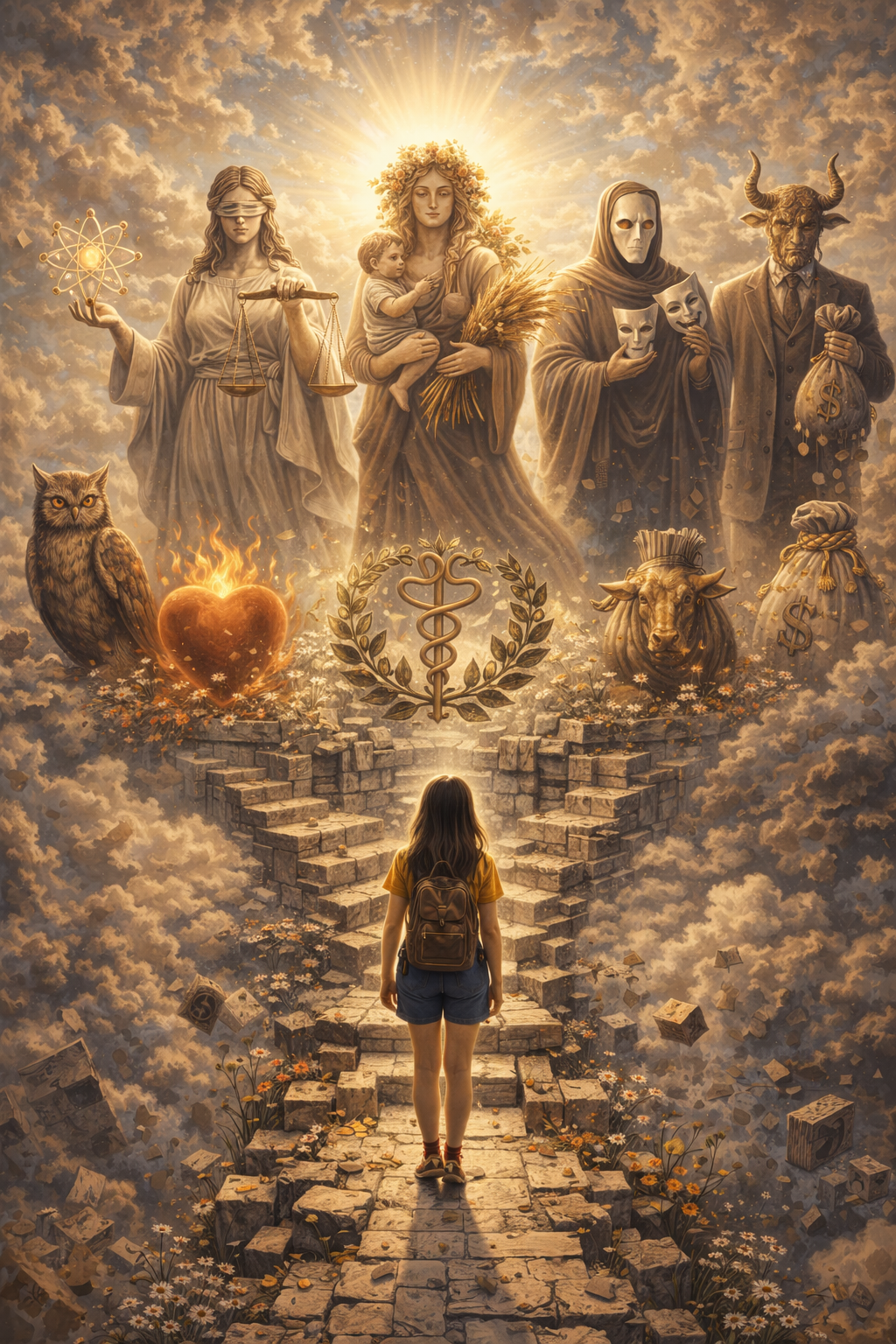
Introduction: The Shape of a Solution
The first essay traced the genealogy of our crisis—how the technological-materialist worldview reduced being to standing reserve and made liquid modernity possible. The second essay presented the evidence: rising mental illness, epidemic loneliness, collapsing fertility, dissolving community. Both converged on a troubling conclusion: the current configuration is self-terminating, but no clear path of escape exists.
This essay proposes a way forward. Not a program, not a policy, not an ideology—but a reorientation of how we perceive obligation itself. The argument: our crisis stems from a centuries-long attempt to reduce the plural goods of human life to a single metric. The correction requires recovering the capacity to hold multiple, incommensurable obligations simultaneously.
The name for this capacity, borrowed from an older vocabulary, is polytheism.
This is not a proposal to worship Zeus. It is a proposal to recognize what the polytheistic worldview understood and what monotheism—theological and secular—has trained us to forget: that human life involves irreducibly plural goods, that these goods make competing claims on us, that the competition cannot be resolved by reducing all values to one, and that the attempt to escape this tension is itself the source of our pathology.
Part I: The Monotheistic Trap
One God, One Metric
The triumph of monotheism—first theological, then scientific, then economic—trained Western civilization to seek unity behind plurality. One God created the world. One set of laws governs nature. One framework should organize society.
The monotheistic impulse doesn’t manifest as literal single-metric optimization in every domain—engineers trade off dozens of constraints, scientists work across incommensurable paradigms, even businesses balance competing objectives. We’re competent pluralists in narrow professional contexts.
What monotheism trained us to expect is unity at the level of worldview. One framework should tell us how to live. One metric should capture national success (GDP, invariably). One political orientation should be simply correct. The product manager who deftly balances six competing objectives becomes, in her philosophical and political life, a monotheist seeking the One True Position.
This shows up most clearly where optimization thinking escapes its proper bounds: social media platforms maximizing engagement regardless of what’s being engaged with; economic policy treating GDP growth as self-evidently good; self-help promising you can “have it all” through correct optimization. The damage isn’t single-metric thinking per se—sometimes that’s appropriate. The damage is losing the capacity to recognize when it has exceeded its scope.
But the same impulse, applied to human life, becomes catastrophic. Because human flourishing involves multiple goods that cannot be collapsed into a single currency without destroying them.
Consider what happens when you measure everything in money:
-
Children become cost centers. The economist’s question—”What is the ROI on a child?”—is coherent within the framework and monstrous outside it.
-
Elders become liabilities. They consume resources without producing. Efficient disposal becomes rational.
-
Forests become lumber inventories. The only question is when to harvest.
-
Relationships become network assets. Maintain them when useful; depreciate them when not.
-
Time becomes billable hours. Every moment has an opportunity cost measured against productive alternatives.
The reductionist sees no problem here. These translations make previously incommensurable goods commensurable—comparable on a single scale. This enables optimization. Optimization enables efficiency. Efficiency enables growth. Growth enables... what?
Here the reductionist falls silent, or gestures toward “human flourishing” as the ultimate end. But human flourishing was precisely what the reductions destroyed. You cannot optimize for flourishing by first eliminating everything that constitutes it.
The Secular Monotheisms
The theological origins of this impulse matter less than its secular descendants, which now dominate:
Scientific materialism posits that one set of physical laws explains everything. Consciousness, meaning, value—all must reduce to matter in motion or be dismissed as illusion. This is methodologically useful for physics and metaphysically disastrous for ethics.
Economic utilitarianism posits that one metric—utility, welfare, preference satisfaction—captures all value. Actions are right insofar as they maximize this quantity. The entire texture of moral life—obligations, virtues, sacred prohibitions—becomes instrumental calculation.
The optimization mindset posits that every domain of life can be improved through measurement, feedback, and iteration. Self-help, productivity culture, life-hacking—all apply engineering logic to the soul. The self becomes a project to be optimized rather than a gift to be received.
Each of these secular monotheisms promises what theological monotheism promised: serve the One (Science, Utility, Optimization), and everything else will be added unto you. Reduce the many to the one, and harmony will follow.
These are lies. The many do not reduce to the one without loss. Harmony does not follow from reduction. What follows is the pathology documented in the empirical essay: a civilization that cannot reproduce itself, that medicates its despair, that optimizes frantically while the substrate of meaning erodes beneath it.
Part II: The Polytheistic Correction
Many Gods, Many Goods
The polytheistic worldview began from a different premise: reality is irreducibly plural. Different domains of existence operate by different logics, make different demands, require different responses. There is no single principle behind everything. There is no final reconciliation.
The gods personified this plurality. Each god represented a domain of existence with its own claims:
-
Zeus: sovereignty, justice, hospitality to strangers
-
Hera: marriage, family continuity, legitimate succession
-
Apollo: reason, clarity, measure, prophecy
-
Dionysus: ecstasy, dissolution, the irrational, transformation
-
Athena: wisdom, craft, civilization, strategic intelligence
-
Artemis: wildness, the hunt, virginity, the untamed
-
Poseidon: the sea, earthquakes, horses, the inhuman depths
-
Demeter: agriculture, fertility, the cycle of seasons
-
Hestia: the hearth, domestic order, the center that holds
-
Hades: death, the underworld, what cannot be escaped
To honor one god was not to honor all. The gods competed, conflicted, made incompatible demands. Agamemnon could not satisfy both Artemis (who demanded his daughter’s sacrifice) and his role as father. Antigone could not satisfy both Creon’s law and the obligations owed to her dead brother. The tragic situation—where every choice betrays something sacred—was not a problem to be solved but a condition to be inhabited.
This is closer to lived experience than any monotheism. Life does involve competing obligations:
-
Career and family make incompatible demands on time.
-
Honoring tradition and pursuing innovation pull in opposite directions.
-
The claims of justice and the claims of mercy do not always align.
-
What reason recommends and what the heart demands may conflict.
The monotheistic promise—that these tensions resolve if you just serve the right One—is false. The tensions are structural. The tragedy is permanent. Maturity consists not in escaping the tension but in learning to hold it.
Obligation Without Belief
The proposal here is not that we should believe in Zeus, Apollo, or Dionysus as supernatural beings. The proposal is that we should recognize what the gods represented: domains of existence that make claims on us independent of our preferences, that cannot be reduced to a single metric, and that must be honored on their own terms.
Call them what you will—gods, values, sacred obligations, irreducible goods. The vocabulary matters less than the structure. What matters is recognizing that:
-
Multiple domains make claims on you. You owe something to your ancestors, your descendants, your community, the land, the truth, your own depth, the stranger, the dead.
-
These claims are incommensurable. You cannot convert your obligation to your parents into career units. You cannot trade environmental stewardship for personal convenience at some exchange rate. The goods do not translate.
-
The claims compete. Honoring one may require slighting another. Time spent with children is time not spent on work. Preserving tradition may impede necessary change. The tragic structure is real.
-
No final resolution exists. You cannot optimize your way out of the competition. There is no algorithm that harmonizes the gods. The tension is the condition.
-
Neglecting any domain produces pathology. Ignore the ancestors, and you lose continuity. Ignore the children, and you lose future. Ignore the wild, and you lose soul. Ignore reason, and you lose truth. Ignore ecstasy, and you lose depth. The gods take revenge when neglected.
This is not a religion. It requires no metaphysical commitment beyond what experience already reveals: that human life involves plural goods, that these goods conflict, and that the attempt to escape the conflict through reduction produces the very crisis we now face.
Part III: The Domains of Obligation
A Provisional Pantheon
What follows is not definitive but illustrative—a sketch of the domains that might constitute a contemporary recovery of plural obligation. Each domain represents a set of claims that cannot be reduced to the others, that must be honored on its own terms, and that exacts a price when neglected.
The Ancestors (Memory, Tradition, the Dead)
The obligation: Honor those who made you possible. Carry forward what they preserved. Do not let their sacrifices be forgotten.
What neglect produces: Rootlessness. The sense that you appeared from nowhere and owe nothing to anyone. The liquid self, infinitely malleable because connected to nothing.
What honor requires: Learning history. Maintaining traditions (even those you modify). Visiting graves. Telling stories. Acknowledging debts you cannot repay.
The monotheist reduction: The past is dead weight. Optimize for the future. “Move fast and break things.”
The Descendants (Children, Future, Legacy)
The obligation: Sacrifice for those who come after. Leave the world no worse than you found it. Accept that your meaning may lie in what you will never see.
What neglect produces: The demographic collapse documented in the empirical essay. But also: environmental destruction, institutional decay, short-term thinking in all domains. If no one comes after, why maintain anything?
What honor requires: Having children, or supporting those who do. Environmental stewardship. Building institutions that outlast you. Planting trees whose shade you will never enjoy.
The monotheist reduction: Children are lifestyle choices. The future will solve its own problems. Discount rates make long-term investment irrational.
The Elders (Care, Wisdom, Continuity)
The obligation: Care for those who cared for you. Receive the wisdom that only age confers. Provide the continuity that only presence enables.
What neglect produces: The warehousing of the old in institutions. The loss of intergenerational transmission. The cult of youth that leaves everyone terrified of aging.
What honor requires: Proximity. Patience. Listening to stories you’ve heard before. Accepting that efficiency is not the highest value in care.
The monotheist reduction: Elders are unproductive. Professional care is more efficient than family care. Optimize for quality-adjusted life years.
The Wild (Nature, the Untamed, Artemis)
The obligation: Preserve what you did not create. Acknowledge that the non-human has claims independent of human utility. Maintain spaces where the wild persists.
What neglect produces: Ecological collapse, obviously. But also: the loss of the experience of wildness, which is irreplaceable for the human soul. The world becomes entirely artifact.
What honor requires: Preservation. Restraint. Accepting limits on human expansion. Visiting wild places with humility rather than conquest.
The monotheist reduction: Nature is resource. Optimize extraction. What cannot be monetized does not exist.
The Hearth (Home, Domesticity, the Center)
The obligation: Tend the space where life happens. Create stability amid flux. Maintain the center that allows departure and return.
What neglect produces: Homelessness—not just literal but spiritual. The sense that nowhere is yours, that you are always passing through, that no place holds you.
What honor requires: Making home. Cooking meals. Maintaining rituals. Staying put long enough to belong.
The monotheist reduction: Home is hotel between work shifts. Rootedness is inefficiency. The global nomad is the ideal.
Reason (Truth, Clarity, Apollo)
The obligation: Pursue truth even when uncomfortable. Submit to logic even when it contradicts desire. Maintain clarity against the seductions of confusion.
What neglect produces: Post-truth. Motivated reasoning. The collapse of shared reality into tribal narratives.
What honor requires: Honesty. Rigor. Willingness to change your mind. Distinguishing what you want to be true from what is true.
The monotheist reduction: Reason is instrumental. Use it to get what you want. Rationality serves desire.
Ecstasy (The Irrational, Dionysus, Depth)
The obligation: Honor what exceeds reason. Allow dissolution, transformation, the depths. Do not reduce life to what can be calculated.
What neglect produces: Flatness. The gray world of pure optimization. Burnout. The achievement-subject who has forgotten what achievement was for.
What honor requires: Art. Music. Intoxication (of various kinds). Ritual. Experiences that shatter the managing ego.
The monotheist reduction: Irrationality is error. Optimize for measurable outcomes. Ecstasy is inefficiency.
Death (Mortality, Finitude, Hades)
The obligation: Face the end. Prepare. Do not live as if you will live forever, because the denial of death distorts everything.
What neglect produces: The terror that underlies the entire optimization project. If I just achieve enough, work enough, acquire enough—maybe I won’t die? The denial of death drives the frantic accumulation that destroys life.
What honor requires: Contemplation of mortality. Funerals attended, not avoided. Wills written. Conversations about the end. The memento mori that gives life shape.
The monotheist reduction: Death is medical failure. Extend life indefinitely. Freeze the body. Upload the mind. Deny, deny, deny.
The Stranger (Hospitality, the Other, Zeus Xenios)
The obligation: The stranger has claims on you. Hospitality is sacred. The other is not merely instrumental.
What neglect produces: Tribalism. The inability to recognize humanity outside your group. The reduction of the stranger to threat or resource.
What honor requires: Welcome. Generosity beyond calculation. Recognition that you too are a stranger somewhere.
The monotheist reduction: The stranger is a market transaction. What can they do for me? Optimize the network for utility.
Part IV: The Doorways
Meeting People Where They Are
The challenge: how do you reach people who have been formed entirely within the monotheistic-reductionist framework? Who have optimized away their obligations, medicated their discomfort, and constructed identities around consumption and achievement?
You cannot argue them into obligation. The arguments only work for those who already sense what’s missing. But you can use what they already love as a doorway into larger obligation.
Everyone loves something. Even the most reduced consumer loves something—a pet, a place, a pleasure. These loves, however diminished, are threads that can be pulled. They open into obligation despite themselves.
The Pet Doorway
The childless person who loves their cat is not beyond reach. The love is real. And the love, if examined, contains more than the person may realize.
Pull the thread:
Where does cat food come from? Industrial agriculture, fishing, complex supply chains. The cat connects you to systems you didn’t choose and barely understand. What obligations arise from this dependency?
What does the cat replace? Often, the child. The demanding other who would have made claims the cat does not make. Why was the less-demanding substituted for the more-demanding? What was avoided?
What happens to your cat when you die? Mortality, continuity, legacy. The cat will outlive you or not. Either way, the relationship forces the question of time.
Why this cat and not another? Particularity. Attachment. The unrepeatable individual. You do not love “cats in general”; you love this cat. Why? What does this preference reveal about the nature of love?
The pet is a training wheel for obligation. You cannot fully instrumentalize a pet without betraying the relationship. The cat demands things—feeding times, attention, care when sick. These demands are obligations, however modest.
The move: Extend the logic. If you accept that you owe something to your cat, what about the species? What about the ecosystem that supports the species? What about the future in which cats (and their ecosystems) exist? What about other beings who might make claims on you?
Stewardship enters through affection. The person who will not accept abstract environmental obligation may accept it for the sake of what they already love.
The Tourism Doorway
The Instagram tourist who travels to consume beauty is not beyond reach either. The love of beauty is real. And beauty, if examined, reveals depths the consumer may not have intended.
Pull the thread:
Why is this place beautiful? Not accident. Geology, ecology, climate—and often, human stewardship over generations. The Alpine meadow is beautiful because it has been grazed in a particular way for centuries. The Japanese garden is beautiful because generations of gardeners tended it. Beauty is often the visible form of sustained care.
Who maintains it? Locals, rangers, communities, traditions, sometimes taboos. The picturesque village requires people who live there, who maintain the buildings, who keep the place alive. The tourist consumes what others produce.
What does your visit do to it? Erosion on the trails. Crowds that displace the atmosphere that drew you. Prices that push out locals. Pollution from travel. The Instagram-optimization of the place itself—as it gets photographed more, it gets modified to be more photogenic, and something real is lost.
Will it exist for those who come after? The temporal question. If everyone who loves this place visits it this way, the place will be destroyed. What does love require?
The move: Confront them with the underbelly of their pleasure. Not moralizing—showing. The bleached coral. The trash in the “pristine” waters. The displaced locals. The cruise ship effluent. The flight emissions.
Then ask: Do you want this place to exist, or just to have photographed it?
If they want it to exist—and most, when confronted honestly, do—they have admitted an obligation beyond their own experience. Now the conversation can turn to what that obligation requires. Stewardship enters through aesthetics.
The Medication Doorway
This is the hardest case. The person who has buffered themselves pharmacologically from the signals that would otherwise create discomfort. The point of the medication is to disable the alarm system.
But even here, threads can be pulled.
Pull the thread:
Why were you suffering? The medication treats symptoms. What produced the symptoms? Loneliness? Meaninglessness? The gap between what you’re doing and what you sense you should be doing? The symptom was information. What was it saying?
What does the medication allow you to tolerate? What previously intolerable conditions are you now tolerating? A job that violates your values? A relationship that diminishes you? A life structure that doesn’t fit? The medication enabled the continuation of something. What?
Is the absence of suffering the same as flourishing? Hedonic zero is not eudaimonic fulfillment. Not being depressed is not the same as being alive. The medication may be necessary, but is it sufficient?
Who are you when you’re not in pain? Identity, not just sensation. The unmedicated self was trying to tell you something. What was it? Does the medicated self know?
The move: Not “stop taking your meds”—that’s dangerous, often wrong, and misses the point. But rather: what was being medicated?
The symptom was a god knocking at the door. The medication drugged the doorman. But the god is still there. What did it want?
Perhaps the depression was the psyche’s response to meaningless work (neglect of the soul’s obligation to purpose). Perhaps the anxiety was the body’s response to rootlessness (neglect of the hearth). Perhaps the emptiness was the spirit’s response to the absence of the sacred (neglect of what cannot be optimized).
The medication manages the symptom. It does not answer the god.
Part V: From Nudge to Norm
What Can Be Done
You cannot legislate love. You cannot force people into obligation. But you can create conditions that make obligation more visible, more accessible, more socially supported. You can nudge toward the sacred.
Make Obligations Visible
Care footprints: We track carbon footprints. What about care footprints? Who raised you? Who educated you? Who will care for you when you’re old? Who are you caring for? Making these visible—as a social practice, not a regulation—reminds people of the web of obligation they already inhabit.
Stewardship tags: Every beautiful place photographed could carry a tag: What is required to maintain this? Who does the maintaining? What threatens it? Not to shame, but to inform. The consumer who sees what sustains beauty may become the steward who protects it.
Mortality reminders: The memento mori tradition, updated. Apps that count down remaining days. Estate planning normalized as a life-stage task. Death cafés where mortality can be discussed without morbidity. Facing the end changes how you inhabit the middle.
Create Rituals That Embody Plural Obligation
Modern life is ritual-poor. We have consumption rituals (holidays as shopping occasions) but few rituals that embody the obligations proposed here.
Ancestor rituals: Days of the Dead, adapted. Family meals where the dead are named. Photo displays, story-sharing, graveyard visits. Not supernatural belief—just honoring the chain that made you possible.
Coming-of-age rituals: Marking the transition into obligation. You are now old enough to owe something to others. What will you contribute? How will you serve? (Not “what do you want to be?” but “what will you give?”)
Seasonal rituals: Marking time’s passage and the obligations it carries. Solstice observances. Harvest acknowledgments. Rituals that connect human life to the larger rhythms.
Elder rituals: Marking the transition into a new phase, not a decline. The elder has obligations too—to transmit, to witness, to hold memory. What are they?
Design Environments That Force Encounter
Much of modern design minimizes friction—and friction is where obligation arises. Alternatives:
Mixed-age housing: Not retirement communities (age-segregated) but developments where young families, working adults, and elders share space. Children encounter the old. The old encounter children. Obligation becomes visible.
Third places: Not home, not work, but spaces where people encounter each other outside their roles. Cafés, parks, libraries, community centers. Designed to slow down, to encourage lingering, to make conversation possible.
Less mediation: Screens intermediate. Every interaction through a screen is an interaction where bodies are absent, where the full presence of the other is reduced. Design for more face-to-face. Accept the friction.
Tell Stories That Model Tragic Choice
Our dominant stories resolve tension. The hero gets the career and the family. Love conquers all. The right choice produces only good outcomes.
Polytheistic stories would be different. They would model what it looks like to face competing obligations and accept that every choice betrays something.
The Greek tragedies do this: Antigone, Agamemnon, Oedipus. Every choice costs. There is no path without loss. The question is not how to avoid tragedy but how to inhabit it with dignity.
Modern equivalents would show:
-
The parent who took the demanding job and missed the childhood, and the parent who stayed home and sacrificed the career—both honored, both having lost something
-
The person who preserved the family tradition and the person who broke it—both with reasons, both with costs
-
The community that prioritized economic growth and the community that prioritized preservation—both facing consequences, neither simply right
Stories that sit in the tension rather than resolving it. Stories that model how to live with plural obligation.
Use the Doorways They’ve Already Opened
As discussed above: pets, places, pleasures. Meet people where they are. Pull the threads they’ve already grasped. Don’t demand that they adopt a new framework—show them that the framework is implicit in what they already love.
Everyone who loves anything has already admitted that something beyond their preference matters. Build from there.
Part VI: The Political Theology
Beyond Left and Right
The left-right political spectrum is itself a monotheistic structure: one axis, one dimension, one set of positions arrayed from one pole to the other.
A polytheistic politics would recognize that multiple, incommensurable values make legitimate claims, and that these claims do not align on a single axis:
The claims of the past: Tradition, ancestors, conservation, continuity. What has been handed down has value. Change must justify itself. This is often coded as “right.”
The claims of the future: Children, sustainability, reform, progress. What will be must be considered. The present cannot mortgage the future. This is often coded as “left” (environmentalism) or “right” (concern for descendants).
The claims of the individual: Freedom, expression, self-determination. The person is not merely a function of collective identity. This is often coded as “libertarian.”
The claims of community: Solidarity, shared meaning, belonging, obligation. The individual is not prior to relationship. This is often coded as “communitarian.”
No existing party represents all these claims. Every party absolutizes one or two and neglects the others. The right neglects the future (climate) and the individual (social freedom). The left neglects the past (tradition) and community (in its deracinated cosmopolitan form). Libertarians neglect community and the claims of those who cannot compete. Communitarians risk neglecting the individual.
A polytheistic politics would aim at balance rather than victory. Not: “How do we defeat the other side?” but “How do we honor all the gods?”
This is essentially what pre-ideological politics attempted. Before the great ideologies promised a single solution to the human condition, politics was the art of balancing competing interests and values. We need to recover this art.
Implications
Institutional pluralism: Not one set of institutions for all purposes, but different institutional logics for different domains. Markets for some goods, commons for others, hierarchies for some purposes, networks for others. No single organizational form is appropriate everywhere.
Temporal pluralism: Policies that honor different time horizons. Some decisions should optimize for the present; others should be removed from present preferences to protect the future (environmental preservation) or the past (heritage, tradition).
Epistemic pluralism: Different ways of knowing for different domains. Science for what science handles well; tradition for what tradition handles well; art for what art handles well; religion for what religion handles well. The monotheism of scientism (only science produces knowledge) is as distorting as the monotheism it replaced.
Part VII: What This Could Look Like
Not a Utopia but a Practice
The polytheistic alternative is not a blueprint for a perfect society. It is a practice—a way of attending to plural obligation that any individual, community, or institution can adopt.
For the individual: Audit your obligations. Which gods are you serving? Which are you neglecting? What would it mean to honor the neglected domains without abandoning the ones you’re already serving? The practice is not perfection but attention—regularly asking whether the balance has gone wrong.
For the family: Create rituals that embody plural obligation. Meals that honor the dead. Conversations about mortality. Time in wild places. Service to the community. Encounters with elders and children. The family can be a school of polytheism, teaching the young that they are embedded in webs of obligation they did not choose.
For the community: Design for encounter. Create third places. Mix ages, classes, types. Establish local traditions that mark time and embody obligation. Resist the optimization pressure that would turn every community institution into an efficient service-delivery mechanism.
For the institution: Recognize that the institution serves multiple masters. A school serves students, families, tradition, knowledge, the future. A business serves customers, workers, community, environment, shareholders. The monotheistic demand to optimize for one (shareholder value, test scores) betrays the others. Pluralistic governance means keeping multiple goods in view.
For the polity: Balance rather than victory. Recognize that political opponents often serve gods you’re neglecting. The tension between tradition and reform, individual and community, past and future is not a problem to be solved but a condition to be navigated. Constitutional structures, checks and balances, federalism—these are polytheistic intuitions encoded in institutional form.
The Recovery of the Sacred
Underneath all of this is a claim: that some things are sacred, meaning that they cannot be traded off, cannot be reduced to utility, cannot be optimized away.
The sacred is what must not be profaned. It is the limit that optimization cannot cross without destroying something irreplaceable.
The gods, in the polytheistic vocabulary, mark these limits. Each god guards a domain. Each domain contains something sacred. To honor the god is to recognize the limit.
Modern society has profaned almost everything. Nothing is sacred; everything is resource. The result is the pathology documented in these essays: a civilization that has optimized itself into a corner, that produces measurable outputs and immeasurable misery, that cannot reproduce itself or explain why it should.
The polytheistic alternative is, at bottom, a recovery of the sacred—not as supernatural belief but as practical recognition that some things must not be reduced.
Conclusion: The Threads You Already Hold
You do not need to believe in gods to live polytheistically. You only need to recognize what you already know: that life involves plural obligations, that these obligations conflict, that the conflict cannot be resolved by reduction, and that neglecting any domain produces pathology.
The doorways are already open. Whatever you love—a pet, a place, a person, a practice—is a thread that leads into obligation. Pull it far enough, and you will find yourself enmeshed in a web of care that extends beyond your preferences, your convenience, your optimization targets.
The gods are patient. They do not require belief, only attention. They do not demand perfection, only acknowledgment. They have waited through the long monotheistic centuries. They are waiting still.
To honor them is not to turn back the clock—it is to recover a capacity that never entirely disappeared, that persists in every genuine love, every encounter with beauty, every moment of care for what cannot care for itself.
The threads are in your hands. You can drop them and return to the gray world of optimization, the endless measurement against receding standards, the achievement-subject burning itself out in pursuit of nothing it can name.
Or you can pull them—and find yourself, perhaps for the first time, at home in a world that makes demands on you.
Those demands are not a burden. They are the shape of a life.
This essay is the third in a series. The first, “The Liquefaction of Being,” traces the philosophical genealogy of the crisis. The second, “The Empirical Case Against Techno-Modernity,” presents the evidence. Together, they form an argument: that the technological-materialist reduction of human life to standing reserve has produced measurable pathologies that threaten civilizational continuity—and that the way forward requires recovering the capacity for plural obligation that modernity destroyed.