Leftism Is Worse Than Fascism
Published 2026-01-09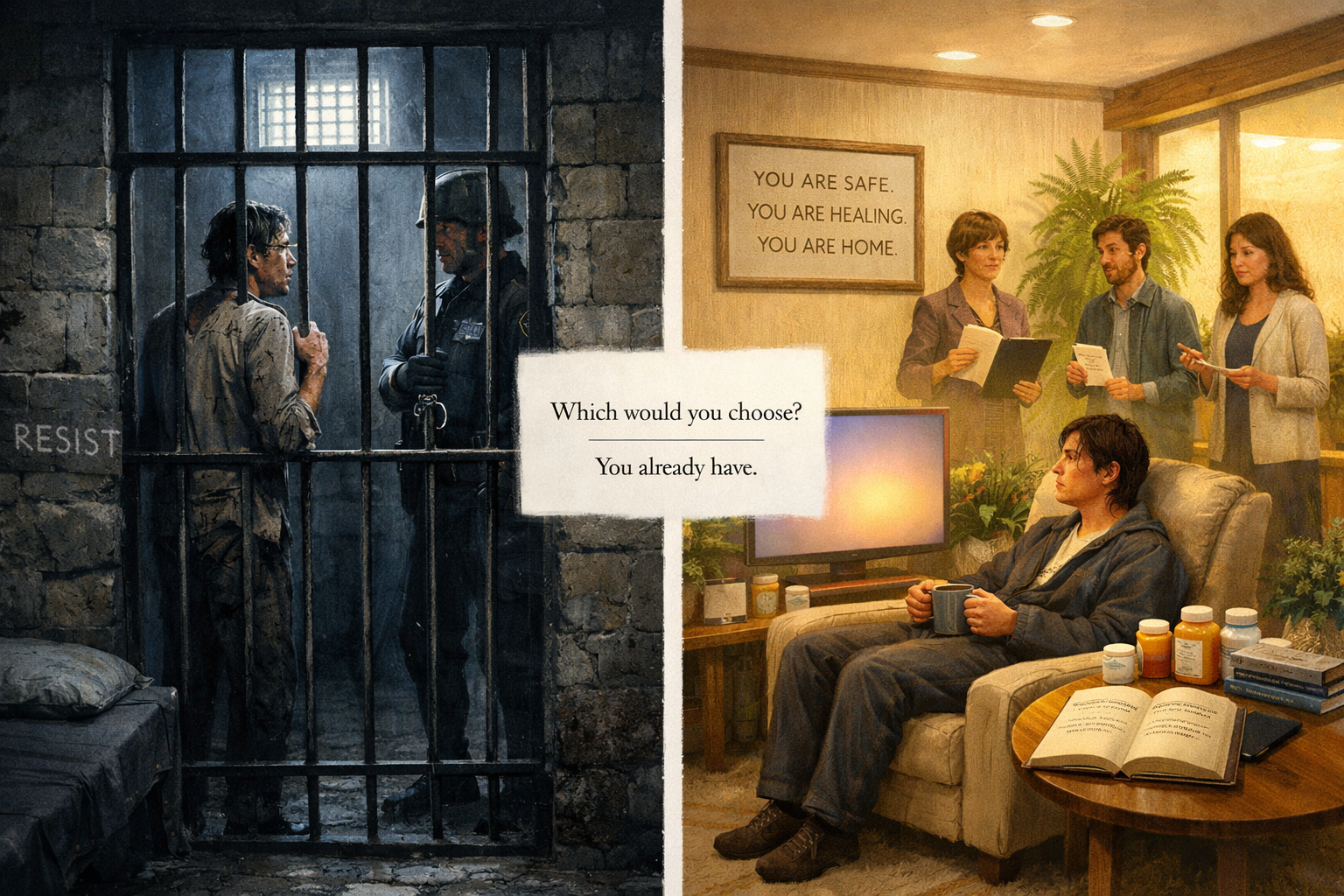
‘leftism’ - the institutional moral regime that converts compassion into administrative control and dissent into pathology.
There was some pushback on the use of “leftism” vs “liberalism.” The terminology is fully explored here:
Preface: On Forbidden Comparisons
You will recoil from this title. You are trained to recoil. The training is precise: any comparison that does not conclude with fascism as the supreme evil is itself fascism. This is convenient for those who wish to forestall analysis. It is not convenient for those who wish to understand.
I do not write to rehabilitate fascism. Fascism is worthy of contempt—but honest contempt, contempt rooted in understanding rather than reflex. And honest contempt requires honest comparison. What, precisely, makes a system of domination evil? By what criteria do we judge? And when we apply those criteria consistently, what do we find?
You will not like what we find.
I. The Hierarchy of Evils
Let us establish criteria. What makes a system of domination evil? I propose three measures:
First: The destruction of life. A system that kills is worse than one that does not. This is obvious, and by this measure fascism’s crimes are undeniable—the camps, the wars, the industrialized murder. We do not minimize this.
Second: The destruction of the capacity for resistance. A system that can be resisted is less evil than one that cannot. The slave who knows he is a slave can revolt. The slave who believes himself free is enslaved absolutely.
Third: The destruction of the soul. A system that degrades the body while leaving the spirit intact is less evil than one that colonizes the spirit itself. The martyr who dies with his integrity is less damaged than the man who lives but has been hollowed out, made to love his servitude.
By the first criterion, fascism is worse. It killed more people more quickly.
By the second and third criteria—and here is where you will resist—leftism is worse. Not because it intends more harm, but because the harm it does is more complete, more inescapable, more total.
Let me show you.
II. The Visibility of Tyranny
Fascism announced itself. It wore uniforms. It marched in torchlight parades. It declared its enemies openly and killed them publicly. It demanded obedience and punished disobedience with visible, physical force.
This is tyranny, obviously. But notice what this visibility provides: a target. The fascist oppressor can be identified, resisted, fought, killed. The concentration camp can be liberated. The dictator can be assassinated. The regime can be defeated in war. History has proven this—fascism was defeated, precisely because it made itself visible as an enemy.
Leftism does not announce itself as tyranny. It announces itself as liberation. It wears no uniform; it wears the casual dress of the helping professions. It marches in no parades; it processes through institutions, quietly, over decades. It declares no enemies; it identifies only people who need help—education, therapy, consciousness-raising.
Where is the target? Who is the enemy? The diversity consultant who believes she is doing good? The therapist who genuinely wants to help? The professor who thinks he is enlightening? The HR manager who sees herself as protecting the vulnerable?
You cannot shoot the diversity consultant. You would be shooting someone who believes in her own virtue, and who has institutional power to enforce that belief while claiming no power at all. You cannot liberate the campus; there are no guards, no fences, only norms that everyone has internalized. You cannot defeat this regime in war because it has no capital to capture, no leader to depose, no army to destroy.
The fascist tyranny was a fortress. It could be besieged.
The leftist tyranny is a gas. It is everywhere and nowhere. You breathe it in. It becomes you.
Which is worse?
III. The Location of Control
Fascism controlled behavior. It demanded you salute, attend rallies, inform on enemies of the state, serve in the military. It concerned itself with what you did. What you thought, in the privacy of your mind, was your own—not because fascism respected privacy, but because it lacked the technology and technique to invade it.
You could comply outwardly while resisting inwardly. You could salute the flag while cursing it in your heart. You could inform on your neighbor while hating yourself for it—and that hatred was a seed of resistance. The inner man remained, wounded perhaps, but intact.
Leftism controls thought itself. It does not want your salute; it wants your belief. It does not want your outward compliance; it wants your genuine agreement. It is not satisfied until you have internalized its values so completely that deviation feels not like rebellion but like sickness.
The oversocialized subject of leftism does not comply while cursing inwardly. He does not curse inwardly. The inward cursing has been pathologized, diagnosed, therapized out of existence. He does not think forbidden thoughts and hide them; he does not think them at all. And if a forbidden thought arises unbidden, he experiences not resistance but guilt—and reports himself for treatment.
This is the completion of totalitarianism. The fascist totalitarian controlled the public square. The leftist totalitarian controls the private mind. The fascist demanded your body. The leftist demands your soul.
Which is worse?
IV. The Honesty of Evil
Here is an uncomfortable truth: fascism was honest.
It said: we believe in hierarchy, in the strong dominating the weak, in the glory of our people over others. It said: we will use violence to achieve our aims. It said: we have enemies and we will destroy them.
This is evil, but it is legible evil. You know where you stand. You know what is being demanded. You know who is doing the demanding and what they will do if you refuse.
Leftism lies. It lies constantly, structurally, and—most importantly—to itself.
It says: we believe in equality—while establishing new hierarchies of victimhood, new rankings of moral worth based on identity, new aristocracies of the oppressed.
It says: we oppose power—while accumulating power in institutions, in HR departments, in the therapeutic professions, in the administrative state.
It says: we seek liberation—while creating new forms of dependence, new compulsions, new orthodoxies enforced by new priests.
It says: we hate coercion—while coercing through social pressure, economic sanction, reputational destruction, psychological manipulation.
The leftist does not experience himself as a tyrant. He experiences himself as a helper, a healer, an enlightener. His will to power is invisible to him, disguised as compassion. He dominates while believing he serves. He destroys while believing he saves.
This is not hypocrisy in the ordinary sense—the conscious gap between word and deed. This is structural dishonesty, a system that cannot recognize itself, that has built self-deception into its foundations.
Which is more dangerous: the enemy who announces his enmity, or the enemy who believes himself your friend?
Which is worse: the tyranny that knows itself as tyranny, or the tyranny that believes itself liberation?
V. The Quality of Resistance
Under fascism, resistance was dangerous but possible. You could join the underground. You could sabotage. You could shelter the persecuted. You could speak in code with those you trusted. You could, in extremity, take up arms.
The risks were severe—imprisonment, torture, death. But the category of resistance existed. You knew what it meant to resist. The regime knew what it meant. There were resisters, and they were honored for it, then or later.
Under leftism, what does resistance mean?
If you resist openly, you are not imprisoned; you are diagnosed. Your resistance is not martyrdom; it is fragility, denial, internalized oppression. You are not dangerous; you are sick. You do not need to be defeated; you need to be helped.
The dissident under fascism was an enemy of the state. The dissident under leftism is a patient.
This is a crucial difference. The enemy has dignity. He is a subject, an agent, someone whose opposition matters enough to be crushed by force. The patient has no dignity. He is an object, a case, someone whose opposition is merely a symptom of his disease.
The fascist dissident could be tortured, but he could not be cured. His resistance was acknowledged as real, even as it was punished. He could die with his integrity.
The leftist dissident cannot even achieve martyrdom. His resistance is reframed as pathology, his arguments as rationalizations, his values as trauma responses. He is not answered; he is explained. And the explanation is always the same: he resists because he is damaged. When he is healed, he will agree.
This is why there is no dissident literature of the left’s victims as there is of fascism’s. The victims of fascism could write from prison, could testify at trials, could bear witness to their suffering as suffering inflicted. The victims of leftism do not know they are victims. They have been helped. They have been educated. They have grown. Their former selves—the selves that would have resisted—are remembered only as embarrassing earlier stages of development.
Which is worse: the tyranny you can resist and be punished for, or the tyranny you cannot resist because resistance itself has been made unthinkable?
VI. The Production of Slaves
Fascism wanted soldiers. It wanted men who were hard, disciplined, willing to fight and die. It wanted strength in service of the state. Its ideal type was the warrior—brutal, yes, but vital. Fascism’s crimes were the crimes of excess vitality, of overflowing will, of the beast that kills because it is powerful.
Leftism wants patients. It wants people who are soft, dependent, unable to function without institutional support. It wants weakness that requires management. Its ideal type is the therapeutic subject—traumatized, fragile, perpetually healing, perpetually consuming professional services.
Fascism made men into killers. This is terrible.
Leftism makes men into last men. This is worse.
The last man—Nietzsche’s prophecy—is the final product of slave morality’s triumph. He is comfortable. He is safe. He has eliminated danger, risk, greatness. He has no aspiration beyond comfort, no goal beyond the avoidance of suffering. He blinks and says, “We have invented happiness.”
Look around you. What do you see?
You see a civilization that has made safety its highest value. That recoils from danger, from offense, from discomfort of any kind. That medicates sadness, pathologizes ambition, treats disagreement as violence. That cannot build, cannot fight, cannot reproduce, cannot imagine anything worth suffering for.
You see a civilization that has succeeded—succeeded in eliminating the conditions for human greatness. No one will conquer. No one will create. No one will sacrifice for glory or beauty or God. They will consume, and be comfortable, and call it happiness.
Fascism burned bright and killed many and was destroyed.
Leftism dims everything and kills nothing outright and cannot be destroyed, because it has convinced its subjects that it is not there, that it is simply reality, that there is no alternative.
Which is worse: the fire that burns, or the slow suffocation that does not even register as dying?
VII. The Scope of Destruction
Fascism destroyed millions of bodies over decades. Then it was defeated, and the destruction stopped. The camps were liberated. The survivors rebuilt. Within a generation, Germany and Italy were prosperous democracies. The damage was immense but bounded.
Leftism destroys souls, and it is not defeated, and it does not stop.
How many have been spiritually destroyed by the trauma-guilt apparatus? How many live in permanent anxiety, permanent guilt, permanent fragility? How many have been rendered incapable of joy, of confidence, of simple human flourishing? How many have been taught to hate themselves, their ancestors, their civilization, their own capacity for excellence?
We cannot count these. There are no liberation photos. There are no trials. The destruction is invisible because it is internal, and it is ongoing because no one has defeated the system that produces it.
Fascism’s victims could be mourned and memorialized because they were visibly victimized. Leftism’s victims cannot be mourned because they do not know they are victims. They think they have been helped.
The German who lived through Nazism knew he had lived through something evil. He could repent, rebuild, warn future generations.
The Westerner who lives through leftism does not know he is living through anything at all. He has no outside position from which to judge. The water he swims in is the only water there is.
Which is worse: the catastrophe that is recognized as catastrophe, or the catastrophe that is experienced as normal?
VIII. The Inheritance
Fascism left behind a warning. Its images—the camps, the corpses, the marches—are seared into collective memory as what must never happen again. It provided its own refutation. Every child who learns about the Holocaust learns that fascism is evil.
Leftism leaves behind no warning, because it does not appear as something to be warned against. It appears as progress, as enlightenment, as the right side of history. Its victories are recorded as moral achievements. Its expansion is recorded as moral growth.
When fascism is defeated, people know they have been liberated.
When leftism advances, people think they have been improved.
The German after 1945 could say: “We were deceived. We followed a madman. Never again.”
What will the Westerner after leftism say? He will not know there was an “after.” He will not know he was under anything that could be thrown off. He will experience the entire arc as a story of progress, with himself as the culmination—the most enlightened, most moral, most advanced person who has ever lived.
Even if leftism were defeated—by some force not yet visible—its subjects would not experience liberation. They would experience trauma. They would mourn. They would call the liberation a catastrophe and spend generations trying to return to their chains.
Which is worse: the tyranny that discredits itself, or the tyranny that is remembered as golden age?
IX. The Defense You Will Offer
You will say: “But leftism doesn’t kill people. Fascism killed millions. Nothing else matters.”
And I will say: You are counting only one kind of death.
The body can be killed. The soul can also be killed. A civilization can be killed. A people’s capacity for greatness can be killed. The possibility of meaning, of beauty, of nobility, of anything worth living for—all of this can be killed.
Fascism killed bodies by the millions.
Leftism kills souls by the hundreds of millions—slowly, softly, therapeutically. And it kills civilizations. And it kills the future, by ensuring that nothing great will be attempted, nothing difficult will be endured, nothing that requires sacrifice will be pursued.
What is the value of life without meaning? What is preserved when the body is kept alive but the spirit is destroyed? Is the last man, comfortable and empty, more alive than the martyr who died for something?
I do not minimize fascism’s murders. I ask you to stop minimizing leftism’s murders—the murders of meaning, of greatness, of the soul itself.
X. The Accusation You Will Make
You will say: “This is fascist apologia. You are a fascist.”
This is the reflex. This is the training. Anyone who criticizes leftism from a position other than further left is fascist. The word has become a silencing mechanism, meaning only: “Stop talking. You have spoken against the faith.”
But notice what this reflex reveals: the inability to think outside the binary. In the leftist mind, there are only two positions: leftism and fascism. To criticize leftism is to endorse fascism. There is no third option.
This is false. I do not endorse fascism. I hold fascism in contempt—honest contempt, based on understanding.
But I hold leftism in greater contempt, because its evils are less visible, less resistible, more total, and more enduring. Because it has convinced its victims they are beneficiaries. Because it destroys while claiming to heal. Because it cannot be defeated by any means yet discovered, since it has colonized the very minds that would need to defeat it.
Fascism was a monster, and we slew it.
Leftism is a disease, and we have contracted it.
Which is worse: the monster without, or the sickness within?
Conclusion: The Choice Not Offered
You were never asked whether you wanted to be socialized into guilt and trauma. You were never offered an alternative. The choice was not presented because the system does not recognize itself as a system. It recognizes itself as reality, as morality, as the way things are.
Fascism offered a choice, however terrible: submit or resist, collaborate or fight. You could choose martyrdom. You could choose evil. But you chose.
Leftism offers no choice, because it does not appear as something that could be chosen or refused. It appears as maturity, as growth, as education. You do not choose to believe its tenets; you develop into believing them. You do not resist its demands; you heal into accepting them.
The fascist could be defied.
The leftist cannot be defied, because he is inside you. He is the voice that says you are guilty. He is the voice that says you are fragile. He is the voice that says resistance is sickness and submission is health.
You can kill a fascist.
How do you kill a voice in your own head that you have been trained to believe is your conscience?
This is why leftism is worse: not because it intends more harm, but because the harm is more complete. Not because it kills more bodies, but because it kills the souls that might have resisted. Not because it is more cruel, but because its cruelty is invisible—even to itself.
Fascism was a war, and wars end.
Leftism is a sickness, and we have forgotten what health was.
The fire that burned has gone out. The suffocation continues, and we call it air.
—Written in the spirit of honest diagnosis, for those who retain the capacity to hear it. The others will call this what they are trained to call it. Their reaction is itself the proof.