Pathologies of Eastern Secularism
Published 2026-01-09“Why Secularism in the West Became Pathological” dealt with pathologies arising from a secularism with a Christian inheritance. Here we explore the pathologies arising from a secularism with a Buddhist inheritance.
Quietism and Political Withdrawal
If suffering arises from craving and the solution is individual detachment, this can rationalize withdrawal from engagement with injustice. “It’s all samsara anyway.” Historical Buddhism has been criticized for reconciling people to oppression - the karmic explanation for your station in life can function as ideological justification for caste, poverty, autocracy. The insight that “the problem is your attachment to outcomes” can become “stop caring about outcomes.”
Where Christian secularism produces crusaders and moral emergency, Buddhist secularism can produce sophisticated passivity.
Spiritual Bypassing
Using non-attachment and equanimity language to avoid genuine emotional processing. “I’m not angry, I’ve let go” when actually you’re dissociating or repressing. Meditation as avoidance of relational work, therapy, confronting trauma. The vocabulary of acceptance weaponized against legitimate grievance.
Solipsistic Practice
The individual focus - my awakening, my practice, my journey - can become spiritual narcissism. The McMindfulness critique applies here: meditation extracted from ethical context and community becomes another self-optimization technology for the professional class. Retreat centers as luxury wellness, enlightenment as personal achievement.
Nihilism Dressed as Wisdom
Emptiness (sunyata) misunderstood as “nothing matters” rather than “nothing has inherent existence.” The philosophical subtlety collapses into a kind of sophisticated shrug. This can manifest as ironic detachment, refusal of commitment, “who’s to say what’s right?” relativism. It looks like wisdom but functions as avoidance.
Present-Moment Escapism
“Be here now” as refusal of temporal responsibility - toward the past (memory, debt, obligation) and future (planning, commitment, consequence). This inverts the Christian pathology but produces its own dysfunction: inability to sustain projects, honor promises, think generationally.
The Asymmetry
The interesting structural point is that these pathologies are complementary opposites of the Christian-secular ones:
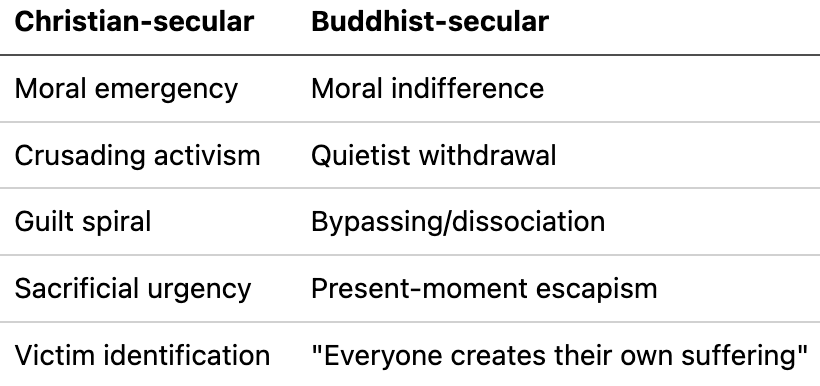
This suggests they might fail different personality types or political contexts differently. The driven, guilt-prone, world-reforming temperament gets captured by secularized Christianity. The avoidant, conflict-averse, inward-turning temperament gets captured by secularized Buddhism.
Institutional Capture
Worth noting: Buddhism in actual Asian contexts has produced its own violent pathologies - Zen support for Japanese militarism, Buddhist nationalism in Sri Lanka and Myanmar. So it’s not that Buddhism is immune to weaponization, just that the secularization failure modes differ.
Western Buddhism’s Hidden Christianity
Some argue Western Buddhism has unconsciously absorbed Christian structures anyway: the emphasis on compassion as supreme virtue (vs. wisdom in traditional Buddhism), charismatic teachers as quasi-messianic figures, the assumption that Buddhism must be socially engaged to be legitimate. So perhaps much “secular Buddhism” in the West is actually a Christian-Buddhist hybrid, inheriting pathologies from both.
Dramatic pathologies - moral emergency, victim hierarchy, permanent guilt, sacrificial urgency - are Christian-derived. Buddhism’s pathologies run toward the undramatic - withdrawal, dissociation, sophisticated indifference. Both are failures, but they’re failures in opposite directions.