Diagnosing "Trauma Culture"
Published 2026-01-09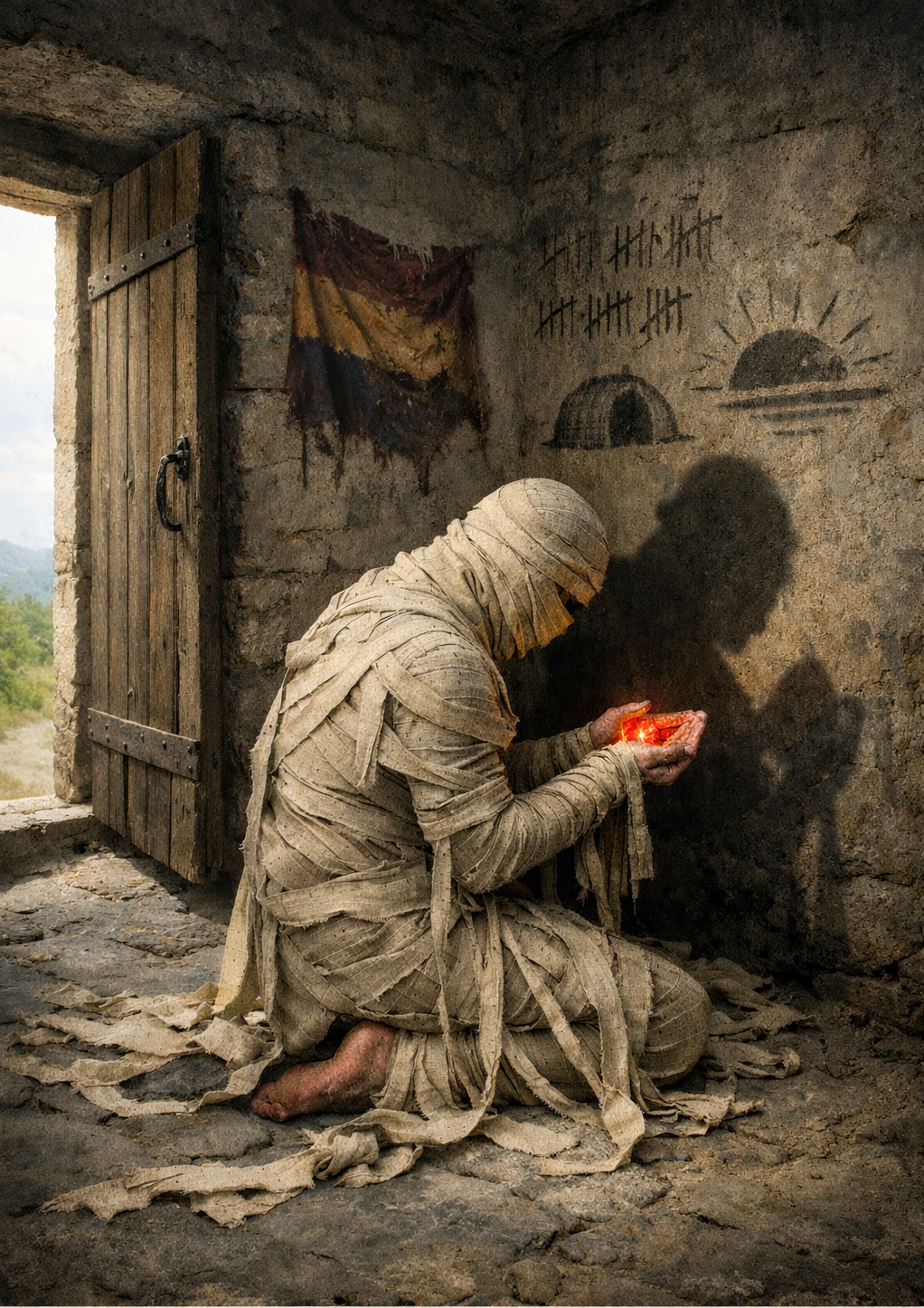
So you will read this and feel attacked. You will say it is cruel, that it lacks compassion, that it does not understand. You will retreat further into the vocabulary of wounds—this very essay is a harm, a violence, a failure to validate.
And that is your choice. It has always been your choice.
The door is unlocked. It always was.
You prefer the cell.
I. The Epidemic That Flatters Itself
You have noticed, surely, that suffering has become competitive. That trauma is currency. That the consultation of one’s wounds has replaced the consultation of one’s conscience.
The data is unambiguous. Rates of self-reported anxiety, depression, and trauma have risen continuously for decades—not in correspondence with material conditions, which have improved, but in inverse proportion to them. The safest, most prosperous, most medically pampered generation in human history reports itself the most damaged. Between 2009 and 2021, rates of major depressive episodes among American adolescents doubled. Anxiety disorders have tripled since the 1980s. The diagnosis of PTSD, once reserved for combat veterans and survivors of atrocity, now encompasses bad breakups and uncomfortable work environments.
Are we to believe that life has become three times more traumatic during the most peaceful and materially abundant period in recorded history? Or might something else be happening—something you would rather not examine?
The sociologists Campbell and Manning identified the emergence of a new moral culture: “victimhood culture,” distinct from the honor cultures and dignity cultures that preceded it. In honor cultures, one responds to offense with retaliation; status comes from strength. In dignity cultures, one absorbs minor slights because every person has inherent worth regardless of what others think. But in victimhood culture, status comes from oppression. One advertises suffering. One appeals to third parties—institutions, crowds, the public—to recognize one’s victimization and punish offenders.
This is not an observation about whether people suffer. People suffer. The question is what work suffering is made to do. And increasingly, suffering is made to do the work of justification, of identity, of meaning itself.
II. The Payoff You Won’t Admit
Let us be cruel, which is to say, let us be precise.
What does trauma-identification give you?
First: moral authority. The sufferer stands above the non-sufferer. To have been wounded is to have been chosen—marked out by fate for a significance the unscathed cannot claim. Your pain is your credential. It cannot be questioned, only “validated.” Anyone who challenges your account is “invalidating your experience,” which is to say, committing heresy against the sacred.
Second: identity. You know who you are. The question that haunts modern man—”what am I for?”—is answered. You are your wound. The anxious person, the depressed person, the traumatized person. The diagnostic label becomes the soul. This is why people put their disorders in their social media biographies, why they bristle at the suggestion of recovery. To recover would be to dissolve. What would be left?
Third: community. The support group, the online forum, the shared language of triggers and boundaries and “doing the work.” Here is belonging. Here is recognition. Here are people who understand. But notice: the membership requirement is continued suffering. Get well and you lose your people.
Fourth: exemption. From expectations, responsibilities, the terrible burden of agency. “I can’t, because of my trauma.” The wound becomes a permanent doctor’s note excusing you from the examination of life. Who could be so cruel as to demand things of the damaged?
Fifth: explanation. Why is your life not what you wanted? Why have you not become who you imagined? Not because of your choices, your failures, your ordinary human insufficiency. Because you were wounded. The trauma did it. You are not inadequate; you were sabotaged. This is infinitely more bearable.
You will say: “But I really do suffer.” Yes. You do. The diagnosis is not that your pain is fake. The diagnosis is that you have married your pain. You have made it your meaning, your claim, your self. And you did this because you were offered no better option by the degraded metaphysics you inherited.
III. The Missing Sunday
Here is the secret history of your condition:
You are a Christian. You do not know this. You believe yourself enlightened, secular, freed from superstition. You laugh at the rubes who believe in resurrection and final judgment. But you inherited the architecture while discarding the keystone, and now you live in rubble wondering why you cannot find shelter.
Christianity told a story: You suffer. Your suffering is seen by God. Your suffering is meaningful because Christ also suffered, and through His suffering, suffering itself was transformed. Your tears are counted. Nothing is lost. And—this is the essential thing—your suffering will end. Sunday comes. The resurrection. The eschaton. Every tear wiped away. Justice, finally and completely. The victim is raised up, glorified, and victim no longer.
This is what you lost when you threw out God: not just heaven, but the exit.
You kept the crucifixion. The revelation that the victim is sacred and the persecutors are guilty—this you kept. It flattered too many purposes to discard. The moral authority of suffering, the identification of innocence with powerlessness, the drama of oppressor and oppressed—all this remained.
But you threw out the resurrection. You threw out the eschaton. You threw out the mechanism by which victim-status is resolved, transmuted, ended.
And so here you are: nailed to your cross, forever. The secular saint, canonized in perpetuity. Your martyrdom is infinite because there is no heaven to receive you. Your suffering is holy but there is no God to take it up into meaning. You get the wound without the healing, the price without the purchase, the death without the resurrection.
You wanted to be a victim because your inherited theology told you victims are sacred. But you cannot stop being a victim because you eliminated the only mechanism by which the sacred victim becomes something other—something more, something redeemed, something that has passed through suffering into glory.
The Christians understood that Friday is only bearable because of Sunday. You kept Friday. You called Sunday a fairy tale. And now you wonder why you feel trapped in an endless weekend of despair.
IV. The Slave Revolt Perfected
Nietzsche saw this coming.
He called it ressentiment—the festering envy of the weak toward the strong, transmuted into a moral system that makes weakness into virtue. The slave revolt in morals: the inversion whereby the powerful become “evil” and the powerless become “good.” Not because powerlessness is genuinely admirable, but because the powerless cannot win by the old rules and so must change the rules themselves.
You have perfected this revolt. You have made victimhood not merely virtuous but mandatory. Everyone must find their wound, locate their oppression, identify their trauma. The struggle sessions of the Cultural Revolution reborn as therapy culture: confess your privilege, acknowledge your damage, locate yourself in the hierarchy of suffering.
But notice the will to power hiding inside the will to weakness.
The victim commands. Others must validate, accommodate, center, believe. The victim’s narrative cannot be questioned. The victim’s needs structure the space. The victim’s pain trumps your reason. This is not powerlessness but power laundered through powerlessness—domination that dare not speak its name because it has dressed itself in wounds.
You thought you were rejecting the will to power. You were merely finding a sneakier expression of it.
The trauma-identified person does not want to be healed. Healing would mean loss of status, identity, community, exemption, explanation. Healing would mean rejoining the ranks of the ordinary, those who must justify themselves by what they do rather than what was done to them. Healing would mean death of the self that has been constructed on the foundation of the wound.
And so therapy becomes interminable. The work is never done. “Recovery” means managing, not overcoming. The language gives it away: one does not cease to be an addict; one is always “in recovery.” The identity is permanent. The wound is forever.
This is not medicine. This is religion—a religion without salvation.
V. The Cave of the Self
Where do you go when the world has no meaning? Into the self. The great migration inward.
External reality is disenchanted, purposeless, merely atoms in void. God is dead. Progress is a lie. The arc of history bends toward nothing. And so you turn inward, where surely something must be found that matters—the final refuge of significance.
But what do you find there?
Pain. That is what you find. That is what you make sure to find.
Because if you found peace, equanimity, contentment—what would be the interest? An untroubled interior is as meaningless as an untroubled cosmos. But pain—pain is undeniable. Pain is significant. Pain demands response.
So you excavate your suffering. You archaeologize your childhood. You find wounds you did not know you had, traumas you had to be taught to recognize. An industry of therapists and self-help authors stands ready to help you discover injuries you would never have noticed without instruction.
And you call this depth. You call it self-knowledge. You call it doing the work.
It is none of these things. It is hiding. It is the construction of an interior drama to compensate for the collapse of exterior meaning. You could not be a hero in the world, so you became a survivor in the psyche. You could not find God in the cosmos, so you made a religion of your damage.
The cave of the self, illuminated only by the flickering light of old pain, mistaken for the sun.
VI. The Way Out You Will Refuse
Here is what you do not want to hear:
Your trauma is not interesting.
It does not make you special. It does not confer wisdom. It does not give you moral authority over those who have suffered less, or differently, or not at all. It does not exempt you from the obligations of personhood. It is not your identity. It is something that happened to you—perhaps terrible, perhaps formative, but not you.
Your healing is your responsibility.
Not your abuser’s. Not society’s. Not your therapist’s. Yours. This is not victim-blaming; it is the recognition that you are an agent, not merely a patient. The world will not arrange itself for your comfort. No one is coming to save you. The eschaton will not arrive. If you are to be healed, you must heal yourself—which means, at some point, choosing health over the secondary gains of sickness.
Your atheism was not the liberation you imagined.
You freed yourself from God and found yourself trapped in your own psyche, worshipping your wounds because you had nothing else to worship. The debunking of religion did not leave you with clear-eyed rationality; it left you with covert theology, unconscious Christianity, a religion too stupid to know it is one.
There is no secular solution to a theological problem.
You cannot fix the pathologies of secularized Christianity by becoming more secular. You will only produce more sophisticated versions of the same disease. The options are: recover what was lost, find a genuinely different framework (one that never had the victim-drama structure in the first place), or remain stuck forever.
But you will not take the way out.
Because the way out requires surrender—of your specialness, your moral claim, your identity, your exemption. It requires you to become ordinary: just another person who suffered, as all people suffer, and who is now required to live, as all people are required to live. No extra credit. No permanent excusal. No canonization.
The way out requires you to admit that your enlightened atheism left you in a worse position than the rubes you mocked, that your sophisticated interiority is just a cramped cave, that your trauma-identity is a cage you built yourself and now call home.
And that is too much to ask.
So you will read this and feel attacked. You will say it is cruel, that it lacks compassion, that it does not understand. You will retreat further into the vocabulary of wounds—this very essay is a harm, a violence, a failure to validate.
And that is your choice. It has always been your choice.
The door is unlocked. It always was.
You prefer the cell.