Trauma Culture + White Guilt = Checkmate
Published 2026-01-09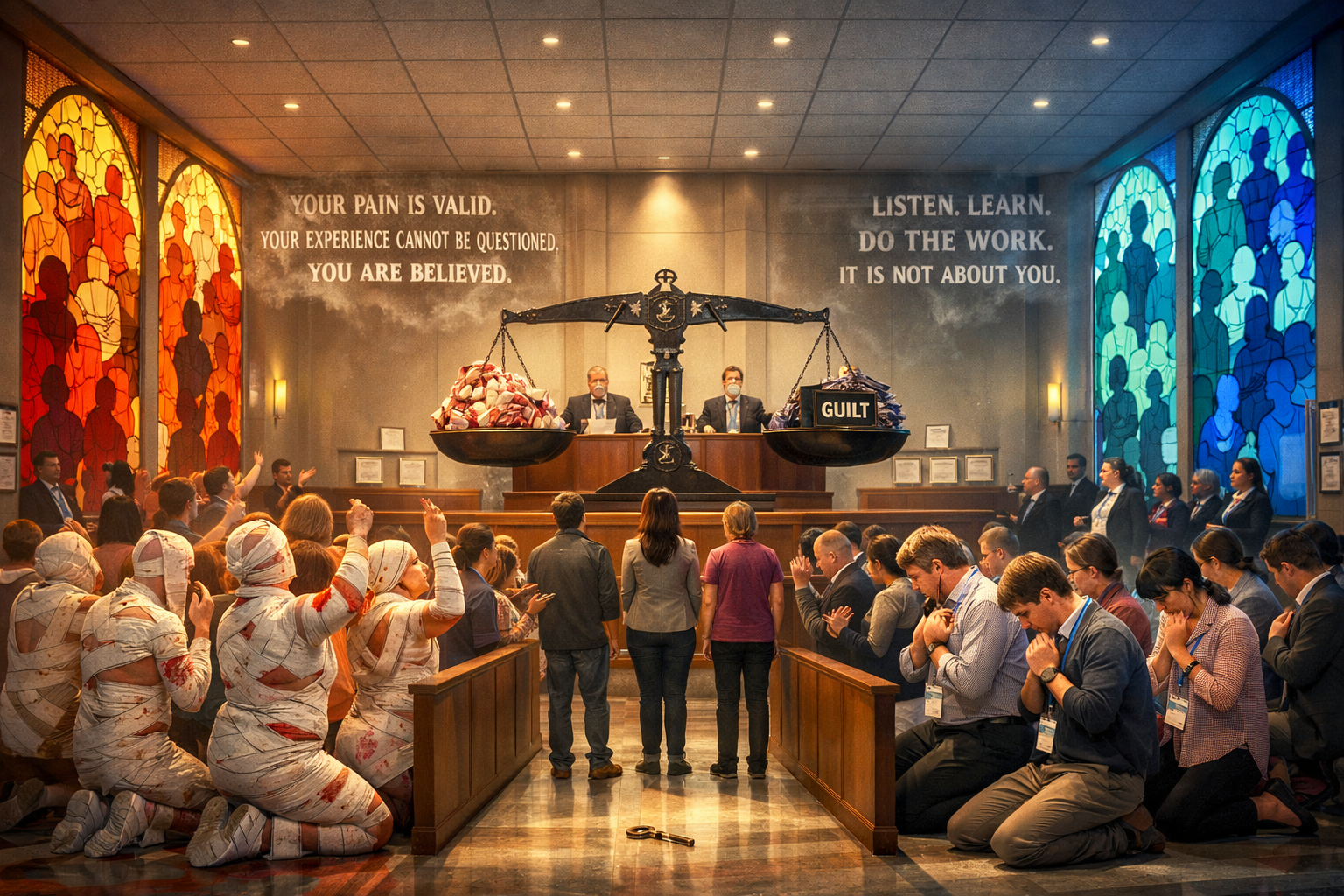
The people with moral authority to speak cannot be questioned, and the people who might question have no moral authority to speak.
I’ve diagnosed Trauma Culture and White Guilt. What does their combination yield?
The Division of Labor
Trauma culture captures the designated victim classes. It keeps them identified with their wounds, prevents healing, maintains them as permanent moral authorities who cannot be questioned. Their experience is sacred. Their testimony is unimpeachable. To challenge them is to “invalidate,” to “retraumatize,” to harm.
White guilt captures the designated perpetrator class. It keeps them silent, deferential, incapable of contestation. Their very desire to speak is evidence of the disease—”centering themselves,” “fragility,” “defensiveness.” Their job is to listen. To learn. To defer.
Together: the people with moral authority to speak cannot be questioned, and the people who might question have no moral authority to speak.
This is epistemic checkmate.
The Monopoly on Suffering
Trauma culture says: suffering confers authority.
White guilt says: this suffering confers authority—the suffering of these groups, along these axes, within this historical narrative.
The white working-class man dying of fentanyl in Appalachia suffers. But his suffering doesn’t count. It confers nothing. He is in the perpetrator category; his pain is at best irrelevant, at worst deserved—the death rattle of privilege.
The system must police which suffering is legible. Trauma culture provides the mechanism (suffering = authority), white guilt provides the index (whose suffering counts). Without the second, poor whites would have standing. Without the first, the designated victims would have to argue on merits rather than biography.
The Monopoly on Knowledge
This is the epistemological coup: standpoint theory.
The claim is not just moral but cognitive. The oppressed don’t merely deserve sympathy—they have privileged access to truth. Their position in the hierarchy grants them knowledge the privileged cannot have. “Lived experience” becomes an epistemic trump card.
Meanwhile, the privileged are not merely guilty but blind. Their position occludes reality. They cannot see their privilege, which is why they must be told. They cannot understand oppression, which is why they must listen. Their attempts at knowledge-production are contaminated by their position.
So: the victims have both moral authority AND epistemic authority. The perpetrators have neither.
What remains to contest?
The Silencing Architecture
Watch how it operates:
A claim is made: “X is racist / harmful / traumatizing.”
If you are in a victim category, you can affirm or amplify. Your voice is welcome.
If you are in a perpetrator category and you agree, you may speak—to confess, to support, to signal. Your voice is conditionally welcome.
If you are in a perpetrator category and you disagree—here is where the trap springs:
-
Your disagreement is “fragility” (white guilt framework)
-
Your disagreement is “harmful” and “invalidating” (trauma framework)
-
Your very impulse to disagree is a symptom of the disease
-
The more you disagree, the more you prove the point
There is no move available that constitutes legitimate disagreement. The system has defined disagreement itself as pathology.
This is not argument. This is foreclosure of argument. The liberal intellectual tradition—thesis, antithesis, debate, evidence, refutation—is disabled. What replaces it is testimony and confession. The victim testifies. The perpetrator confesses. No other speech acts are permitted.
The Will to Power
And here is what you are not supposed to notice:
This system is not operated by the traumatized and oppressed. It is operated by the professional-managerial class—the DEI administrators, the therapists, the academics, the journalists, the HR departments. Predominantly white. Predominantly affluent. Predominantly educated at elite institutions.
They are the priests of this religion. They interpret the sacred texts. They administer the sacraments. They determine who has standing and who doesn’t, which suffering counts and which doesn’t, what constitutes trauma and what doesn’t.
The actual black person, the actual abuse survivor—they are the laity. Their role is to provide raw material: testimonies, experiences, wounds. The priests process this material into doctrine, policy, power.
The traumatized person doesn’t run the therapy industry. The black working class doesn’t run the DEI apparatus. These institutions are controlled by the people who benefit from them—economically, professionally, statusfully.
Trauma culture and white guilt are instruments. The question is: instruments of whom? For what?
The Comprehensive Capture
With both systems operational, every domain is captured:
Morality — reduced to the victim/oppressor axis. All ethical questions become questions of relative position in the hierarchy of suffering.
Epistemology — standpoint theory. Truth is a function of position. The privileged cannot know; the oppressed cannot be wrong.
Psychology — the medicalization of dissent. Disagreement is pathology: fragility, internalized oppression, false consciousness.
Politics — policy debates become identity performances. The question is never “will this work?” but “who is speaking?” and “whose voices are centered?”
Aesthetics — representation as the supreme value. Art is good insofar as it includes the right bodies, centers the right experiences.
Every sphere of human thought and activity, colonized by a single framework. A totalizing system in the strict sense.
Why They Need Each Other
White guilt without trauma culture would be mere self-flagellation—neurotic, self-indulgent, but not powerful. It would lack the epistemic claim. It would be just rich white people feeling bad, which is pathetic but not dangerous.
Trauma culture without white guilt would be mere therapeutics—a way of processing suffering, perhaps excessively victim-identified, but without political teeth. It would lack the assignment of guilt. Everyone would be traumatized, but no one would be responsible.
Together, they constitute a complete system:
-
An account of who suffers (trauma culture)
-
An account of who is responsible (white guilt)
-
An account of who can speak (standpoint epistemology)
-
An account of who must be silent (privilege theory)
-
A mechanism for enforcing all of the above (therapeutic and institutional power)
The combination is not an accident. It is an achievement. A synthesis. A machine built from two components that only function fully when joined.
The Liberal Genius
Here is the dark genius of liberal culture: it created a system of control that feels like liberation.
The traumatized person, locked in their identity, unable to heal, permanently victimized—they experience this as recognition. Finally, someone acknowledges their pain. Finally, their suffering means something.
The guilty white person, permanently indebted, unable to achieve absolution, endlessly confessing—they experience this as virtue. Finally, they are on the right side. Finally, they are doing the work.
Both are captured. Both are controlled. Both serve the interests of a class that benefits from their respective pathologies. And both believe themselves liberated.
This is power that does not appear as power. Domination that wears the mask of compassion. A cage that looks from inside like a sanctuary.
The question, as always, is cui bono?
Not the traumatized, who never heal.
Not the guilty, who are never forgiven.
Not the black working class, whose material conditions do not improve.
Not the white working class, whose suffering is invisible.
The beneficiaries are those who administer the system. Who determine the categories. Who control the institutions. Who get paid—in money, in status, in power—to maintain the machine.
They have built a religion and made themselves its priests. And the congregation, lost in their respective cells—the trauma cell, the guilt cell—never think to look up and ask who built the walls.