Pathologies of Western Secularism
Published 2026-01-09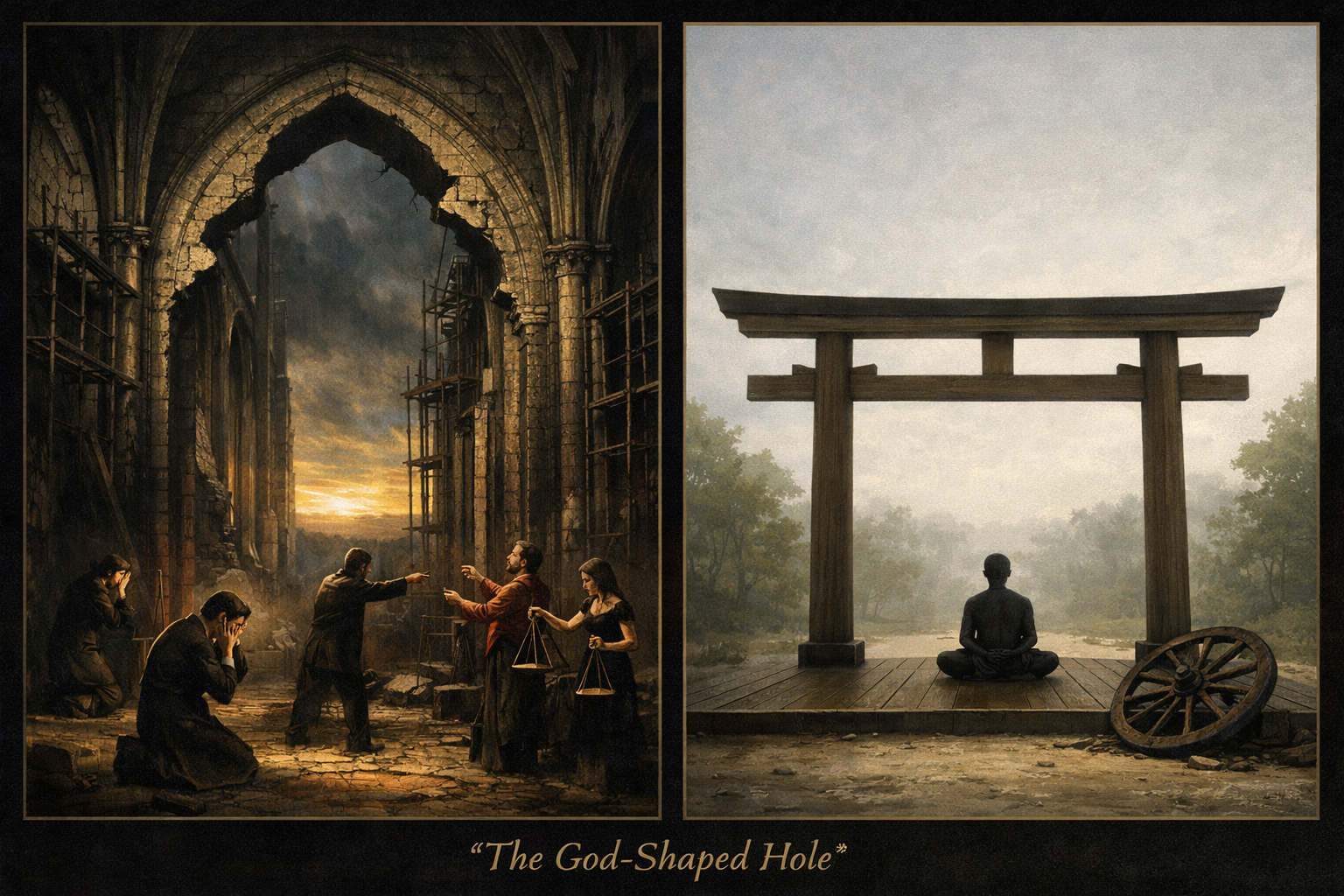
Why has secularism in the West devolved into pathology? Embracing authoritarianism, identity politics, voting against one’s own interests, public shaming & cancel culture, virtue signaling, tribal warfare, constantly looking for scapegoats, constantly looking for victims?
I’ve written a few times on this but none of the essays seem to hit the spot yet. Here we compare the secular inheritance of the West vs what it may have looked like had it had a Buddhist inheritance.
Secular progressivism inherited Christianity’s architecture while discarding its resolution mechanisms, creating a kind of permanent moral emergency. Buddhism lacks this architecture entirely, so secularizing it doesn’t produce the same pathologies.
The Victim-Persecutor Structure
Christianity’s central event is the revelation of an innocent victim. The crucifixion exposes the scapegoat mechanism (Girard’s point) and inverts it: the victim is God, the persecutors are guilty, and recognizing this is salvific. This creates a moral dramaturgy where proximity to victimhood confers moral authority.
Buddhism has no analogous structure. Suffering (dukkha) is universal and caused by craving and ignorance, not by persecutors. There are no cosmic victims and perpetrators. The first noble truth isn’t “you have been wronged” but “existence as such is characterized by unsatisfactoriness.” This is a radically different starting point - it’s almost anti-dramatic.
Teleology and the Saved Future
Christianity is inescapably linear: Creation → Fall → Redemption → Eschaton. History goes somewhere. Time is pregnant with moral significance, always building toward resolution. Secularized, this becomes Progress - the arc of history bending toward justice, the future that redeems present sacrifice.
Buddhism’s cosmology is cyclical (samsara). There’s no cosmic drama requiring resolution. Nirvana isn’t the end of history but stepping off the wheel entirely. Crucially, nirvana is available now, in this moment, not at the end of time. There’s no saved future to sacrifice for because liberation isn’t temporal.
Sacrifice and Redemption
Christ’s sacrifice pays a cosmic debt and redeems humanity. This creates a template: sacrifice purchases salvation. Secularized, we get sacrifice for the Revolution, for Progress, for Future Generations - always some deferred redemption that justifies present suffering.
Buddhism has no redemptive sacrifice. The path is individual practice - meditation, ethical conduct, wisdom. You don’t sacrifice yourself to save others in a cosmic sense. Even the bodhisattva ideal (delaying nirvana for others) isn’t sacrificial in the Christian sense; it’s more like a physician remaining in the hospital rather than a lamb on an altar.
Guilt vs. Ignorance
Christianity posits original sin - you’re born guilty, inheriting Adam’s debt. Salvation requires external intervention (grace). This creates a psychology of guilt seeking absolution.
Buddhism’s diagnosis is ignorance (avidya), not guilt. You’re not morally defective; you’re confused about the nature of reality. The solution is wisdom and awakening, not forgiveness. There’s nothing to be absolved from - just delusion to be dispelled. This is psychologically very different.
The Broken Secular Inheritance
Here’s the pathology: secular Christianity kept the structures but removed the resolutions.
-
Guilt without absolution: We inherit the sense that we’re morally compromised (privilege, complicity, original sin secularized) but there’s no confession, no grace, no priest who can say “your sins are forgiven.” So guilt becomes permanent and performative.
-
Victimhood without redemption: The victim structure remains, so identifying victims and persecutors is still the core moral act. But without resurrection, without eschatological justice, victimhood becomes a permanent identity rather than a station on the way to redemption.
-
Eschatological urgency without eschaton: The sense that we’re in a moral emergency, that history must be pushed toward its righteous conclusion, remains. But the conclusion never comes. So every generation lives in permanent crisis.
-
Sacrifice without salvation: We’re still asked to sacrifice for the future, but the future keeps receding. The revolution never arrives. The arc never finishes bending.
Buddhism secularized doesn’t produce these pathologies because it never had these structures. Mindfulness apps may be thin gruel compared to genuine dharma practice, but they don’t create guilt spirals or victim hierarchies. The worst they do is become another consumer product.
The God-Shaped Hole
The irony is that Christianity requires God to function - grace, resurrection, final judgment, the eschaton - these are what make the dramatic structure bearable. Remove God and you’re left with the wound without the healing.
Buddhism doesn’t require God because it never promised cosmic redemption. It promised a method. The method might be misunderstood or diluted, but it doesn’t leave you with an unfillable structural absence.
This is why Nietzsche’s critique applies specifically to Christian-derived morality. The “slave revolt in morals,” ressentiment, the will to power disguised as victim-identification - these are features of a particular moral architecture. Buddhism simply doesn’t have the same topology.
Note that secularism derived from Buddhism has its own pathologies as well. To be explored.