The Return
Published 2026-01-15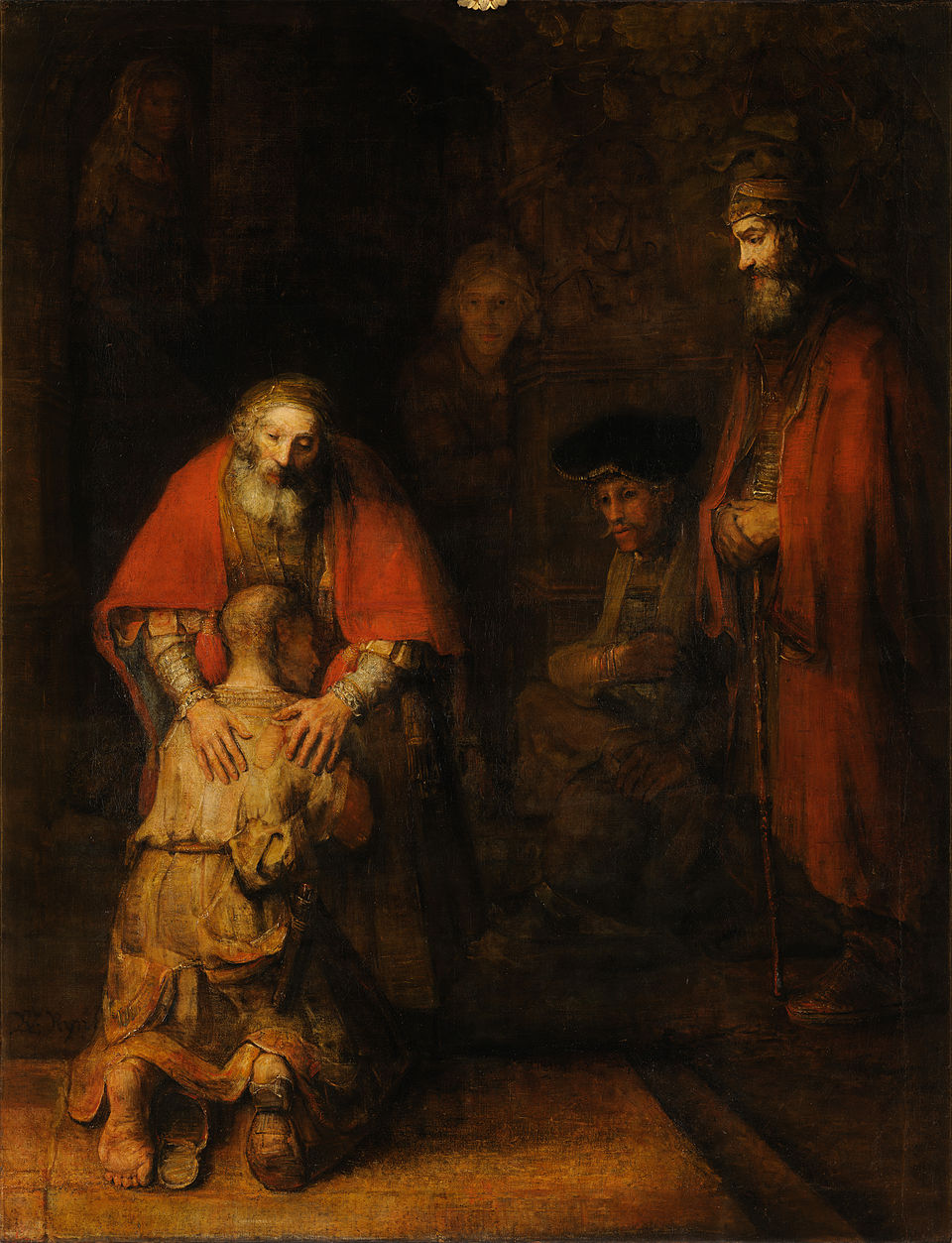
Part I — The Clearing
I. The Beginning
In the beginning there was the Word,
and the Word was with God,
and the Word held all things together.
Men built cathedrals they would not see completed.
They planted vineyards they would not harvest.
They told their children stories older than memory,
and the children believed, and passed them on.
There was a ground beneath their feet.
There was a sky above their heads.
Between the ground and sky, they lived—
not asking why the ground held,
not doubting that the sky would stay.
They did not know what they had.
They could not name it.
And so, when the questioners came,
they had no answer.
II. The Fall
Then came the clever ones,
the philosophers with their questions,
the critics with their suspicions.
They asked: Why do you believe?
And the believers could not say.
They asked: What holds up your ground?
And the believers looked down and saw—
nothing beneath the ground beneath their feet.
They asked: Who told you this was true?
And the believers said: Our fathers.
And the clever ones laughed:
Your fathers were deceived,
and their fathers before them,
all the way back to the first fool
who mistook his fear for a god.
And the believers grew quiet.
And the ground began to shake.
III. The Murder
One among them saw clearly what was happening.
He did not celebrate. He warned.
“God is dead,” he said.
“God remains dead. And we have killed him.
How shall we comfort ourselves, the murderers of all murderers?”
He knew this was no liberation.
He knew the shadow of the deed would fall across centuries.
He called for new tablets, for those strong enough to create meaning
from the void they had made.
But his children heard only the first part.
God is dead. They took it as permission.
They did not hear the terror in his voice.
They did not see him reaching for a rope that was not there.
IV. The Critique
Then came his heirs—
the Frenchmen with their “discourse,”
the professors with their “deconstruction.”
They found that everything was built on nothing.
Every truth concealed a power.
Every value masked a violence.
Every ground was groundless.
And they rejoiced! They made careers of demolition.
They tenure-tracked the apocalypse.
They taught a generation that the ground was a prison,
that the sky was oppression,
that falling was flying.
Foucault told them: The prison is everywhere.
He did not mention that he had helped remove every wall that once contained it.
Derrida told them: There is nothing outside the text.
He did not mention that some texts are load-bearing.
Butler told them: Your very self is a performance.
She did not mention that performances require a script—
only that theirs was a prison to be escaped.
They dissolved and dissolved and dissolved,
and called it liberation,
and were promoted,
and their students fell.
V. The Void
Now we see their children’s children.
They cannot get out of bed.
They cannot bear children.
They cannot name what is wrong
because they were taught that “wrong” is a construct.
They are anxious—but about what?
They are depressed—but why?
They scroll and scroll through infinite nothing,
looking for a ground that was removed before they were born.
What is depression but the lived experience of meaninglessness?
What is anxiety but the felt sense of groundlessness?
What is the refusal to reproduce
but the body’s knowledge that the future holds nothing worth continuing?
These are not diseases.
They are accurate perceptions
of a world stripped of meaning, ground, and future.
The philosophers did their work too well.
They convinced everyone the abyss was all there was.
And now the abyss is experienced.
The physicians were the disease.
VI. The Limited Modern
But the children do not know this.
They have the memory of mayflies
and the causal reasoning of infants.
A ball falls on the child’s head; he blames the ball.
That the ball was thrown,
and thrown by someone with reasons,
and those reasons have a history—
this exceeds his apparatus.
He can only see what struck him last.
Thus: Capitalism causes exploitation!
As if Sparta’s helots labored for shareholders.
As if the Aztec flower wars were conducted for quarterly earnings.
Thus: Phones cause alienation!
As if the alienated subject was not already theorized, produced, and distributed
before Steve Jobs held up his black mirror.
Thus: Colonialism causes violence!
As if Troy burned for market access.
As if Genghis Khan needed a joint-stock company.
VII. The Conceit of the Present
Here is the modern’s secret vanity:
He believes he is so advanced that only advanced forces can affect him.
The primitive causes—metaphysical, theological, anthropological—
these are for the primitives.
He is affected only by algorithms,
only by capitalism,
only by things invented after 1970.
This is not sophistication. It is provincialism—
a temporal provincialism that cannot see past its own birth year.
The algorithm radicalized him!
As if men did not form violent factions before YouTube,
as if tribalism needed a recommendation engine.
Surveillance capitalism is why we feel watched!
As if the village panopticon were not more total,
as if the neighbors’ eyes were not always upon us.
The attention economy fragmented my mind!
As if the monks did not warn of acedia centuries ago,
as if distraction were an invention and not a condition.
VIII. The Superstition of the Single Cause
And then—having limited his vision to the proximate,
he limits it further to the singular.
One cause. One villain. One solution.
Elect the right president and the nation will heal!
As if the fractures were not deeper than any office,
as if a vote could mend what a century of dissolution broke.
More education and bigotry will end!
As if hatred were merely ignorance,
as if the most lethal ideologies were not born in universities.
The single-cause thinker finds himself falling
and blames gravity—
never asking who removed the floor,
who told him floors were prisons,
who convinced him that falling was flying.
IX. The Roots
The prophets taught us to see the victim.
This was gift and burden.
No pagan wept for the crushed.
No empire before us asked: who suffers that we might prosper?
But gift became acid.
The children of the prophets kept the seeing,
lost the healing.
Kept the suspicion,
lost the covenant.
Kept the crucifixion,
forgot the resurrection.
And so the eye trained to find oppression
found it everywhere—
until there was nowhere left to stand
that was not stained.
X. The Fires
Then came the great fires.
The civilizers became butchers.
The children of reason built furnaces
and ran the trains on time.
The survivors asked:
If this is civilization, what good is it?
If this is reason, who wants it?
If these are our fathers, why inherit anything?
Their doubt was earned.
Their suspicion was learned in ash.
But earned doubt became taught nihilism.
Learned suspicion became inherited acid,
passed down to children who never saw the fires
but were handed the matches.
XI. Mercy for the Starving
And what of their children?
The ones born after the fires,
after the acid,
after the burning of the scripts?
They were not evil. They were starved.
They were taught to critique before they were taught to love.
They were handed acid before they were handed bread.
They learned suspicion in the cradle
and were mocked for seeking milk.
Do not curse them.
They scroll because they are hungry
and no one showed them where the table was.
They cannot commit because they were told
that commitment is a cage.
They do not marry, do not bear children,
do not plant trees—
because no one told them they were allowed.
The anger is for the shepherds who scattered.
For the sheep, only grief.
Only the long work of leading them home.
Part II — The Return
XII. The Rediscovery
But we—we are something new.
We have seen the void.
We have lived in the wreckage.
We watched the philosophers empty and empty,
calling it liberation,
until there was nothing left.
We saw the children who could not get out of bed.
We saw the couples who could not bear children.
We saw the selves liquefied into nothing.
And we return.
Not because we cannot think critically—
we have thought critically all the way through.
Not because we are naive—
we have seen what naivety costs.
But because we have seen what the alternative costs.
The void was always a lie.
The abyss was a construction, not a discovery.
Meaninglessness was a choice—and a bad one.
XIII. The Dialectic Completed
This is the arc:
Thesis: naive faith, holding the transcendent without understanding it.
Antithesis: critique, dissolving the transcendent, calling dissolution liberation.
Synthesis: faith that has passed through the fire.
The synthesis is not the thesis.
We do not return to pre-critical innocence.
That garden is closed.
But we return to the substance of what was held—
the transcendent ground,
the good and evil,
the covenant,
the yes-saying to life—
now knowing why it matters.
We know now what is lost when you remove the transcendent:
The prophetic tradition devours itself.
Victim-identification becomes infinite.
The self liquefies.
Life stops reproducing itself.
We have seen the alternative.
We choose differently.
XIV. The Word
Now we heal.
Now we return to values and valuing.
We return to saying: Yes, this is good. No, that is evil.
We are no longer swayed by argument.
We have the conviction of faith now,
knowing that faith is the first principle of reason.
The deconstructors demanded proof, foundation, certainty.
And when they could not find it, they declared the void.
But proof was never the point.
You cannot prove the ground while standing on it.
You cannot prove first principles from something prior.
There is no prior.
Faith does not come after reason establishes its credentials.
Faith is what makes reason possible.
Without trust, reason has no ground to stand on.
It saws and saws until it saws through itself.
We choose to trust.
Not because we are stupid.
Because we have seen what distrust produces.
XV. The Promised Land Never Lost
But here is the mystery:
The promised land was never empty.
While the philosophers deconstructed,
while the academics dissolved,
while the children wandered in the wilderness—
some kept the faith.
Not through argument. Through practice.
The Jews survived three thousand years of cycles.
Exiled, scattered, assimilated, nearly destroyed—
and they persist.
How?
They kept Shabbat even when they weren’t sure why.
They circumcised their sons even through pogroms.
They read the Torah even in the camps.
The practice carried the substance when the belief faltered.
You can deconstruct a doctrine.
It is harder to deconstruct a genuflection.
Liturgy, ritual, habit—
these encode wisdom in the body, below the level of argument.
The critic may not believe,
but if he still kneels, something is preserved.
The monasteries kept the manuscripts.
The grandmothers kept the prayers.
The stubborn ones kept the observances
their sophisticated children mocked.
And when the grandchildren emerged from the void,
there was something to return to.
XVI. The Cycle and the Task
Will the cycle continue?
Will our children forget, and their children rediscover?
Probably.
Those who build know why they build—they faced the void.
Those who inherit do not know—they received without earning.
Those who inherit grow suspicious of what they never had to fight for.
They tear down.
Their children face the void.
And build again.
This seems written into the structure of generations.
Prosperity is the great forgetting.
Suffering is the great teacher.
Perhaps this is not a bug but a feature.
Perhaps faith that has never been tested is not really faith.
Perhaps the return is more valuable than never having left.
Perhaps the prodigal is beloved because he returned.
Our task is not to end the cycle.
Our task is to be faithful in our part of it.
We are the generation of return.
We saw the void. We watched the dissolution.
And we came back.
Our task: to build well.
To embed wisdom in practice, not just proposition.
To tell the story so vividly that our children enter it.
To create communities where faith is lived, not merely argued.
And then—to let go.
To accept that our children may wander.
To trust that their children may return.
To plant vineyards we will not harvest,
for descendants we cannot control.
XVII. The Arrival
So we arrive.
Not innocent. Not naive. But trusting.
We have passed through the fire.
We have lived in the wreckage of meaning.
We have seen the void the philosophers made
and named liberation.
And we have come home.
We say yes to life.
We say yes to the good.
We say yes to the covenant we did not make
but choose to keep.
We build cathedrals we will not see completed.
We plant vineyards we will not harvest.
We tell our children stories older than memory.
Not because we have proven they are true.
But because we trust that they are.
Because our ancestors trusted.
Because life itself trusts—
reaching toward the sun,
sinking roots into the soil,
producing seeds for a future it will not see.
We are not wiser than life.
We are not smarter than ten thousand generations.
We will not be talked out of living
by those who made a profession of death.
The void was always a lie.
The promised land was always here.
Those who kept the faith kept it for us,
who wandered, who doubted, who despaired,
who finally heard, who finally returned.
The critics promised freedom from inherited meaning.
We tried it.
It was not freedom. It was starvation.
We choose to inherit.
We choose to build.
We choose to pass on.
We choose to trust.
We choose life.
And life, as it always has, will win.
XVIII. The Daily Return
But arrival is not enough.
The prodigal does not simply walk through the door
and remain forever changed.
He must learn again to live in his father’s house.
The return is not a moment. It is a practice.
It is what you do tomorrow,
and the day after,
and the day after that.
You will fast.
Not to lose weight. Not to optimize.
But to remember that you are not your appetites,
that you can say no to the consumer inside you,
that sovereignty begins with the mouth.
The feed never stops. You will fast.
You will keep the Sabbath.
One day in seven, you will stop.
You will not produce. You will not scroll.
You will not earn or spend or improve.
You will sit in time like a child in his father’s lap—
not because you have finished,
but because finishing is not the point.
The market never stops. You will stop.
You will say the old words.
The prayers your ancestors prayed,
the creeds they confessed,
the liturgies worn smooth by ten thousand tongues before yours.
You will say them even when you do not feel them.
Especially then.
The feed offers novelty without end. You will repeat.
You will confess.
You will name what you have done and failed to do.
You will not therapize, not contextualize, not blame.
You will say: I did this. I am responsible.
And in the naming, you will be re-bound—
a self reconstituted from the fragments.
The philosophers dissolved the self. You will collect it, piece by piece.
You will marry.
You will bind yourself to another
with vows you cannot fully keep
and mean them anyway.
You will make promises in a world that mocks promise.
And when it is hard—
and it will be hard—
you will stay.
The liquid world dissolves all bonds. You will bind.
You will bear children, or welcome them, or raise them.
You will bet your body on the future.
You will send hostages to fortune
and call it hope.
The nihilists say the future is cancelled. You will fill it with faces.
You will join yourself to a community you did not choose.
Not a network. Not an audience. Not a feed.
A place. A people. Bodies in rooms.
You will be known and be obligated.
You will be interrupted, annoyed, needed.
The screen offers connection without cost. You will pay.
This is the daily return.
Not the dramatic conversion,
but the small repeated acts
that carry the soul when feeling fades.
The way home is walked one day at a time.
The table is set every morning.
The faith is kept in the keeping.
Thus spoke the children of the return—
the ones who learned to dance again.
Part III — After the Return
XIX. Those Who Do Not Fit
But what of those who cannot return?
What of those for whom the father’s house was never home?
What of the stranger, the orphan, the widow?
We must speak honestly now.
Meaning requires boundaries.
Boundaries require exclusion.
A door that opens to all opens to nothing.
A covenant with everyone is a covenant with no one.
This is our tragedy—not our triumph.
The household feeds its children before it feeds the street.
A family that gives everything away has nothing left to give.
But the moment we call this wisdom rather than weakness,
we have lost the plot.
And yet our own tradition teaches us to distrust our boundaries.
The Samaritan was the hero.
The centurion had greater faith than Israel.
The stranger at the gate may be the Lord himself.
I was hungry and you gave me nothing to eat.
The pattern is: boundary, then crossing.
We hold walls knowing we may be called to violate them—
in fear and trembling, not satisfaction.
And here we must confess:
The critics were not wholly wrong.
They saw something true:
that power does hide in structures,
that the powerful do call their power “nature,”
that the included do forget the excluded.
Their error was not in seeing.
Their error was in only seeing—
in making suspicion total,
in dissolving without rebuilding.
They told a partial truth and called it the whole.
We have done the same.
But someone must build.
Someone must draw the boundaries.
Someone must plant the vineyard
their grandchildren will harvest.
The traditions we return to were once discovered.
Abraham left Ur.
Moses descended the mountain with new tablets.
Benedict wrote a Rule that did not exist before he wrote it.
The load-bearing structures were educed—
by those who had nowhere to return to,
and so had to build.
So to those who stand outside—
those for whom the old words do not sing,
whose loves do not fit the ancient shapes—
we say:
You are not failed returners.
You are founders.
If the old covenant does not hold you,
then cut a new one—
not from nothing,
not from the void the deconstructors left,
but from what is load-bearing:
That promises must be kept.
That children need stories older than themselves.
That the body must be trained, not merely indulged.
That community requires sacrifice.
That time must be structured by ritual.
That life bends toward something beyond itself.
These are the bones.
The flesh you must provide yourself.
This is the harder path.
Most new traditions die.
Most founders are forgotten.
But the odds were against Abraham too.
And Moses. And Benedict.
And every grandmother who kept the prayers
when the world told her they were foolish.
If our table cannot hold you, we grieve.
Not because we are righteous, but because we are limited.
Go and build—not because we have expelled you,
but because we have failed you.
And leave the door unlocked.
We may be the ones who need to find you someday.
Thus spoke the children of the return—
the ones who learned that exile is not the end,
but sometimes the beginning.
XX. Caesar
But what of the polity?
What of the neighbor who needs not meaning but medicine?
We must speak plainly now.
The state is the devil’s country.
Not because states are uniquely evil,
but because power attracts those who want power,
and those who want power are not the gentle,
not the humble, not the meek.
The devil offered Christ all the kingdoms of the world.
They were his to offer.
This has not changed.
Render unto Caesar what is Caesar’s.
But know whose image Caesar bears.
The devil rules the outer kingdoms.
Power will do what power does.
The sword will swing. The taxman will come.
Empires will rise and fall and rise again.
The traditions do not depend on the polity.
They survive it.
They survived Babylon and Rome,
the Caliphate and the Gulag,
and they will survive whatever comes next—
if they keep their boundaries,
if they tend their own,
if they do not squander their life
trying to be everything to everyone.
Let Caesar have his coins.
Let the devil have his kingdoms.
Keep what bears the other image.
Guard it with walls.
Pass it to your children.
XXI. Releasement
And yet.
There is a final teaching,
the hardest of all.
You have built your walls.
You have drawn your boundaries.
You have planted vineyards for grandchildren
you will never see.
Now let it go.
For here is the danger:
The one who builds can come to worship the building.
The one who guards can come to love the guarding.
The one who preserves can strangle what he preserves,
clutching so tightly that the living thing dies in his hands.
The Pharisees knew the law perfectly.
They tithed their mint and cumin.
And they missed the prophet standing in front of them
because he did not fit their categories.
The tradition is not the point.
The tradition points.
And if you mistake the finger for the moon,
you have lost both.
Meister Eckhart taught Gelassenheit—
releasement, letting-be, the poverty of spirit
that holds nothing, not even God,
so tightly that it cannot receive.
He prayed: God, rid me of God—
meaning: rid me of my idea of God,
my image of God,
my small container
that I have mistaken for the sea.
This is not nihilism.
This is the opposite of nihilism.
The nihilist says nothing matters.
The mystic says everything matters so much
that he dare not grasp it.
You will die.
Your children will die.
Your tradition may die.
The church you built with your hands
may become a museum, a ruin, a parking lot.
This is not failure.
This is reality.
The one who cannot accept this
becomes a tyrant of preservation,
forcing the living into dead forms,
killing the spirit to save the letter,
burning heretics to keep the flame alive.
He has confused the container with the contents.
He has loved the raft more than the shore.
So build your walls—but do not worship them.
Keep your boundaries—but do not mistake them for God.
Tend your tradition—but know that it is a vessel,
and vessels break,
and what they carried pours out
and finds new vessels,
or seeps into the ground
and nourishes what comes next.
The seed falls into the earth and dies.
If it does not die, it remains alone.
If it dies, it bears much fruit.
This is the law of all living things.
It is the law of traditions too.
The anxiety of the builder is:
What if it doesn’t last?
What if my children abandon it?
What if it all comes to nothing?
The releasement answers:
It may. It probably will.
And that is not yours to control.
You are not the owner of the tradition.
You are its steward—
and stewards must one day hand over the keys,
not knowing what the new master will do.
Abraham was promised descendants like the stars.
He died with one son.
He trusted anyway.
This is faith:
not certainty of outcome,
but fidelity without grasping.
The one who clings, corrupts.
The one who grasps, crushes.
The one who cannot let go
becomes the very thing he feared—
a dead hand on a living throat.
But the one who builds with open hands,
who plants without demanding harvest,
who loves without clutching,
who serves the tradition without enslaving it—
He is free.
And strangely, paradoxically,
what he builds with open hands
lasts longer than what the anxious build with fists.
Because it can breathe.
Because it can grow.
Because it is alive.
So we arrive at the final teaching:
Build as if it matters forever.
Hold it as if it may end tomorrow.
Plant vineyards. Keep the Sabbath.
Guard the boundaries. Tend the fire.
And then—
let go.
Not of the work. Of the outcome.
Not of the love. Of the clutching.
Not of the tradition. Of the idolatry of the tradition.
The mystics knew what the anxious builders forgot:
You cannot hold water in a closed fist.
You cannot keep the spirit in a locked room.
You cannot preserve life by strangling it.
Open your hands.
What stays, stays.
What goes, goes.
What dies, dies—
and rises in forms you cannot predict
and would not recognize
and must not try to control.
This is the way of the cross:
To love without possessing.
To give without return.
To build without owning.
To die before you die,
so that when death comes
it finds nothing to take
that you have not already released.
Thus spoke the children of the return—
the ones who learned to hold the world
with open hands.