The ICE Protest That Changes Nothing
Published 2026-01-25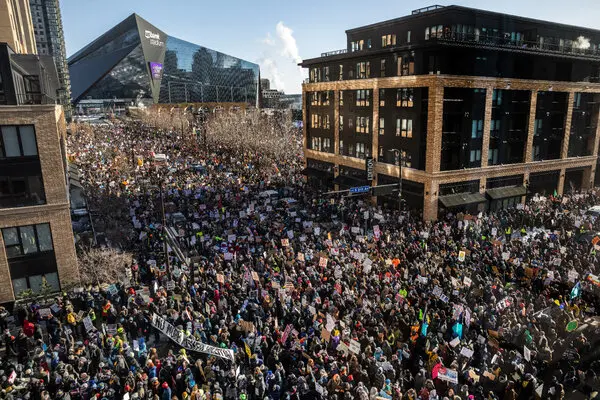
The machine does not care which slogan you chant. It only cares that you keep asking it to solve your problems. Every protest that demands state action—whether “more enforcement” or “no enforcement”—is a petition to the machine. You are asking the apparatus of coercion to align with your preferences.
For background context on how this fits into the broader tapestry of power see “The Machine That Eats the World”:
I. Two Crowds, One Machine
Fifty thousand people march through Minneapolis in subzero cold. Operation Metro Surge—the largest immigration enforcement action in American history—has occupied their city for weeks. Two citizens are dead, shot by federal agents. Clergy are arrested. A general strike shutters businesses across the state. The signs read “ICE OUT.” The chants echo off frozen buildings.
And on the other side, different Americans watch the same footage and see something else: a lawless city, local officials obstructing federal agents, a nation finally enforcing its borders. They call the resistance treason.
Both crowds believe they are on the side of justice. Both crowds believe the other is dangerous, deluded, or evil. Both crowds will go home, post about it, and wait for the state to do something.
Neither crowd has taken anyone in.
Both crowds believe they are on the side of justice. Both crowds believe the other is dangerous, deluded, or evil. Both crowds will go home, post about it, and wait for the state to do something.
Neither crowd has taken anyone in.
You see the protest signs. “No Human Is Illegal.” “Abolish ICE.” You see the counter-posts. “Enforce the Law.” “They’re All Criminals.” You feel strongly about which side is righteous.
But notice what both sides share: an appeal to power. One side wants the state to stop. The other wants the state to act. Both have outsourced the problem to an institution. Both are asking armed men to do something on their behalf. Both will go home to houses with empty guest rooms.
The machine does not care which slogan you chant. It only cares that you keep asking it to solve your problems. Every protest that demands state action—whether “more enforcement” or “no enforcement”—is a petition to the machine. You are asking the apparatus of coercion to align with your preferences.
You are not solving anything. You are requesting a different configuration of violence.
II. The Moral Laundry
Here is what happens when you post about immigration.
You see a video. A mother separated from her child. Or a crime committed by someone who shouldn’t have been here. The footage is selected to produce an emotional response. It works. You feel something—outrage, fear, compassion, disgust.
You share the video. You add commentary. You are now on record. You have taken a position. You have announced to your network which kind of person you are.
And something happens inside you. A sense of completion. You have done something. You have raised awareness. You have spoken truth to power. You have stood on the right side of history.
You have done nothing.
The mother is still separated. The crime still happened. The border is unchanged. The detention center holds the same number of people. But you feel as if you’ve contributed. The algorithm registered your engagement. Your friends saw your virtue. The little dopamine hit confirmed you are good.
This is moral laundry. You have taken the dirty work of actual compassion—the inconvenience, the cost, the awkwardness of real human encounter—and you have cleaned it through the machine of social media. What comes out looks like virtue. It requires nothing.
The person who posts “No Human Is Illegal” and the person who posts “Deport Them All” have more in common than either would admit. Neither will be inconvenienced. Neither will sacrifice anything. Neither will have their life disrupted by an actual immigrant, legal or otherwise. They are performing positions, not living them.
You have found a way to care about “immigrants” without knowing any.
III. What You Have Not Seen
You have opinions about immigration. Strong ones, probably. Let me ask you something.
How did you form them?
You have likely never sat across a table from someone who walked through the desert. You have probably never heard, firsthand, why they came. What they left. What they expected. What they found. You have not seen the trajectory of their life—the specific, irreducible story of one human being making choices under constraints you have never faced.
What you have seen is media.
You have seen footage selected for impact. Statistics curated for argument. Stories told to confirm what you already believed. You have seen “illegals”—a category, an abstraction, a policy problem. You have not seen Juan, who left Guatemala because the gangs told him they would kill his son. You have not seen Maria, who overstayed a visa because her mother was dying and she couldn’t get back in time. You have not seen the ones who came for money, or adventure, or simply because they could.
You have seen arguments about these people. You have not seen the people.
The pro-immigration media shows you sympathetic faces. Children. Families. Hardworking strivers. The anti-immigration media shows you criminals. Gang members. People who disrespect the law. Both are true. Both are selections. Neither is the whole.
You have formed your opinions from a highlight reel. You are arguing about people you have never met, based on stories you have been told by people who want something from you.
This is not knowledge. This is programming.
IV. The Test
Here is a way to find out what you actually believe.
Take one in.
Not symbolically. Not through a donation to a nonprofit. Not through a vote for a policy. Actually take a person—an undocumented immigrant, a refugee, an asylum seeker—into your home. Your actual home, with your actual family, disrupting your actual life.
Offer them a room. Share your food. Help them find work. Vouch for them. Put your name next to theirs. Accept responsibility for what happens next.
Can you do this?
If you cannot, ask yourself why.
Perhaps you will discover practical objections. You don’t have space. You have children to protect. You don’t know where to find such a person. You worry about legal liability. These are real concerns. They are also the concerns that, scaled up, constitute the case for borders.
Perhaps you will discover something about yourself. That your compassion was theoretical. That “No Human Is Illegal” was a slogan, not a commitment. That you wanted the warm feeling of virtue without the cold reality of sacrifice.
Or perhaps you will do it. You will take someone in. And then something else will happen.
You will see them.
Not “immigrants.” Not “illegals.” Not a category. A person. With a name, a history, irritating habits, unexpected kindnesses, a specific and irreducible humanity that no media coverage could have conveyed.
And you will be changed. Not by policy. Not by argument. By encounter.
V. What Encounter Does
When you take someone into your home, the abstractions collapse.
You cannot maintain your ideology in the presence of a person. The talking points dissolve. The statistics become irrelevant. You are not dealing with “immigration policy.” You are dealing with Miguel, who snores, who misses his mother, who makes incredible tamales, who doesn’t understand why you keep the house so cold.
You will learn things that complicate your position—whichever position you held.
If you believed all immigrants are hardworking saints, you may discover that some are difficult, or ungrateful, or take advantage. If you believed they are all criminals and invaders, you may discover that most are simply people—no better or worse than your other neighbors, trying to make their way in a confusing world.
You will discover that the categories were always lies. There are no “illegals.” There are only people who crossed a line that someone drew, for reasons that are sometimes noble and sometimes selfish and usually complicated.
And here is the strange thing: your opinion about policy may not change. You may still believe in borders, or still believe in open migration, or still be uncertain. But your relationship to the question will be transformed. It will no longer be abstract. It will no longer be a performance. It will be something you have lived.
You will have earned your position.
VI. The Voucher
Consider the difference between two immigrants facing deportation.
The first has no connections. He lives in the shadows. He works jobs that pay cash. No one knows his name. When ICE comes, there is no one to speak for him. He is a number, a case file, an abstraction. He is easy to remove because he is easy to forget.
The second has been taken in. A family knows him. A community has integrated him. When ICE comes, there are people who say: “This is our friend. We vouch for him. We take responsibility for him.” There are names attached to his name. Faces. Stories. Relationships of actual obligation.
Which one is harder to deport?
The machinery of enforcement works best on the anonymous. It processes abstractions efficiently. What gums up the machine is particularity—the specific, named, vouched-for human being who has become enmeshed in a web of real relationships.
You want to resist deportation? Don’t protest. Don’t post. Take someone in. Attach your name to theirs. Make their removal costly—not in terms of political controversy, but in terms of the human relationships that would be severed.
This is not a guarantee. The state can still act. But you will have done something that no protest sign can do: you will have made a person visible.
And if you are on the other side—if you believe in enforcement, in the rule of law, in the distinction between legal and illegal—consider: which cases actually bother you?
Is it the immigrant with deep community ties, with Americans who vouch for him, with a track record of contribution and integration? Or is it the one with no connections, no investment, no stake?
The honest enforcer knows the difference. The problem is never the people who have been woven into the fabric of community. The problem is the anonymity, the separateness, the failure of integration. And that problem is not solved by enforcement. It is solved by the very thing the pro-immigration side refuses to do: take actual responsibility for actual people.
VII. Why You Won’t Do This
You won’t take anyone in. I know this. Let me tell you why.
It is inconvenient. Your life is arranged. You have routines, spaces, privacies. A stranger in your home would disrupt everything.
It is risky. You don’t know this person. They might steal from you. They might be dangerous. They might create legal complications.
It is awkward. You don’t speak the language. You don’t understand the culture. You don’t know what to do.
These are the reasons you will give. They are not untrue. But notice something: these are the same reasons that nations give for having borders.
Inconvenience. Risk. Cultural friction. The disruption of what is known and settled by what is foreign and uncertain.
You have rediscovered, at the personal level, the logic you denounce at the national level. You want your home to have borders even as you protest that your nation should not.
This does not make you a hypocrite. It makes you honest—if you will admit it. The impulses that create borders are not evil. They are human. They are the same impulses that make you lock your door at night, that make you cautious about strangers, that make you protect what you have built.
The question is not whether these impulses are legitimate. They are. The question is what you do with them.
You can project them onto the state and demand enforcement. You can deny them and demand open borders. Or you can integrate them—accepting that both the desire for boundaries and the call to compassion are real, and that the resolution cannot be found in policy.
The resolution can only be found in encounter. In the specific, costly, inconvenient, transformative act of taking someone in.
VIII. The Way Out
The protests will continue. The posts will multiply. The arguments will grow more vicious. Each side will become more certain. The algorithm will feed both flames, because engagement is engagement.
And nothing will change.
The people chanting outside the detention center will not free a single person. The people demanding enforcement will not secure the border. Both will feel righteous. Both will be ineffective. Both will have outsourced their moral responsibility to a machine that serves no one’s values.
There is another way.
Stop asking the state to embody your compassion. Stop asking the state to enforce your boundaries. Stop performing positions for an audience that doesn’t exist.
Find a person. An actual person. Someone who has crossed a line that others say they shouldn’t have crossed. Sit with them. Hear their story. See if you can see them.
And then decide.
If you cannot take them in—if the practical concerns are insurmountable, if the risks are too high, if your life cannot accommodate this disruption—then at least you will know something real. You will know that the case for limits is not just Fox News propaganda. It is something you have discovered in yourself.
If you can take them in—if you can offer hospitality, take responsibility, vouch for a human being—then do it. And you will know something else. You will know that the case for compassion is not just MSNBC sentimentality. It is something that has cost you, and therefore something you have earned.
Either way, you will have escaped the machine.
You will have stopped asking power to solve what only love can solve. You will have stopped performing for strangers on the internet. You will have entered into the only space where human questions get human answers: the space between two people who have met.
The protest changes nothing.
The encounter changes everything.
Choose.